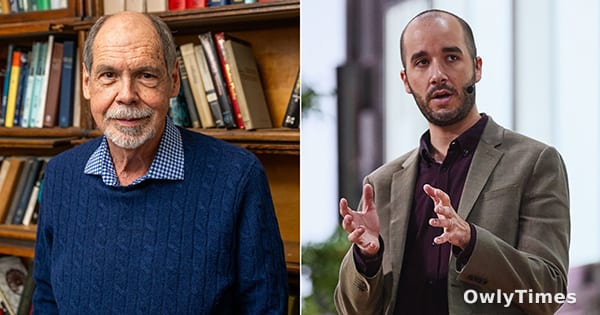

The fundamental nature of our universe is often defined by the tiny discrepancies that refuse to fit into our established mathematical models. When the standard theories of physics—our most reliable maps of reality—begin to show cracks, we look to the researchers who have dedicated their careers to measuring the exact size of those fissures. On April 18, 2026, in Santa Monica, California, two Boston University faculty members were recognized for their roles in pushing these boundaries, receiving 2026 Breakthrough Prizes for their contributions to physics and cosmology.
Lee Roberts, a professor of physics at the College of Arts & Sciences, was awarded the Breakthrough Prize in Fundamental Physics. This recognition centers on his multi-decade involvement in the muon g-2 experiments, a series of international collaborations at CERN, Brookhaven National Laboratory, and Fermilab. The prize specifically honors the precision with which these teams measured the muon’s anomalous magnetic moment.
To understand the weight of this achievement, one must look at the methodology: the muon is an unstable, heavy cousin of the electron that functions essentially as a subatomic magnet. By measuring its magnetic strength to an accuracy of 127 parts per billion—a feat 30,000 times more precise than the inaugural 1965 experiment—physicists are testing whether the "Standard Model" of particle physics is complete. The hope, and the scientific tension, lies in the possibility that unknown forces or particles are influencing the muon's behavior. While early data from Fermilab hinted at a significant discrepancy with theoretical predictions, recent refinements have narrowed that gap, illustrating the cautious, iterative nature of high-stakes experimental science.
While Roberts’ work focuses on the subatomic, Dillon Brout, a CAS assistant professor of physics and astronomy, received the New Horizons in Physics Prize for his work on the cosmic scale. Brout, who joined the university in 2023, was recognized for his contributions to supernova research and the cosmic microwave background. As a key leader in the Dark Energy Survey (DES), Brout helped build the Pantheon+ dataset, currently the largest and most precise collection of supernova data used to map the expansion history of the universe.
The distinction between the headline—often focusing on the "Oscars of Science" prestige—and the actual study findings is critical. For Brout, the significance of the Pantheon+ dataset lies in its explicit contradiction of measurements from the Planck Collaboration. By challenging the data derived from the early universe, Brout’s work has ignited a debate regarding the accuracy of existing cosmological theories, specifically those related to Einstein’s theory of general relativity.
However, there are inherent limitations to consider in these breakthroughs. In experimental physics, the closer one gets to the limits of measurement, the higher the risk of observational bias or unforeseen systematic errors. Roberts himself noted that the strength of the muon g-2 collaboration—which involved over 170 scientists from 34 institutions—was its ability to distribute the burden of these "ingenious solutions" across diverse skill sets, a necessity when dealing with the extreme logistical challenges of moving 50-ton storage rings across thousands of miles.
The next phase of this research is already in motion. Brout is now leading the Dark Energy Science Collaboration for the Rubin Observatory’s Legacy Survey of Space and Time (LSST) in the Chilean Andes. The next reading of data from the LSST, which utilizes a more sensitive alert system and a significantly larger field of view, will indicate whether the current tensions in cosmological expansion measurements can be resolved or if they signal a fundamental shift in our understanding of dark energy. As for the muon g-2 experiments, the long-term impact will be measured by the continued refinement of theoretical predictions, which remain the primary benchmark for determining whether we are on the verge of discovering physics beyond the Standard Model.





