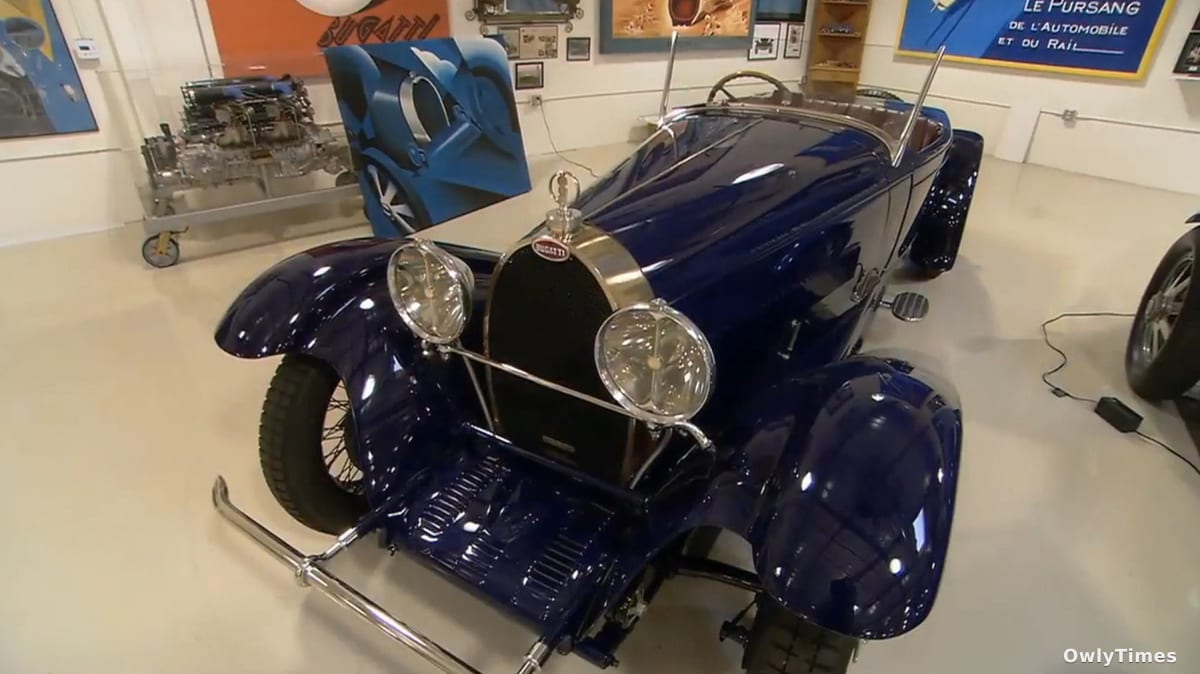

The chipped paint and missing floorboards tell a story, but it’s not the one most people assume. Standing in Jay Leno’s famed Big Dog Garage, a 1926-1928 Bugatti T38A isn’t just a meticulously restored piece of automotive history; it’s a rolling, chrome-plated testament to accidental transatlantic journeys, Hollywood hubris, and the strange alchemy of celebrity association. Valued at an estimated $100 million as part of Leno’s larger collection – placing him among the world’s ten largest private car collectors – this particular Bugatti’s value isn’t rooted in pedigree alone, but in a series of improbable events that transformed a French engineering marvel into a bit player in Golden Age cinema. It’s a story that goes “Beyond the headlines” of classic car auctions and celebrity ownership, revealing a fascinating collision of industries and egos.
The car’s very existence is a bit of a fluke. In the 1920s, Ettore Bugatti, the visionary behind the marque, was captivated by the performance of American Miller race cars. Rather than simply studying them, he orchestrated a trade with racer Leon Duray, swapping a Bugatti Type 35 and a T38 chassis – chassis 38435, to be exact – for two Miller Specials. This seemingly straightforward exchange set in motion a chain of events that would result in the only Bugatti ever to receive a custom-built American body, crafted by the Murphy Body Co. of Pasadena. The resulting “Murphy Roadster” wasn’t just a car; it was a statement, a transatlantic collaboration born from competitive spirit. It’s a reminder that even the most iconic brands aren’t immune to influence, and that innovation often flows in unexpected directions.
Based on the original jalopnik.com report.
But the Bugatti’s journey didn’t end with its uniquely American makeover. It stumbled into Hollywood in 1933, landing a role in “Christopher Strong,” starring Katherine Hepburn. The film cast the car as the vehicle of a modern, independent female pilot, a role that cemented its association with Hepburn in the public imagination. A now-iconic promotional photo of Hepburn posed in the cockpit has become synonymous with the car, even though she never actually owned it. The studio, however, treated its rental with a shocking disregard. Wooden floorboards were ripped out and lost, a rumble seat was added, hinges were removed, and, in a particularly egregious act of brand sabotage, a Hispano Suiza emblem was slapped onto the hood. This casual disrespect speaks to a broader cultural moment – a time when the glamour of cinema often overshadowed the value of the objects within it.
The Murphy Roadster wasn’t finished with its silver screen ambitions. It reappeared in 1935’s “Remember Last Night?,” undergoing further modifications, including a steering wheel replacement and a complete dashboard overhaul. Most bafflingly, a Rolls-Royce emblem was affixed to the hood, despite the film acknowledging the car’s Bugatti origins with a character’s confused query: “The Bu-what?” A possible, though unconfirmed, cameo in 1934’s “The Gay Divorcee” adds another layer to the car’s cinematic history. These fleeting appearances, often involving significant alterations, highlight the disposable nature of props in early Hollywood, and the willingness to sacrifice authenticity for the sake of the story. It’s a stark contrast to the reverence with which classic cars are treated today.
For years, the Bugatti languished, deteriorating in a lockup in Orange County, until Jay Leno acquired it in the early 2000s. Ironically, Leno admits to disliking “celebrity cars,” preferring to value vehicles for their engineering and historical significance. Yet, the story of this Bugatti – a car associated with a celebrity, but never owned by one – proved too compelling to resist. He eventually restored the car, even tracking down and reinstalling its original wired wheels, which had been swapped for alloy wheels by a previous owner for racing purposes. The restoration wasn’t just about preserving a car; it was about reclaiming a narrative, correcting the historical record, and rescuing a unique piece of automotive and cinematic history.
The story of the Hepburn Bugatti isn’t just about a car; it’s about the enduring power of stories, the often-careless relationship between Hollywood and its props, and the surprising ways in which cultural artifacts find new life. As collectors increasingly focus on provenance and authenticity, will the value of these “story cars” continue to rise, even if their historical accuracy has been compromised? And as the lines between automotive history and celebrity culture blur, what will it take to truly appreciate these vehicles for what they are – not just who drove them?