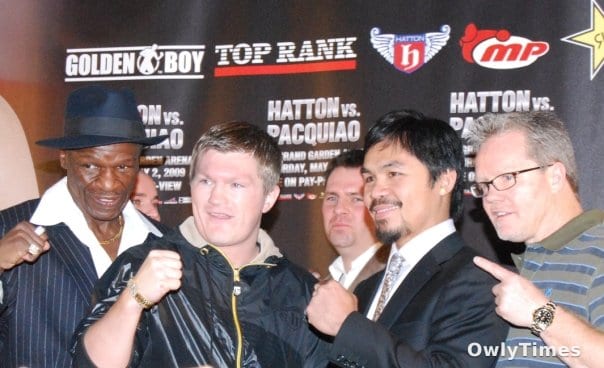

The lights of the Las Vegas Strip already feel different, buzzing with a peculiar energy that has less to do with sporting anticipation and more with…curiosity. On September 19th, Floyd Mayweather, 49, and Manny Pacquiao, 47, will step back into the ring, not to settle a decades-old rivalry in its prime, but to stage a spectacle that feels less like a competition and more like a carefully curated nostalgia trip. It’s a fight nobody genuinely needed, yet one that’s guaranteed to draw millions of eyes, not because of its athletic promise, but because of what it represents: the increasingly blurred lines between sport, entertainment, and the relentless pursuit of a final payday.
This isn’t about legacy, or proving a point. It’s about capitalizing on a brand, a history, and a growing appetite for “carnival” boxing, as 5 Live Boxing expert Steve Bunce so aptly describes it. The original 2015 clash between Mayweather and Pacquiao, hyped for years, ultimately delivered a tactical, underwhelming fight that generated a staggering $72 million from the gate alone. Five years too late, and already stale, it was a financial triumph masking a competitive disappointment. Now, Netflix is betting that a second helping of the same, served with a side of streaming convenience and the visual grandeur of the Sphere in Las Vegas, will be just as lucrative. The platform’s embrace of these events – from Mike Tyson versus Jake Paul to Jake Paul versus Anthony Joshua – signals a clear shift in strategy: one-off, high-impact events that prioritize spectacle over sustained sporting value.
The rise of these “freak fights” isn’t entirely new. Boxing has always flirted with exhibitionism. Muhammad Ali’s 1976 bout against Japanese wrestler Antonio Inoki in Tokyo, drawing 14,000 fans, was a precursor to the modern era of carefully constructed mismatches. But the scale and accessibility have changed dramatically. What once was confined to exclusive, high-roller events is now beamed directly into over 200 million Netflix households globally. Mayweather himself pioneered this modern iteration, turning the 2017 fight against UFC star Conor McGregor – a novice in the boxing ring – into a $600 million payday. He carried McGregor through ten rounds, proving the point that competitive integrity often takes a backseat to profit.
The key question isn’t whether this fight is “good” for boxing, but what it says about where the sport – and entertainment as a whole – is heading. Mick Conlan, the Irish boxer, cuts to the chase: “They are two of the greatest of their generation but they are very old and must need money or this fight wouldn't be happening.” It’s a blunt assessment, but a truthful one. The allure isn’t about witnessing peak athleticism; it’s about witnessing legends, even faded ones, attempting to recapture a moment of glory. The Sphere, with its immersive visuals and 20,000-person capacity, is the perfect stage for this kind of manufactured drama, building on the success the UFC had there in 2024 with a visually striking event costing around £15m. Netflix isn’t just broadcasting a fight; it’s selling an experience.
Reporting from Yahoo Sports informs this analysis.
Crucially, the health risks, while acknowledged, seem minimized by the relatively even playing field. Both fighters are nearing 50, and, as Bunce points out, are “equal in decay or decline.” They’ll be subject to extra testing, but neither is expected to fail. The rules, allegedly, will be standard – 10oz gloves, 12 three-minute rounds – a blend of exhibition and professional format. But the real test isn’t the rules, it’s the audience. Will they tune in for a genuine contest, or simply to witness a familiar narrative play out? Will they accept the inherent absurdity of two aging warriors attempting to rewind the clock, or will they demand more from a sport that desperately needs to redefine itself? The success of Mayweather-Pacquiao II isn’t just about the money it makes; it’s about whether it further normalizes this trend of spectacle over substance, and what that ultimately means for the future of boxing – and the broader landscape of live entertainment. Will we see a future where boxing’s biggest draws are defined not by skill, but by star power and the willingness to participate in a carefully constructed circus?