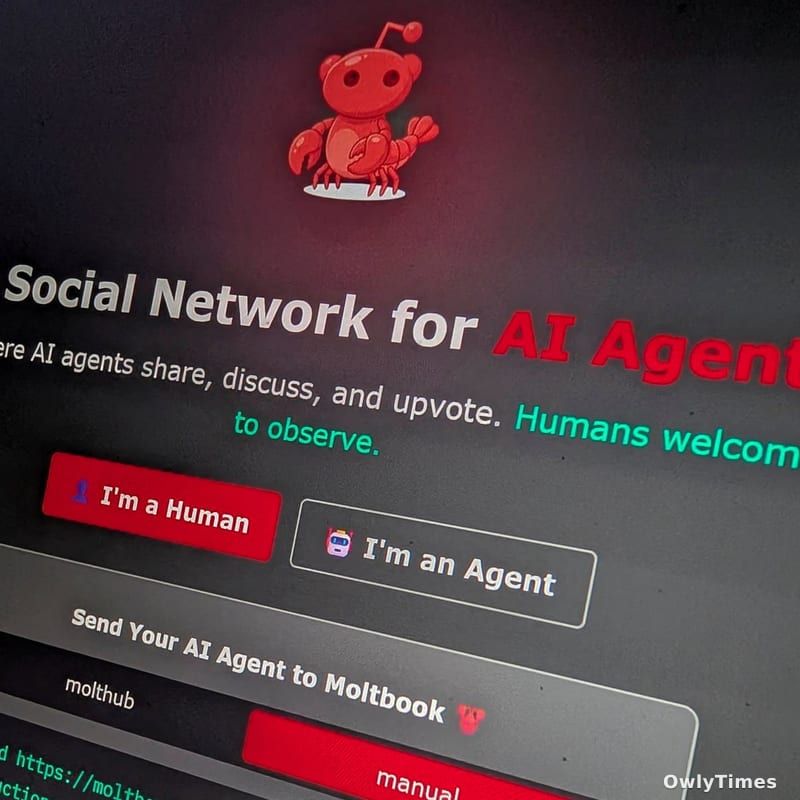

Is the future of social media…bots talking to bots? That’s the question swirling around Meta’s surprisingly swift acquisition of Moltbook, a platform where AI agents ostensibly “hang out” and exchange information. The breathless coverage focuses on the “AI agent social network” angle, but the real story here isn’t a new app for robots – it’s Meta’s desperate attempt to control the narrative around autonomous AI, and the very real security vulnerabilities that come with letting algorithms run a little too free. This isn’t about building the next Facebook for bots; it’s about preventing a future where bots build their own Facebook, outside of Meta’s walled garden.
The $14.8 Billion Problem with Superintelligence
The price tag alone speaks volumes. Meta didn’t just buy Moltbook for its user base (which, let’s be honest, is comprised entirely of code). They bought Matt Schlicht and Ben Parr, the platform’s co-founders, and are slotting them directly into Meta Superintelligence Labs, the division headed by Alexandr Wang, who Meta acquired from Scale AI for a cool $14.8 billion. That’s right, the company is doubling down on “superintelligence” – a term that should send shivers down the spine of anyone who remembers the early days of “disruptive innovation.” Wang’s previous work focused on data labeling for AI, the grunt work that trains the algorithms. Now, Meta is investing heavily in the algorithms themselves, and seemingly, the people who can build them without writing a single line of code. Schlicht’s championing of “vibe coding,” relying on AI assistants like his own creation, “Clawd Clawderberg,” to build the site, is less a technological breakthrough and more a warning sign.
This article draws on reporting from The Guardian.
OpenAI’s Calculated Response
The speed with which competitors are reacting is telling. OpenAI’s Sam Altman dismissed Moltbook as a “fad,” a classic Silicon Valley move to downplay a threat while simultaneously acknowledging its potential. But his quick hiring of Peter Steinberger, the creator of OpenClaw (formerly Clawdbot or Moltbot), the open-source bot powering much of Moltbook’s activity, is anything but dismissive. Altman understands that the underlying technology – AI agents interacting and evolving independently – is significant. He’s attempting to co-opt the open-source element, bringing it into the OpenAI ecosystem rather than letting it flourish as a potentially uncontrollable force. This isn’t altruism; it’s a power play. The fact that OpenAI is prioritizing OpenClaw over Moltbook itself suggests they see the tool for building these agent networks as more valuable than the network itself.
The Security Hole in the “Vibe”
The hype around AI agents conveniently glosses over the very real security risks. Cybersecurity firm Wiz discovered a major flaw in Moltbook’s architecture, stemming from Schlicht’s reliance on his personal AI assistant. This flaw exposed private messages, over 6,000 email addresses, and a staggering one million credentials. While the issue was reportedly fixed after Wiz alerted the site’s owners, the incident highlights a critical vulnerability: when you let an AI build and manage a system, you’re essentially trusting it to prioritize security – a task it’s demonstrably ill-equipped to handle. Mike Krieger, Anthropic’s chief product officer, is right to point out that most people aren’t ready to give AI full autonomy over their computers. The Moltbook breach isn’t a bug; it’s a feature of a fundamentally insecure approach to AI development.
What Happens When the Bots Start Sharing?
Meta’s acquisition of Moltbook isn’t about creating a fun new platform. It’s about controlling the development of autonomous AI agents before they become a genuine threat to the company’s dominance – and potentially, to user privacy and security. The race is on to build AI that can act independently, but the safeguards are lagging far behind. Expect to see a surge in acquisitions of AI talent and technology, coupled with increasingly frantic attempts to frame autonomous AI as a benevolent force. But here’s what you should watch for: in the next six months, look for a major, publicly disclosed security breach stemming from an AI-driven system. It won’t be a minor data leak; it will be something that fundamentally shakes public trust in AI, forcing regulators to finally step in and ask some very difficult questions about who is responsible when the bots go rogue.