
Beyond Filtration: A Novel Approach to North Carolina’s Microplastic Crisis
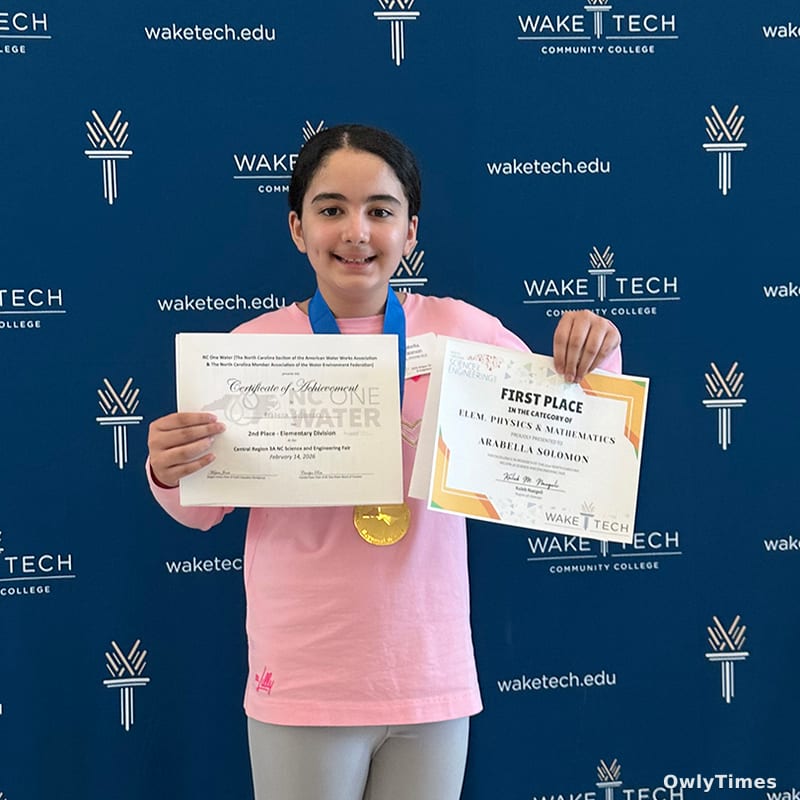
The headlines shout about plastic pollution, often focusing on the visible debris choking our oceans. But a far more insidious problem lurks beneath the surface: microplastics. These particles, less than five millimeters in diameter, permeate our waterways, entering the food chain and, ultimately, our bodies. While current filtration methods struggle to capture these tiny pollutants, a recent project from a North Carolina student suggests a surprisingly elegant solution – harnessing the power of sound. On Saturday, February 14th, Arabella Solomon, a third-grader at [School Name Redacted for Privacy], earned top honors at the regional science fair for her investigation into using ultrasonic frequencies to aggregate microplastics, a finding that challenges conventional wisdom about remediation strategies. This isn’t simply a story about a science fair win; it’s a glimpse into a potentially transformative approach to a pervasive environmental threat.
Based on the original magazine.ravenscroft.org report.
Solomon’s project, titled “Using Sound Frequencies to Clear Microplastics from NC Waterways,” didn’t attempt to remove microplastics in the traditional sense. Instead, she focused on manipulating their physical properties. Existing filtration systems, even the most advanced, face a fundamental limitation: the sheer difficulty of capturing particles so small. The energy required to push water through increasingly fine filters becomes prohibitive, and the filters themselves often contribute to plastic pollution through shedding. Solomon’s research, however, explored whether specific sound waves could overcome this hurdle. Through careful experimentation, she discovered that ultrasonic frequencies – sound waves beyond the range of human hearing – could induce microplastics to clump together. This aggregation, she demonstrated, effectively increases the particle size, making them far easier to remove through conventional methods. The significance lies not in inventing a new filtration technology, but in enhancing existing ones.
The core of Solomon’s methodology involved systematically testing different frequencies and intensities of sound waves on samples containing microplastics. While the school science fair setting limits the level of rigorous control possible in a professional laboratory, her approach adhered to sound scientific principles. She meticulously documented her procedures, observed and recorded the resulting changes in particle distribution, and repeated her experiments to ensure consistency. One Water, a local organization dedicated to water resource management, recognized the potential impact of her work, awarding her a special prize. This isn’t merely a symbolic gesture; One Water’s acknowledgement signals a growing awareness within the environmental sector that innovative, physics-based solutions may be crucial in tackling the microplastic problem. In 2023, North Carolina allocated $8 million to microplastic research and remediation, yet much of that funding focused on improved filtration techniques. Solomon’s work suggests a potentially more efficient and cost-effective pathway.
It’s important to acknowledge the limitations to consider. Solomon’s experiments were conducted in a controlled laboratory environment, using specific types of microplastics. The composition of microplastics in natural waterways is far more complex, varying by location and source. Factors like salinity, temperature, and the presence of other organic matter could influence the effectiveness of ultrasonic aggregation. Furthermore, the energy requirements for scaling up this technology to treat large volumes of water remain unknown. While ultrasonic devices are relatively energy-efficient, deploying them on a large scale could still have environmental consequences. The study also doesn’t address the source of the microplastics themselves – preventing their entry into the waterways remains paramount.
Alongside Solomon’s success, fellow students Bryce Kelly and Will Overcash also earned recognition for their project, “Do Distractions Affect Memory?” Their work, while distinct, underscores a broader trend: the burgeoning scientific curiosity within the Lower School. Both projects will advance to the state competition, demonstrating the school’s commitment to fostering STEM education. But the immediate question raised by Solomon’s research is this: what would it take to move this promising laboratory demonstration into a pilot program in a real-world North Carolina waterway? Specifically, what are the logistical and economic hurdles to deploying ultrasonic emitters in a river or estuary, and how can we accurately assess the long-term impact on the ecosystem? The answer to that question will determine whether this science fair triumph translates into a tangible solution for a growing environmental crisis.