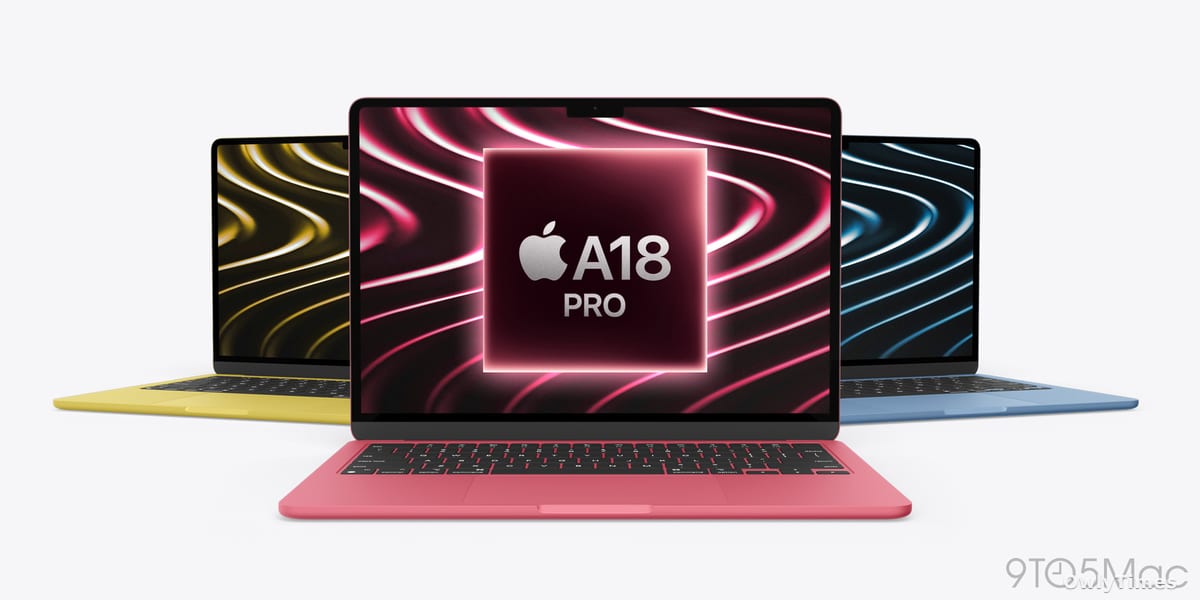

Is Apple deliberately muddying the waters? This week’s launch of a new, low-cost MacBook isn’t about expanding the Mac family – it’s about forcing a reckoning with how much computer power we actually need. For years, Apple has enjoyed a premium based on perceived performance. Now, they’re about to offer a machine powered by a chip remarkably similar to what’s in your phone, and the real story here isn’t about cheaper hardware – it’s about challenging the very idea of diminishing returns in computing.
The Smartphone Chip in Your Laptop: Not as Crazy as it Sounds
The initial reaction to the news of a MacBook powered by an A18 Pro chip – the same family found in iPhones – was predictable skepticism. Laptops are powerhouses, phones are…not. But this narrative ignores Apple’s own history. The original MacBook Air, the one that truly popularized the category, was powered by an M1 chip, and it was a revelation. The A18 Pro, as benchmarks demonstrate, isn’t a downgrade. In single-core performance, it exceeds the M1, scoring 3,409 on Geekbench 6 compared to the M1’s 2,369. Multi-core performance is virtually identical (8,492 for A18 Pro versus 8,576 for M1). This isn’t about Apple cutting corners; it’s about leveraging advancements in mobile silicon to deliver surprisingly capable performance in a new price bracket.
This piece references the 9to5mac.com report.
Who Actually Needs More Power?
Apple now offers three portable Mac options: the MacBook, the MacBook Air, and the MacBook Pro. The Pro is for professionals with genuinely demanding workflows – video editors working with complex timelines, developers compiling massive codebases, 3D artists rendering intricate scenes. The original MacBook Air caters to those with basic needs: email, web browsing, writing. But a huge segment of MacBook Air buyers, Apple admits, fall into that first category, using their machines for tasks that barely scratch the surface of the M-series chips’ capabilities. This is where the new MacBook steps in, targeting users who do a little more – occasional 4K video editing, modest photo editing, light audio work – but haven’t reached the point where the extra cost and weight of a MacBook Pro are justified.
The 8GB RAM Question and Real-World Usage
There’s one key difference to consider: the new MacBook will ship with 8GB of RAM, while many MacBook Air models offer 16GB. This is a limitation of the A18 Pro chip itself. Is 8GB enough? David Knight, a tech consultant who tested the waters with a refurbished M1 MacBook Air, found that 16GB was sufficient for his photo and video editing needs, even while traveling and leaving his more powerful M1 Max MacBook Pro at home. His experience suggests that for the majority of tasks, 8GB will likely be adequate. The caveat, of course, is multitasking. Running a dozen apps simultaneously will undoubtedly strain the system, but for focused work, the MacBook should hold its own.
Beyond Specs: The Shifting Value Proposition
For years, the decision was simple: if you needed power, you bought a MacBook Pro. If you didn’t, you bought a MacBook Air. Now, Apple is forcing consumers to ask a more difficult question: what am I actually doing with this machine? The new MacBook isn’t just a cheaper alternative; it’s a challenge to the prevailing notion that more power is always better. It’s a bet that many users will find the A18 Pro-powered MacBook perfectly capable, and that they’ll be perfectly happy saving a few hundred dollars.
My prediction? In two years, we’ll see Apple further refine this strategy, pushing the boundaries of mobile silicon even further. The real question isn’t whether M1-level performance is acceptable in 2026 – it’s whether Apple can convince enough people that they don’t need anything more than that. Watch for a surge in refurbished M1 and M2 MacBook Air sales as consumers realize they’ve been paying for power they weren’t using all along.