
If your smartphone battery is the digital equivalent of a leaky faucet, why are we still obsessed with building bigger buckets instead of fixing the pipe? We spend billions chasing faster processors and brighter screens, but the real story here isn't the raw speed of our devices—it’s the fundamental inefficiency of how they store a simple "zero" or "one."
Computer memory works by controlling how electricity flows through a material. For decades, the industry has been trapped in a game of diminishing returns: as we shrink components to make devices sleeker, the energy required to manage that flow creates heat, which in turn drains your battery. It is an engineering stalemate where the physics of the very small usually fights back against the ambition of the designer.
The Ferroelectric Pivot
The quest for a more efficient way to store data is not new; it dates back to 1971 with the introduction of the ferroelectric tunnel junction (FTJ). This technology relies on ferroelectricity, which allows a material’s internal electric polarization to be reversed, effectively acting as a toggle switch for current. The challenge has always been that traditional materials lose their composure—and their performance—once they reach a certain level of miniaturization.
A significant shift occurred in 2011, when researchers identified that hafnium oxide could maintain its electric polarization even at incredibly thin scales. This material, which is already a staple in modern semiconductor manufacturing, provided the blueprint for a potential revolution. Recently, Professor Yutaka Majima and his team at the Institute of Science Tokyo (Science Tokyo) pushed this concept to a new extreme. They successfully developed a memory device just 25 nanometers wide, which is roughly one three-thousandth the thickness of a human hair.
Engineering Against the Leak
When you pack electronics into a space that small, you run into the problem of "leakage," where electrical current escapes through the boundaries between tiny crystals in the material. Historically, this has been the wall that stopped further progress in its tracks. Most engineers have spent years trying to patch these leaks, but Majima’s team decided to lean into the problem instead.
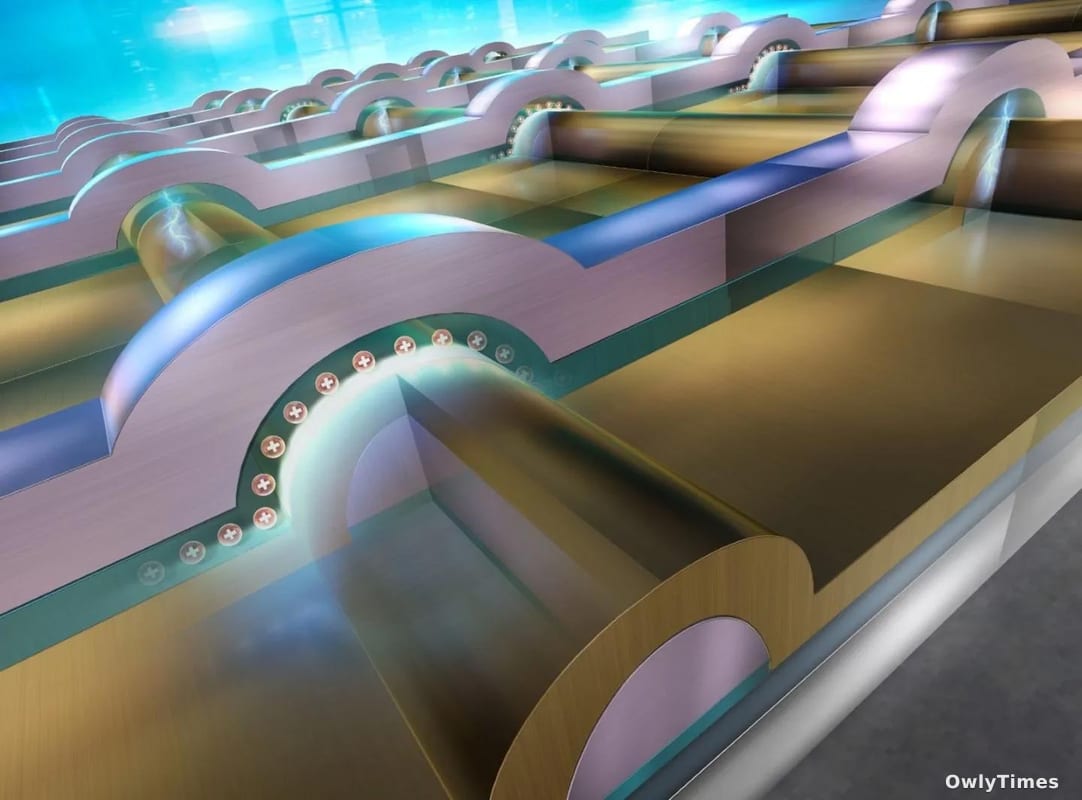
By shrinking the device further, the team actually reduced the impact of those problematic crystal boundaries. They paired this with a clever manufacturing tweak: heating the electrodes to force them into a semicircular shape. This effectively creates a structure that mimics a single crystal, drastically cutting down on the paths where electricity can leak out. The resulting research, featured as the cover illustration for the journal Nanoscale (published by the Royal Society of Chemistry with artwork by Majima), proves that miniaturization doesn't always have to come with a penalty.
Efficiency as a Default Setting
The implications for the average user are substantial. If this architecture makes it into commercial production, the era of the daily phone charge might finally draw to a close. We aren't just talking about a minor boost in battery life; this could allow smartwatches to run for months or enable vast networks of sensors to operate indefinitely without maintenance.
Furthermore, this development arrives at a critical juncture for artificial intelligence. As AI models demand more energy-intensive processing, the ability to store data with minimal power consumption will be a primary competitive advantage for hardware manufacturers. Because hafnium oxide is already compatible with current fabrication methods, the bridge between this lab-scale success and your next device is shorter than it appears. The next reading of energy-efficiency metrics in hafnium-based memory testing will show whether this design can scale to the high-volume production required for mass-market consumer electronics.