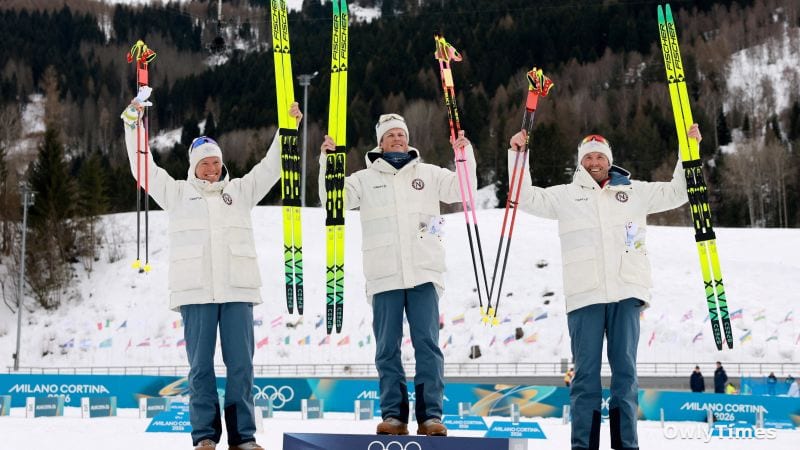

The rasp in Tore Øvebrø’s voice wasn’t entirely from a cold. It was, he admitted with a chuckle to CNN Sports, likely a side effect of exuberant cheering. Norway had just secured another gold medal at the Milan Cortina 2026 Winter Olympics, pushing their record-breaking tally to 16 – a number that would ultimately climb to a staggering 18 golds and 41 total medals. But this isn’t just a sports story; it’s a cultural phenomenon, a quiet revolution in athletic development that’s leaving the rest of the world asking a simple question: how does a nation of 5.5 million people consistently dominate the Winter Games, and increasingly, the sporting world at large? Beyond the headlines of gold medals and record-breaking performances lies a radical philosophy that prioritizes joy, participation, and long-term development over early specialization and cutthroat competition.
It’s a stark contrast to the hyper-competitive youth sports landscape in countries like the United States, where the pressure to perform begins at alarmingly young ages. Comedian Josh Mancuso’s viral Instagram reel, skewering the exorbitant costs and relentless travel schedules of American youth baseball, resonated with millions precisely because it tapped into a shared anxiety. “First tournament is a regional in South Florida,” his character, a coach, deadpans. “From there, we’ll head to Costa Rica and Ecuador… This is basically the major leagues… It will cost $27,000 per family.” The humor is laced with a painful truth: a system that prioritizes elite performance for a select few, often at the expense of a child’s love for the game and a family’s financial well-being. In Norway, such a scenario is unthinkable.
Based on the original CNN report.
The secret, according to Øvebrø, Norway’s director of elite sport, isn’t about identifying prodigies and pushing them to their limits. It’s about creating a system where everyone gets a chance to play, to explore different sports, and to develop a lifelong love of physical activity. Until the age of 12, scores aren’t kept, and league standings are nonexistent. Everyone gets a trophy, not to diminish achievement, but to encourage continued participation. “I find that many of the big sporting systems are more occupied with getting rid of people at the young age than develop many,” Øvebrø explained. “We are few. We have to take care of everybody.” This isn’t just a feel-good policy; it’s a strategic investment in a nation’s athletic future. They recognize that talent can emerge at any age, and that early specialization can lead to burnout and missed potential. Erling Haaland, one of the world’s most feared soccer strikers, played in a mixed development group with 39 other boys and one girl until he was 16 – a group that wasn’t divided into tiers, where no one was cut.
This philosophy extends beyond simply letting kids play. It’s about fostering a culture of collaboration, communication, and care, as described by Geir Jordet, a professor of psychology and soccer at the Norwegian School of Sports Sciences. The proximity of Norway’s elite sports center to the Sport University facilitates a constant exchange of knowledge between athletes, coaches, and researchers. “There’s a very strong sharing culture across sports in Norway,” Jordet emphasized. “There are very short lines of communication when it comes to knowledge.” This interconnectedness allows for a holistic approach to athlete development, incorporating cutting-edge science, technology, and psychology. It’s a rising tide that lifts all boats, where success in one sport often benefits others. Johannes Høsflot Klæbo, the most decorated Winter Olympian of all time with 11 gold medals, initially believed his future lay in soccer, a testament to the freedom young athletes have to explore their options.
The numbers tell a compelling story. By age 25, 93% of Norway’s population has participated in organized sports. In the US, the American Academy of Pediatrics reported in 2024 that a staggering 70% of youth athletes drop out by age 13, citing injury and burnout as primary reasons. This mass exodus isn’t just a loss for individual athletes; it’s a loss for the nation’s athletic potential. Author Brad Stulberg, author of “The Way of Excellence,” believes the American system is fundamentally flawed. “I think that Americans could learn a lot from the Norwegian model,” he said, “especially the emphasis on fun and participation over winning.” He notes that the number one reason kids quit sports is because it’s no longer fun, and the number two reason is pressure. His observations on Instagram sparked a surprisingly defensive reaction from some American parents, revealing a deeply ingrained belief that relentless competition is the only path to success.
Norway’s success isn’t just about winning medals; it’s about building a sustainable system that nurtures a lifelong love of sport and maximizes the potential of its entire population. It’s a model that challenges the conventional wisdom of early specialization and cutthroat competition, offering a compelling alternative for nations struggling to develop their athletic talent. The question now isn’t whether other countries should adopt the Norwegian approach, but whether they have the cultural will to dismantle the existing systems that prioritize short-term gains over long-term development and, crucially, the well-being of young athletes. Will we see a shift in priorities, a move towards prioritizing fun and participation, or will the pressure to produce elite athletes continue to overshadow the joy of the game? The future of youth sports – and perhaps, the future of athletic dominance – may depend on the answer.

