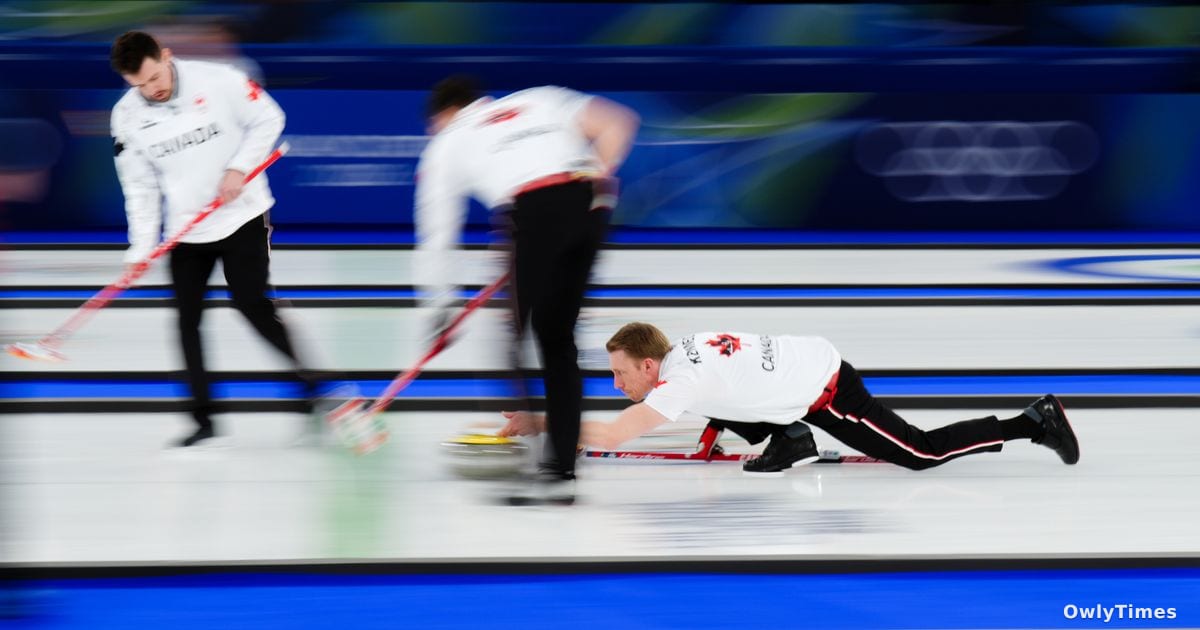

The air in the curling arena felt…different this Olympics. Not because of the roaring crowds, or the precision of the stone slides, but because of a single, venomous phrase caught on camera: “fuck off.” It wasn’t the language itself that was shocking – competitive sports are hardly known for their polite tea parties – but who was saying it, and to whom. Marc Kennedy, a member of the Canadian curling team, directed that colorful dismissal at a Swedish opponent who dared to question a potential rules violation. What unfolded wasn’t just a dispute over a “double-touch” – a subtle manipulation of the stone after it crosses the “hog line” – it was a microcosm of a world increasingly comfortable with bending, breaking, and then brazenly denying the rules, all while cloaking itself in national pride. And it’s a moment that speaks volumes about where we are, not just in sports, but in society at large.
The comforting illusion of sports lies in its structure. Boundaries, objectives, scoreboards, and ultimately, resolution. But that structure relies on a fundamental agreement: everyone plays by the same rules, and there’s someone there to enforce them. The Olympics, in theory, amplify this ideal, presenting a vision of global unity through fair play. Yet, the curling scandal, as documented by Will Leitch in New York Magazine, reveals a starkly different reality. It’s a reality where the rules are porous, enforcement is weak, and the incentive to win trumps any sense of sportsmanship. This isn’t about a quirky, niche sport; it’s about the erosion of trust in institutions and the normalization of dishonesty. The fact that this unfolded on the Olympic stage, meant to represent the best of humanity, is particularly unsettling.
Curling, with its origins in 16th-century Scotland and its current popularity in Nordic and Canadian bars, has always operated on a unique code of honor. Traditionally, players self-police, resolving disputes amongst themselves with politeness and fairness. As Rodger Sherman pointed out in his Sports! newsletter, officials are present, but lack real authority. This system worked for centuries, fostering a culture of respect and integrity. But the landscape shifted last year with a similar incident at the World Championships involving China, and now, with the Canadian team’s blatant disregard for the rules – and their subsequent denial – the cracks in the foundation are widening. The problem isn’t the rule itself, but the lack of consequences for breaking it. The Canadian team didn’t just bend the rules; they actively mocked the idea of accountability.
Based on the original nymag.com report.
The response from the Canadian team was a masterclass in deflection. Kennedy initially dismissed the accusation, then complained about being labeled a “cheater” despite video evidence. The national team issued a statement reaffirming their commitment to “fair play” – a statement dripping with irony – and even blamed the Swedish team for attempting to “trap” them. The following day, a player on the women’s team repeated the same infraction, further demonstrating a pattern of behavior. This wasn’t a one-off mistake; it was a calculated strategy, predicated on the assumption that they could get away with it. And they were right. World Curling’s response – appointing fewer officials – was less a solution and more an admission of powerlessness. This isn’t just about curling; it’s a reflection of a broader societal trend where truth is malleable and accountability is optional.
The parallels to the political sphere are striking. We’ve witnessed leaders routinely disregard facts, rewrite history, and accuse their critics of bad faith. The curling scandal, in its own small way, mirrors this pattern of denial and deflection. It highlights a growing discomfort with impartial observers and a willingness to prioritize personal gain over collective integrity. The fact that this unfolded in a sport historically defined by its sportsmanship is particularly poignant. The Canadian curlers weren’t just breaking a rule; they were dismantling a tradition. They exposed the fragility of a system built on trust and the ease with which it can be exploited when faced with a culture of shamelessness. The question now isn’t just whether curling can recover its integrity, but whether we, as a society, can rediscover our own. Will we continue to reward those who prioritize winning at all costs, or will we demand a return to basic principles of fairness and accountability? The ice is melting, and the game has changed.