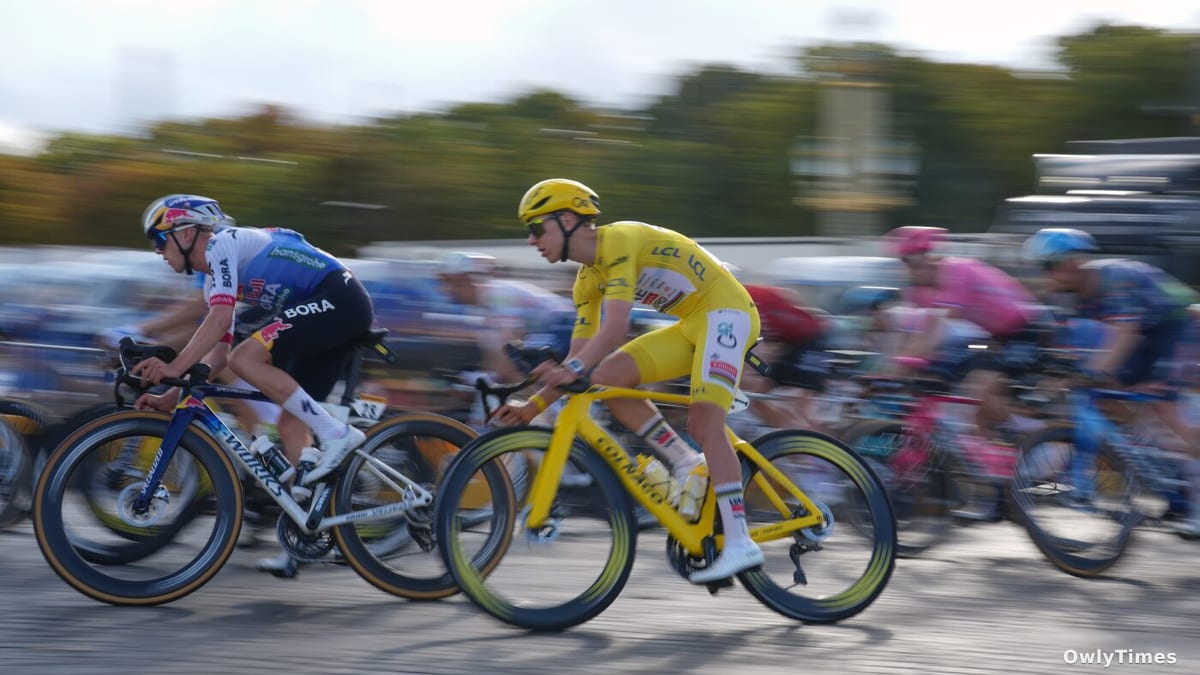

The late afternoon sun struck the famous cobbles of Paris on Sunday, July 26, 2026, but the atmosphere was far from typical. The air was thick, choked by stifling summer temperatures and the drifting anxiety of wildfires raging in southwest France. Against this dramatic backdrop, Tadej Pogačar rode into the capital wearing the yellow jersey, cementing his place in the pantheon of athletic legends. By crossing the finish line just before 8 p.m. local time, the 27-year-old Slovenian secured his fifth Tour de France victory, a feat of relentless dominance that feels almost mythic.
Yet, this historic conclusion was shaped as much by environmental crises as it was by athletic prowess. As reported by NPR, the final stage of the race had to be shortened from 133 kilometers to 89 kilometers, and its start time delayed, because French police and security resources were redeployed to battle the wildfires. The race, which was originally scheduled to begin in Thoiry, instead forced organizers to adapt on the fly. It was a stark reminder of how climate change is actively reshaping the world’s most prestigious sporting spectacles, forcing athletes to perform in increasingly hostile conditions.
The Battle of the Cobbles and Disputed Podiums
While Pogačar had the overall victory locked up, the final sprint on the Champs-Élysées provided its own theatrical drama. Dutch powerhouse Mathieu van der Poel broke away with Pogačar on the final climb of the Butte de Montmartre, eventually fending off a charging pack to take the stage win in 1 hour, 58 minutes, and 49 seconds. According to the BBC, Van der Poel pipped his own teammate, Jasper Philipsen, by "inches" in a frantic finish, while The Guardian described the winning margin as "a tyre's width."
With this fifth overall victory, Pogačar joined cycling royalty, drawing level with Jacques Anquetil, Eddy Merckx, Bernard Hinault, and Miguel Induráin. While NPR and The Guardian noted that his final winning margin over Belgium's Remco Evenepoel was "almost six and a half minutes," both the BBC and Deadline provided the exact figure of 6 minutes and 26 seconds. Pogačar's total winning time for the entire Tour was clocked at 73 hours, 56 minutes, and 26 seconds.
However, the minor podium positions revealed a slight discrepancy among reporting outlets. The Guardian stated that French debutant Paul Seixas climbed onto the podium. Conversely, the BBC reported that while the 19-year-old Seixas looked strong on the climbs, he faded substantially on Saturday, allowing Pogačar's 22-year-old Mexican teammate, Isaac del Toro, to claim third place overall and take the white jersey for the best young rider.
Beyond the Headlines: Night Tests and Whispers of the Past
Beyond the headlines of historic triumphs, a deeper, more complicated narrative continues to shadow the sport. Cycling has never fully escaped the ghosts of its doping-riddled past, a point underscored by the fact that American Lance Armstrong's seven titles remain stripped and omitted from the record books. The modern peloton operates under an intense microscope, and this year's Tour was no exception.
Just before stage 15, the Independent Testing Agency conducted highly unusual, court-authorized night-time anti-doping tests. As the BBC detailed, Pogačar was awoken at 5 a.m., while his main rival, Danish rider Jonas Vingegaard, was tested at 2 a.m. before Vingegaard unfortunately crashed out of the race later that week. Pogačar took the disruption in stride, stating he accepted the tests if they proved the riders were clean.
Yet, as The Guardian pointed out, Pogačar's UAE Team Emirates-XRG manager, Mauro Gianetti, carries historical baggage that keeps skeptics on high alert. Gianetti was the manager of the Saunier Duval team in 2008 when star rider Riccardo Riccò tested positive for a blood-doping agent, a scandal Gianetti recently claimed he was a "victim" of. This lingering distrust is perhaps why Pogačar was even booed by some spectators during this Tour, as fans grapple with whether his otherworldly dominance is a marvel to celebrate or a spectacle to question.
The Cultural Weight of a Relentless Era
This tension between awe and fatigue defines the current cultural moment in professional cycling. Pogačar's superiority is so absolute that some fear the sport is losing its competitive edge. He has now amassed 127 wins in an eight-year professional career, a level of success that led the legendary 81-year-old Merckx to predict that Pogačar will easily break the all-time record with a sixth Tour victory.
But the champion himself seems to view his career with a surprising level of detachment. In an interview with TNT Sports, cited by Deadline, Pogačar admitted, “I definitely will not be doing this for too much long time, I think.” For now, however, he remains the undisputed king of the road, with plans already in motion to target August's Vuelta a España to complete his Grand Tour collection.
This moment matters because it represents the peak of an era where human potential is being pushed to its absolute limit, even as the physical world literally burns around it. Whether Pogačar continues his reign or walks away early, he has fundamentally redefined what is possible on two wheels. As the Tour looks north toward a magical Grand Départ in Scotland next year, the cycling world must decide how to appreciate a genius who makes the extraordinary look routine, while performing on a planet that is rapidly changing.