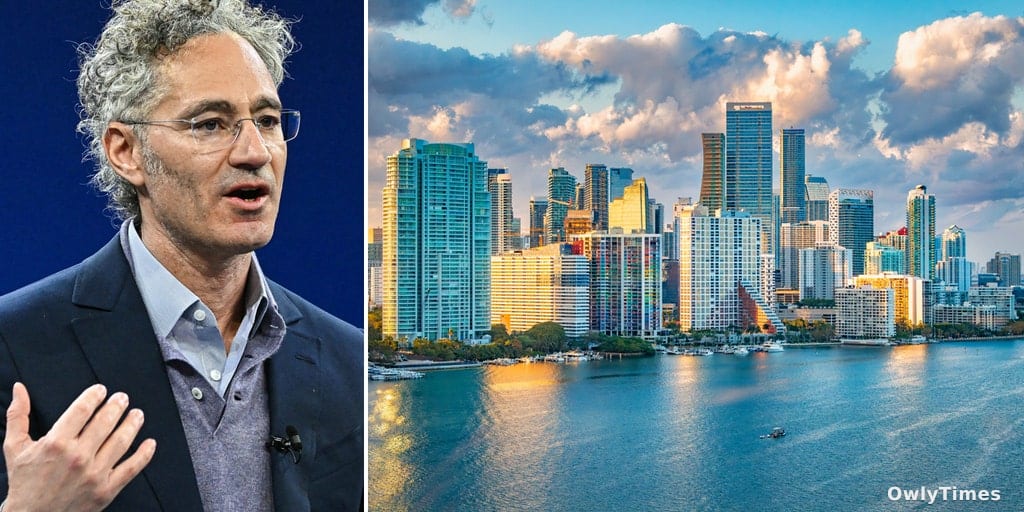

$4.5 billion in revenue – that’s the figure that now anchors Palantir Technologies’ future, and increasingly, Florida’s economic landscape. The artificial intelligence firm’s recent, and remarkably abrupt, headquarters relocation from Denver to Aventura, Florida, isn’t simply another company “moving to Florida.” It’s a concentrated injection of high-value capital and talent into a state actively courting disruption, and a pointed signal about where the next phase of tech growth is expected to occur. Follow the money, and it leads directly to a calculated bet on Florida’s business climate, fueled by tax advantages and a growing ecosystem of relocated wealth.
The Exodus From California Accelerates
This isn’t Palantir’s first relocation; in 2020, the company left Palo Alto, California, for Denver, with Alex Karp, CEO of Palantir, citing a “clash between Silicon Valley’s ‘values’” and the company’s mission. While the initial move was framed as a search for a more pragmatic environment, the shift to Miami represents a different dynamic – a clear alignment with a burgeoning concentration of capital. The move follows similar decisions by high-profile figures like Peter Thiel, Jeff Bezos, and Ken Griffin, who have either moved their personal residences or relocated entire firms, like Citadel, to the Sunshine State. This isn’t organic growth; it’s a deliberate migration driven by concerns over California’s proposed wealth tax and increasingly stringent regulations. The sheer scale of this movement is noteworthy. Palantir’s valuation exceeding $300 billion instantly makes it the largest publicly traded company headquartered in South Florida, eclipsing NextEra Energy, a long-standing regional leader.
This piece references the foxbusiness.com report.
Florida’s Aggressive Recruitment Strategy
The timing of Palantir’s move coincides with the launch of “Ambition Accelerated,” a marketing initiative spearheaded by the Florida Council of 100, backed by significant funding from Stephen Ross of Related Companies and Ken Griffin. The campaign, targeting executives in New York, Chicago, and California, isn’t subtle. Ads pose direct challenges – “What if you could scale in the top metro for GDP growth?” – and highlight Florida’s advantages: no state income tax, low business regulation (second-lowest per capita in the U.S.), and consistent high rankings in GDP growth and new business formations. This isn’t passive attraction; it’s an active, well-funded effort to reshape the economic map of the United States. The lack of advance notice given to Colorado Governor Jared Polis regarding Palantir’s departure underscores the speed and decisiveness of these relocations, and the effectiveness of Florida’s direct engagement with corporate leadership.
Beyond Tax Breaks: The National Security Angle
While tax incentives are a significant draw, framing Palantir’s move solely as a tax play overlooks a crucial element: national security. Florida is actively positioning itself as a hub for AI innovation with implications for defense and intelligence. The Florida Council of 100 explicitly hailed the move as a “watershed moment” validating Florida’s role in these sectors. Palantir’s core business – providing data analytics platforms to government agencies, including the Department of Defense – aligns perfectly with this strategic focus. This isn’t simply about attracting tech companies; it’s about attracting specific tech companies with capabilities deemed vital to national interests. The company’s 2025 revenue projection of $7.2 billion, nearly doubling the previous year’s $4.5 billion, suggests confidence in continued government contracts and expansion within this sector.
What This Means For Your Wallet
Palantir’s move isn’t likely to directly impact individual consumer prices in the short term. However, the broader trend of tech migration to Florida could lead to increased competition for skilled labor, potentially driving up wages in the region. More significantly, the concentration of wealth and innovation in South Florida could accelerate economic growth, benefiting local businesses and creating new job opportunities. The question investors should be asking isn’t if Florida’s economic momentum will continue, but how it will be sustained. Will the state’s infrastructure – housing, transportation, education – keep pace with the influx of new residents and businesses? And will the aggressive recruitment strategy ultimately deliver on its promise of long-term, diversified economic growth, or simply create a bubble fueled by short-term capital gains?