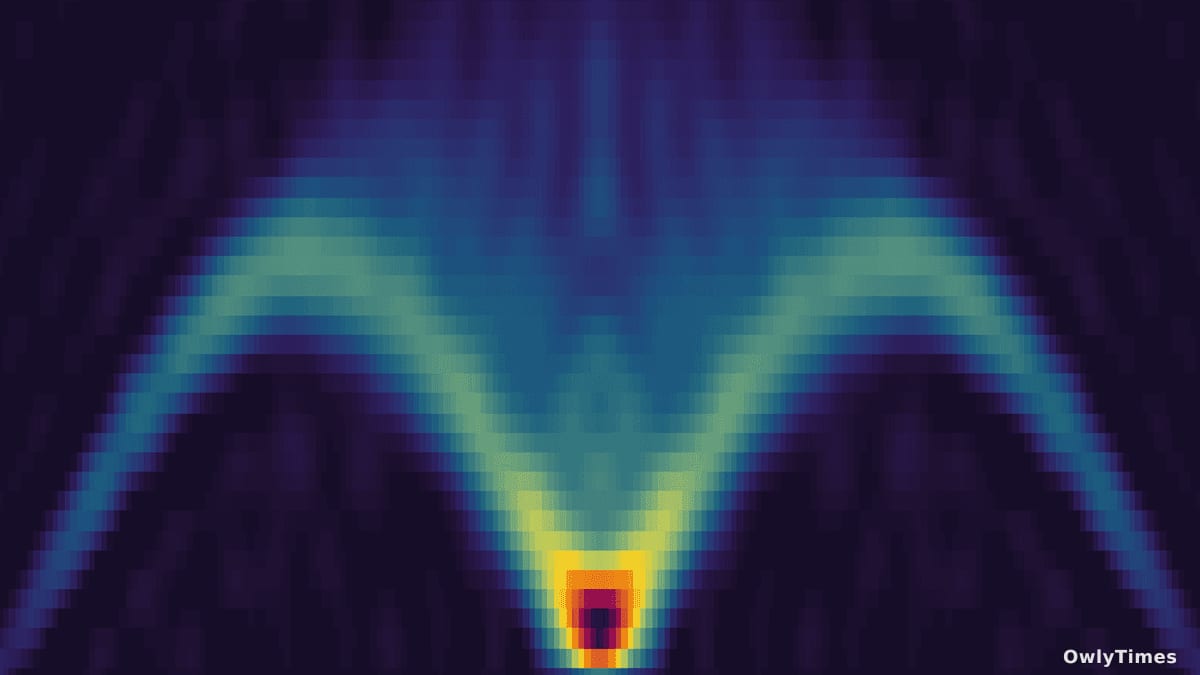

The promise of quantum computing has always hinged on its ability to solve problems intractable for even the most powerful conventional supercomputers. But translating that theoretical potential into demonstrable scientific breakthroughs has been a slow, painstaking process. A new study, a preprint released by a collaboration spanning Oak Ridge National Laboratory (ORNL), Purdue University, Los Alamos National Laboratory, University of Illinois at Urbana-Champaign, University of Tennessee, and IBM, isn’t announcing a quantum revolution – it’s demonstrating a crucial step within that revolution. Researchers have successfully used the IBM Quantum Heron processor to simulate the behavior of a real material, KCuF33, with a level of accuracy previously unattainable, effectively mirroring data obtained through neutron scattering experiments. This isn’t simply about confirming a simulation; it’s about validating a new methodology for materials science, one where quantum computers aren’t just predicting properties, but actively informing experimental design.
The core of the achievement lies in the successful computation of the energy-momentum spectrum of KCuF33, a well-studied magnetic material. For decades, scientists have relied on neutron scattering – bombarding a material with neutrons and analyzing how they scatter – to understand its internal structure and dynamics. As Arnab Banerjee, assistant professor of physics and astronomy at Purdue University, explains, neutrons offer a “clean” probe, interacting weakly with the material and providing a dependable model for theoretical analysis. However, interpreting the vast amounts of data generated by neutron scattering, particularly in complex magnetic materials where many spins are entangled, has proven computationally challenging for classical computers. The new research demonstrates that a 50-qubit quantum simulation, leveraging the unique capabilities of the Heron processor, can accurately reproduce the neutron scattering data. This isn’t a case of the simulation approximating the experiment; according to study co-author Allen Scheie of Los Alamos National Laboratory, it’s “the most impressive match I've seen… and it definitely raises the bar.”
Original reporting: research.ibm.com.
What’s often lost in headlines proclaiming quantum computing milestones is the distinction between theoretical capability and practical realization. Many demonstrations focus on idealized scenarios, while this work tackles a genuinely complex, real-world problem. The researchers didn’t simply choose KCuF33 at random. The interaction between the material’s spins and neutrons maps efficiently onto quantum circuits – a crucial factor given the current limitations of quantum hardware. As Bibek Pokharel, an IBM research scientist and lead author, noted, the team initially wasn’t sure how many qubits and computational steps (“gates”) would be required for a successful simulation. The success hinged not only on the increasing scale and quality of quantum processors, specifically the low error rates across all 50 qubits used, but also on a noise-robust algorithm and the integration of classical computing resources at the Illinois Campus Cluster to streamline the quantum circuits. This exemplifies IBM’s vision of “quantum-centric supercomputing,” where quantum and classical systems work in tandem.
However, it’s vital to acknowledge the limitations to consider. While the simulation accurately reproduces the neutron scattering data for KCuF33, this doesn’t mean quantum computers are poised to replace classical methods entirely. The current simulation required a relatively simple material and still relied heavily on classical pre- and post-processing. The 50-qubit processor, while a significant achievement, is still far from the fault-tolerant quantum computers needed to tackle truly intractable problems. Furthermore, the mapping of spins to qubits, while efficient for KCuF33, may not be as straightforward for other materials. The study also doesn’t address the broader challenge of scaling up quantum simulations to handle larger, more complex systems. The researchers were able to leverage the same processor to simulate cobalt-based materials, but the complexity of those interactions remains a hurdle.
The next steps for this research team, and the broader quantum materials science community, are focused on expanding the scope and complexity of these simulations. They plan to apply this methodology to materials with higher dimensionality and more intricate interactions than KCuF33. Travis Humble, director of QSC at ORNL, emphasizes the potential for a “feedback loop” between experimental characterization and quantum simulation, where increasingly accurate simulations can guide the design of new materials with tailored properties. But a crucial question remains: will this iterative process lead to the discovery of materials with functionalities currently beyond our reach, or will the limitations of current quantum hardware continue to constrain progress? The coming years will reveal whether this demonstration of quantum simulation is a harbinger of a new era in materials discovery, or simply a promising proof-of-concept.