
$8.6 Billion Flows Into the Triangle: Why Raleigh is Becoming a Magnet for Midwest Tech
A net domestic migration of 8.6 billion dollars into the Raleigh, North Carolina metropolitan area between July 2022 and July 2023 isn’t just a demographic shift—it’s a capital reallocation signaling a fundamental re-evaluation of where American businesses believe growth lies. This influx, revealed in recent U.S. Census Bureau data, is directly fueling an expansion wave attracting companies like Atomic Object, a Midwest-based software firm, and prompting the Wisconsin School of Business (WSB) to prioritize Raleigh as a key destination for its Career Forward program. Follow the money, and a clear picture emerges: Raleigh isn’t simply a growing tech hub, it’s becoming a deliberate alternative to increasingly expensive and saturated coastal markets.
Reporting from poetsandquantsforundergrads.com informs this analysis.
The decision by Taylor Vanden Hoek and Ryan Abel, managing co-directors of Atomic Object, to open a Raleigh office wasn’t based on serendipity. After months of evaluating potential expansion locations, they identified Raleigh’s burgeoning tech sector as uniquely attractive. This isn’t an isolated case. While the West Coast grapples with tech layoffs and rising operational costs—San Francisco saw a net outflow of over $12 billion in the same period—the “Triangle” region (Raleigh, Durham, and Chapel Hill) is experiencing a surge in investment. The WSB’s Career Forward program, designed to connect students with companies nationwide, reflects this trend. The program’s focus on Raleigh, alongside established destinations like New York City, demonstrates a strategic shift towards identifying and leveraging emerging economic centers.
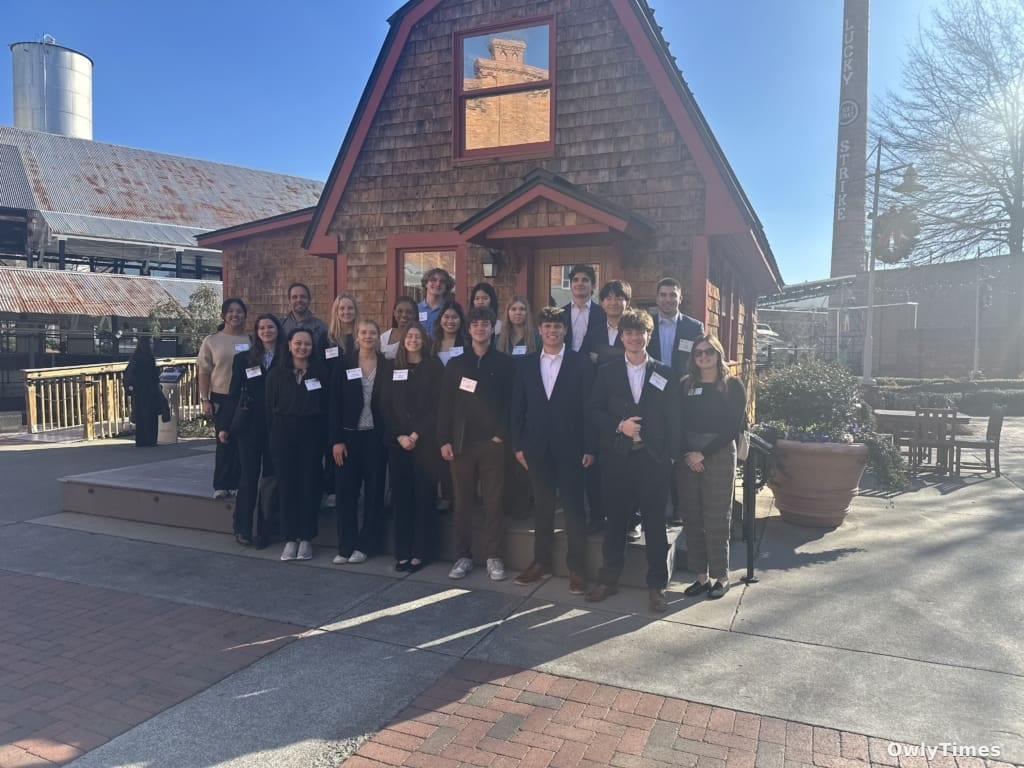
The WSB’s Career Treks, like the one undertaken by junior marketing major Lauren Downham and 19 of her peers in January, are more than just company tours. They are reconnaissance missions, scouting locations where future talent pipelines will need to be established. Downham’s experience—visiting not only Atomic Object but also a local television station, the Durham Bulls baseball stadium, and the Lenovo Design Lab—highlights the diversity of opportunity within the Raleigh ecosystem. This breadth is crucial. While Silicon Valley remains dominant in specific niches, Raleigh offers a more diversified base, attracting companies across industries. The program’s very existence—and its $250,000 annual budget dedicated to student travel and networking—is a direct investment in identifying these emerging opportunities.
The appeal of Raleigh extends beyond pure economics. The presence of three major universities—Duke University, North Carolina State University, and the University of North Carolina–Chapel Hill—creates a highly skilled labor pool and fosters a culture of innovation. This “university triangle” generates approximately 70,000 graduates annually, providing a consistent stream of talent for expanding companies. Compare this to the aging populations and skills gaps plaguing many established tech hubs, and the advantage becomes clear. Furthermore, the lower cost of living—housing costs in Raleigh are roughly 40% lower than in San Francisco—makes it a more attractive destination for both companies and employees. This cost differential translates directly into increased profitability for businesses and higher disposable income for workers, further fueling economic growth.
The WSB’s Career Treks aren’t just benefiting students like Downham; they’re providing valuable feedback to the university itself. The program’s ability to expose students to emerging career pathways—careers that weren’t even on the radar of some “undecided” freshmen, as Downham observed—allows the school to refine its curriculum and ensure it’s preparing students for the jobs of tomorrow. This iterative process, driven by real-world exposure, is a key differentiator for the WSB. The program’s expansion, with multiple treks planned throughout the year, indicates a commitment to staying ahead of the curve and proactively positioning its graduates for success.
What this means for your wallet: Expect increased competition for skilled tech workers, potentially driving up salaries in the Raleigh area. For investors, the continued influx of capital into the Triangle suggests a strong potential for growth in real estate, technology, and related sectors. But the key question remains: can Raleigh maintain its momentum as it scales? Watch for indicators of infrastructure strain—particularly in housing and transportation—and whether the region can successfully manage its growth while preserving its quality of life. If it can, the $8.6 billion inflow is likely just the beginning.