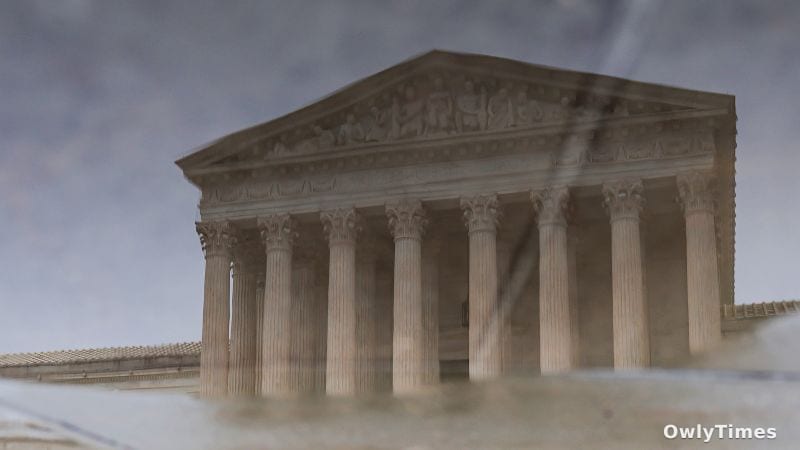

The Supreme Court’s Friday decision striking down President Trump’s emergency tariffs wasn’t simply a legal setback; it was a calculated risk assessment by the Court itself, signaling a potential recalibration of power dynamics after a sustained period of deference to the executive branch. The 6-3 ruling, fracturing the conservative majority and including dissenting voices from within Trump-appointed justices, reveals a strategic attempt to define the boundaries of presidential authority – not necessarily to halt Trump’s economic agenda entirely, but to force a renegotiation of how that agenda is pursued. This isn’t about tariffs; it’s about who controls the means of economic coercion, and the Court has just asserted its role in that control.
The immediate fallout is clear: roughly $134 billion in tariff revenue collected under the invalidated policy now faces a complex repayment process, a “procedural mess” as Justice Amy Coney Barrett herself predicted. But the larger question is who benefits and who loses from this shift. American businesses and consumers, burdened by increased costs, stand to gain from the potential refunds and a more predictable trade environment. However, the administration loses a significant tool for leveraging trade negotiations and applying economic pressure, forcing a reliance on Congress for future tariff actions – a far less nimble and more politically fraught process. Republican lawmakers, already wary of Trump’s tariff policies, now face a difficult vote: supporting tariff extensions in an election year risks alienating voters, while opposing them could be interpreted as undermining the President.
This ruling echoes historical precedents where the judiciary has stepped in to curb executive overreach during times of perceived crisis. Consider the Youngstown Sheet & Tube Co. v. Sawyer (1952) case, where the Supreme Court curtailed President Truman’s authority to seize steel mills during the Korean War. Like Truman, Trump attempted to justify expansive presidential power based on national security concerns, but the Court, in both instances, insisted on explicit congressional authorization. The parallel isn’t perfect – the steel seizure was a direct intervention in private property, while the tariffs were framed as a trade policy – but the underlying principle remains: the executive branch cannot unilaterally expand its authority at the expense of established legal frameworks. The Court is signaling that even in the face of perceived economic emergencies, the rule of law still applies.
This article draws on reporting from CNN.
Trump’s Reaction and the Fractured Majority
Donald Trump’s visceral reaction – calling the justices in the majority a “disgrace” and questioning their motives – underscores the political stakes. His anger isn’t simply about the loss of a policy tool; it’s about the erosion of a perceived invincibility at the Supreme Court. The fact that two of his own appointees, Neil Gorsuch and Amy Coney Barrett, sided against him is particularly stinging. This isn’t a case of liberal activism overriding conservative jurisprudence; it’s a demonstration that even conservative justices are bound by legal principles, and that deference to the executive branch has its limits. The internal fissures within the conservative bloc are now visible, and the Court’s future decisions may reflect this new dynamic.
The Limits of the “Major Questions Doctrine”
The Court’s reliance on, and debate surrounding, the “major questions doctrine” is crucial. This relatively new legal principle asserts that agencies cannot make decisions of vast economic and political significance without clear congressional authorization. While Chief Justice John Roberts invoked the doctrine to justify striking down the tariffs, Justices Brett Kavanaugh and Elena Kagan offered dissenting views on its application. Kavanaugh argued it shouldn’t apply to foreign affairs, while Kagan believed the decision could be reached without it. This disagreement highlights the uncertainty surrounding the doctrine’s scope and future application. The Court is still grappling with how to define “major questions,” and the outcome of future cases will depend on how this definition evolves.
Congressional Complications and Economic Realities
The ruling forces President Trump to seek congressional approval for future tariffs, a significant hurdle. Senator Chuck Grassley’s carefully worded statement – expressing support for Trump’s negotiating skills while urging collaboration with Congress – encapsulates the Republican dilemma. They want to avoid alienating the President, but they also recognize the potential economic fallout of broad-based tariffs, particularly in an election year. Polling data reinforces this concern: a Marquette Law School poll found 56% of Americans believe tariffs hurt the US economy, and majorities of Democrats and independents share that view. The administration’s attempt to enact a 10% global tariff under Section 122, while a signal of intent, is limited by its 150-day duration and the need for congressional extension.
The State of the Union Stage
The timing of the decision, just days before President Trump’s State of the Union address, adds another layer of complexity. The address provides a global stage for Trump to air his grievances and attempt to reassert control of the narrative. The presence of the justices, traditionally seated in the front row, will be particularly fraught with tension. Trump’s past interactions with Chief Justice John Roberts – the warm handshake after securing immunity from prosecution – stand in stark contrast to the likely reception he will receive this time. The justices, accustomed to a degree of deference, will be forced to sit silently as the President publicly criticizes their decision.
The political chess move to watch next isn’t about tariffs themselves, but about the administration’s response to the Court’s assertion of authority. Will Trump attempt to circumvent the ruling through alternative legal avenues, potentially pushing the boundaries of executive power even further? Or will he attempt to work with Congress, signaling a willingness to compromise and respect the separation of powers? The answer will reveal whether this Supreme Court decision represents a genuine reset in the relationship between the executive and judicial branches, or merely a temporary setback in a larger power struggle. Specifically, monitor the language and proposed legislation surrounding the extension of existing tariffs – will it be framed as a negotiation with Congress, or a demand for compliance? That will be the clearest indicator of the administration’s long-term strategy.





