
The Supreme Court’s recent tariff case, Learning Resources v. Trump, wasn’t decided on the merits of trade policy, but on a strategic calculation of judicial positioning. The staggering 164 pages of opinions – a figure openly mocked during oral arguments in a subsequent case – reveal a court less concerned with establishing clear legal precedent than with solidifying ideological battle lines for future conflicts. This isn’t simply about disagreement; it’s about a fundamental shift in how justices perceive their role in shaping the law, moving from consensus-building to assertive doctrinal defense.
The exchange between Justice Samuel Alito and lawyer John Bursch – Alito quipping about aiming for an opinion “160 pages less” than the tariff ruling – wasn’t just courtroom banter. It was a pointed acknowledgment of the unusual volume of dissent and concurrence, and a subtle signal of the court’s internal dynamics. Chief Justice John Roberts, visibly amused, had already delivered the majority opinion, a relatively concise 21 pages, only to find himself waiting as colleagues appended lengthy statements to it. Who benefits and who loses from this trend? The public loses clarity, and the legal community faces a more complex landscape. But individual justices, particularly those seeking to establish a lasting legacy, gain a platform to articulate their judicial philosophies.
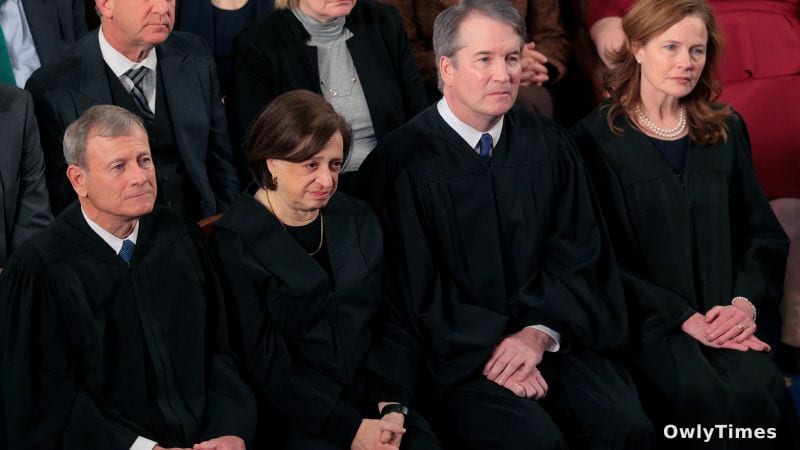
The sheer number of separate opinions – seven in total, including dissents and concurrences from Justices Brett Kavanaugh, Neil Gorsuch, Amy Coney Barrett, Elena Kagan, Ketanji Brown Jackson, and Clarence Thomas – demonstrates how a single case can become a proxy for broader doctrinal disputes. University of Pennsylvania law professor Jean Galbraith observed that concurrences are increasingly used for “big brush strokes,” for “laying out and defending broad judicial philosophies.” This echoes a historical pattern: the late 19th and early 20th centuries saw similar lengthy dissents, often used to challenge prevailing economic doctrines. However, the current surge differs in its focus – less about specific policy outcomes and more about fundamental approaches to statutory interpretation and constitutional law.
Drawn from CNN.
The rise in concurring opinions, documented by Adam Feldman of Legalytics, shows a 42% increase between 2000 and 2024. This isn’t a uniform trend across the court. While Justice Thomas historically led in supplemental writings, Justice Jackson is rapidly closing the gap, authoring 29 concurrences since joining the bench in 2022, second only to Thomas’s 35. This contrasts sharply with Justice Kagan, who has penned only five concurrences in the same period. The disparity isn’t about ideological alignment alone; it’s about a deliberate strategy to actively shape the legal discourse. Jackson’s 13-page concurrence in Berk v. Choy, sparring with Justice Barrett over procedural rules, exemplifies this approach – a willingness to engage in detailed, even pointed, disagreement.
The core of the dispute in Learning Resources v. Trump wasn’t about tariffs themselves, but about the “major questions doctrine” – the idea that Congress must clearly authorize any presidential action with significant economic or political consequences. Roberts correctly concluded that Congress hadn’t granted Trump the authority to impose the disputed tariffs. However, the ensuing debate over the doctrine’s application revealed deep fissures within the court. Gorsuch’s critique of his colleagues’ approaches, and Barrett’s sharp rebuttal, weren’t merely academic exercises. They were preemptive strikes in the ongoing battle over the balance of power between the executive and legislative branches.
This dynamic isn’t new. The court’s 2024 ruling on the Second Amendment, with five concurring opinions alongside the 8-1 majority decision, mirrored the pattern seen in the tariff case. The justices, even when agreeing on the outcome, felt compelled to articulate their individual reasoning, anticipating future challenges to gun control measures. Gorsuch’s closing remark – “if history is any guide, the tables will turn…” – is a telling admission. He understands that these lengthy opinions aren’t about resolving the current dispute, but about positioning the court for the next one.
The political chess move to watch next is whether Chief Justice Roberts will attempt to reassert control over the court’s opinion-writing process. Will he actively discourage lengthy concurrences, or will he allow the current trend to continue, potentially leading to even more fragmented and less predictable rulings? The answer will reveal whether Roberts intends to maintain the court’s image as a unified institution, or whether he accepts its transformation into a forum for ongoing ideological warfare.