
Can a legacy automaker actually learn to speak the language of a Silicon Valley software shop before its market share evaporates?
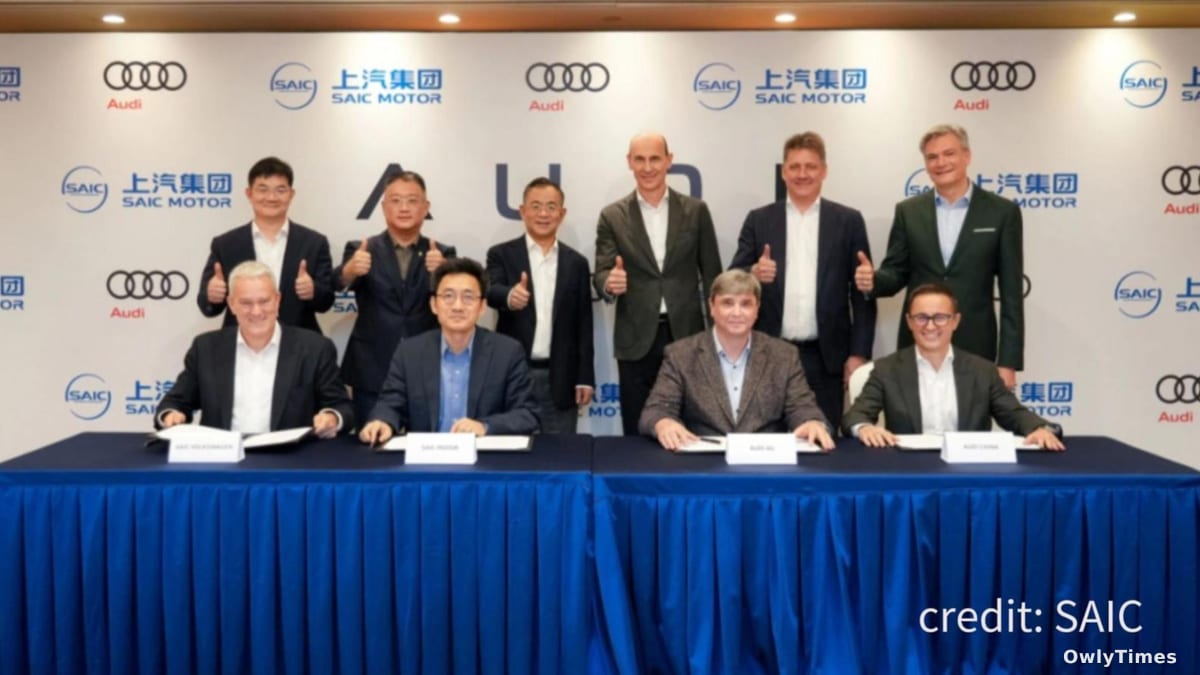
The real story here isn’t just that Audi is building another innovation center in Shanghai—it’s that they are effectively outsourcing their own identity to survive the Chinese EV arms race. By deepening their strategic cooperation with SAIC Group and technology partner Momenta, Audi is signaling a total surrender of the "German engineering" mystique in favor of a joint China-Germany development model. When a brand like Audi hands over core platform definition to local teams, they aren't just adapting to a new market; they are admitting that the traditional way of building cars is dead.
The E7X and the Death of the "Slow Build"
The Audi E7X is the physical manifestation of this shift. Positioned as a "smart performance flagship SUV," it’s packing a 900V high-voltage platform and a massive 109.3 kWh battery, boasting a CLTC range of 751 km. But the hardware is almost secondary to the software integration. By tapping into Momenta’s R7 reinforcement learning world model, the vehicle promises point-to-point assisted driving that feels more like a smartphone update than a mechanical evolution.
When the E7X hits presale on May 8, 2026, the industry will be watching to see if the 21.4-inch QD Mini LED display and AI assistant 2.0 can actually keep up with the hyper-competitive local offerings. Audi is aiming to develop four models based on this Advanced Digitized Platform (ADP), with a third vehicle already slated for 2027. For the ordinary driver, this means the car in your driveway is transitioning from a piece of machinery you maintain into a high-speed data node that you subscribe to.
CATL’s Infrastructure Monopoly
While Audi is redesigning the car, Contemporary Amperex Technology Co., Limited (CATL) is quietly redesigning the entire grid. On April 21, 2026, CATL didn't just announce a battery; they announced an "integrated charging and battery swapping" network. Their 3rd-gen Shenxing battery is the standout, capable of charging from 10% to 80% in just 3 minutes and 44 seconds.
If you’ve ever sat at a public charger for 40 minutes, you know that this isn't just an incremental improvement—it’s the difference between electric vehicles being a "lifestyle choice" for the patient and a standard utility for everyone. CATL plans to deploy 4,000 stations by the end of 2026, covering 190 cities. They are betting that if they control the "gas station" of the future, it won't matter whose brand is on the hood of the car.
The Cost of Complexity
The final piece of this puzzle is the push for "centralized computing," which sounds like buzzword bingo until you look at the financials. On April 22, 2026, Horizon Robotics partnered with BICV Technology and PATEO Connect Technology to push for integrated cockpit-driving solutions.
By using Horizon’s Starry single-chip platform to unify cockpit and autonomous driving, these companies are aiming for a cost reduction of RMB 1,500 to 4,000 per vehicle. In an industry where margins are razor-thin, that is a massive efficiency gain. However, it also means that your vehicle is becoming a single point of failure; when the "centralized brain" glitches, everything from your infotainment to your lane-keeping assist goes dark.
The next reading of the 4,000-station deployment target for CATL will show whether this massive infrastructure bet can keep pace with the rapid-fire hardware releases from the Audi-SAIC partnership, or if the grid will become the ultimate bottleneck for the EV transition.