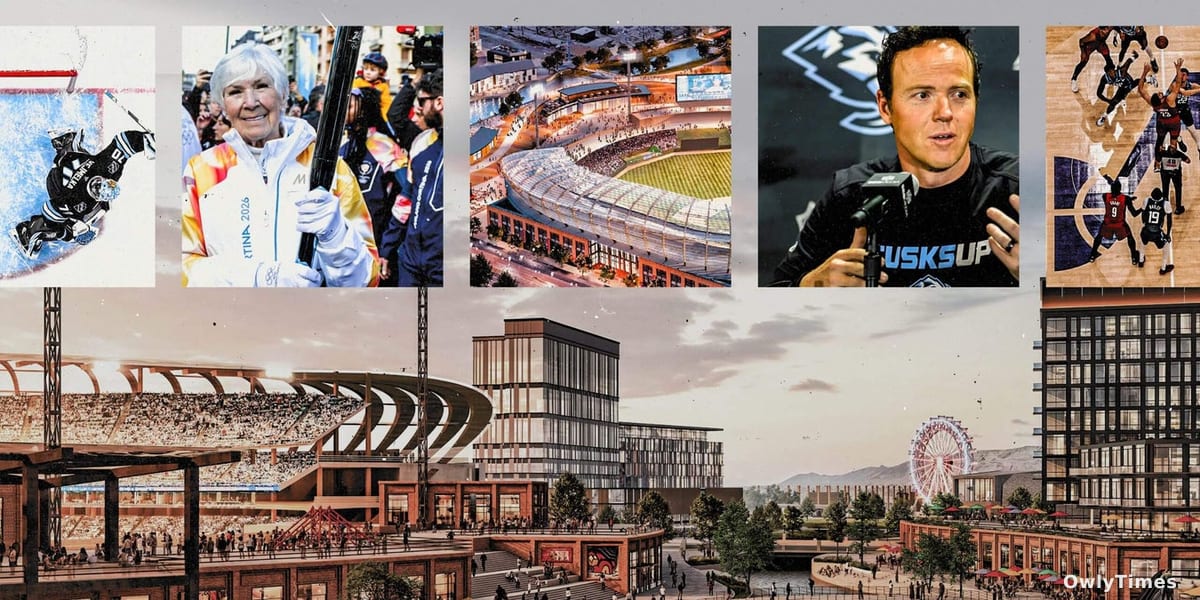

The chair wobbled slightly as Erin Mendenhall, Mayor of Salt Lake City, balanced precariously, pointing a finger across a massive map dominating the wall outside her office. It wasn’t just a map; it was a living document of ambition, crisscrossed with colored tape marking priority projects – orange for city initiatives, green for the burgeoning “Green Loop,” and a vibrant yellow outlining the $3.5 billion Power District. But her attention lingered on a barren patch of industrial lots, a space that, on paper, seemed unremarkable. Yet, it could be the future home of a Major League Baseball franchise, and the latest, most audacious symbol of Salt Lake City’s improbable sports renaissance. This isn’t simply about attracting another team; it’s about a city deliberately engineering its identity, leveraging sports not just for entertainment, but as a catalyst for economic and cultural transformation.
Salt Lake City’s ascent as a sports boomtown feels almost overnight, a whirlwind of construction and announcements. An NHL franchise, the Utah Mammoth, arrived after a swift relocation from Arizona. The city is the frontrunner for MLB expansion. And in 2034, the Winter Olympics will return, a full 22 years after a successful, yet somewhat insecure, debut. But those involved insist this isn’t a sudden surge, but a “crescendo” – two decades of meticulous planning stemming from the 2002 Winter Games, a deliberate strategy to position Utah as a year-round sporting destination. The sound of that crescendo is now a constant hum of construction throughout the Salt Lake Valley, a physical manifestation of a city rewriting its narrative.
Based on the original The New York Times report.
The Larry H. Miller Company’s Power District, spearheaded by CEO Steve Starks, is central to this vision. Standing on the future site, where a drill rig relentlessly bores into the earth, Starks echoes a sentiment deeply ingrained in Utah’s history: “When the pioneers came into the valley, they said, ‘This is the place.’” Now, as they court Major League Baseball, the message is the same: “This is the place – and we’re ready.” That readiness isn’t just rhetoric. Unlike other cities offering vague promises and renderings, Salt Lake City presented MLB with a fully-fledged plan: 100 acres of land, a coalition of influential Utahns, bipartisan political support, a funding strategy, and a credible investor in the Miller family. This isn’t a city hoping for a team; it’s a city offering a turnkey solution.
The story of the Larry H. Miller family is inextricably linked to Utah’s sporting ambitions. Gail Miller, who took the helm after her husband’s death in 2009, has become a driving force, leveraging the family’s business empire – initially built on auto dealerships and later expanded – to secure the city’s sporting future. After selling the Utah Jazz and their dealerships, the Millers are now leading the charge for an MLB franchise, a move that speaks to a deeper commitment than simply owning a team. It’s about legacy, about solidifying Utah’s place on the national stage, and about fulfilling a vision Larry Miller first articulated decades ago. This isn’t just about baseball; it’s about the Millers’ enduring influence on the state’s identity.
But the ambition extends beyond baseball. City and state officials aren’t shy about their aspirations. Stuart Adams, Utah’s Senate President, openly states the desire to “round out” the sports landscape with baseball, explicitly eyeing the NFL as the next target. The market itself is ripe for expansion. The Salt Lake City-Provo-Orem corridor has nearly doubled in population since MLB’s last expansion in 1998, now boasting nearly 3 million residents. This demographic surge, coupled with a pro-business climate and a sports-friendly legislature, creates a fertile ground for growth. However, the true “secret sauce,” according to Jeff Robbins of the Utah Sports Commission, lies in the unprecedented unison between public and private stakeholders. Utah doesn’t just want these teams; it’s meticulously engineered the conditions for their success.
This coordinated effort, however, hasn’t been without its critics. The nearly $2 billion in public funding allocated to the sports projects has drawn scrutiny, with economists like David Berri questioning whether the economic benefits will outweigh the costs. Berri argues that the deal to keep the Jazz downtown is unlikely to generate significant growth, framing it as a vanity project for a city eager to be perceived as “major league.” Yet, proponents, including Governor Spencer Cox, emphasize the transformative potential for revitalizing Salt Lake City’s downtown and investing in historically under-resourced west-side neighborhoods. This tension – the balance between public investment and private gain – is a defining characteristic of Utah’s sports strategy.
The narrative surrounding Salt Lake City is also undergoing a significant shift. For decades, the city was often portrayed as insular, homogenous, and dominated by the Church of Jesus Christ of Latter-day Saints. Sport, however, has served as a “cultural bridge,” as noted by professor Matthew Bowman, connecting Utah to the broader United States. The arrival of professional sports teams, coupled with a growing and diversifying population, is challenging these long-held perceptions. Ryan Smith, owner of the Jazz and Mammoth, believes Utah is finally telling its own story, one of innovation, growth, and opportunity. But the question remains: can Utah truly shed its historical image and embrace a more inclusive, cosmopolitan identity?
The story of Utah’s sports boom isn’t just about building stadiums and attracting teams; it’s about a state consciously constructing its future. The Olympic torch relay, with 82-year-old Gail Miller carrying the flame in Milan, symbolized this ambition. Utah isn’t just prepared to host the 2034 Winter Olympics; it’s overprepared, with venues already in place and over $250 million in private funding secured. This level of preparedness, born from a decades-long vision, is what sets Utah apart. But the real test isn’t just hosting successful events; it’s whether this sporting renaissance can translate into broader economic and social benefits for all Utahns, and whether the state can navigate the inherent tensions between public investment, private profit, and evolving cultural identity. The question isn’t if Salt Lake City will become a major sports hub, but what kind of city it will be as it arrives.