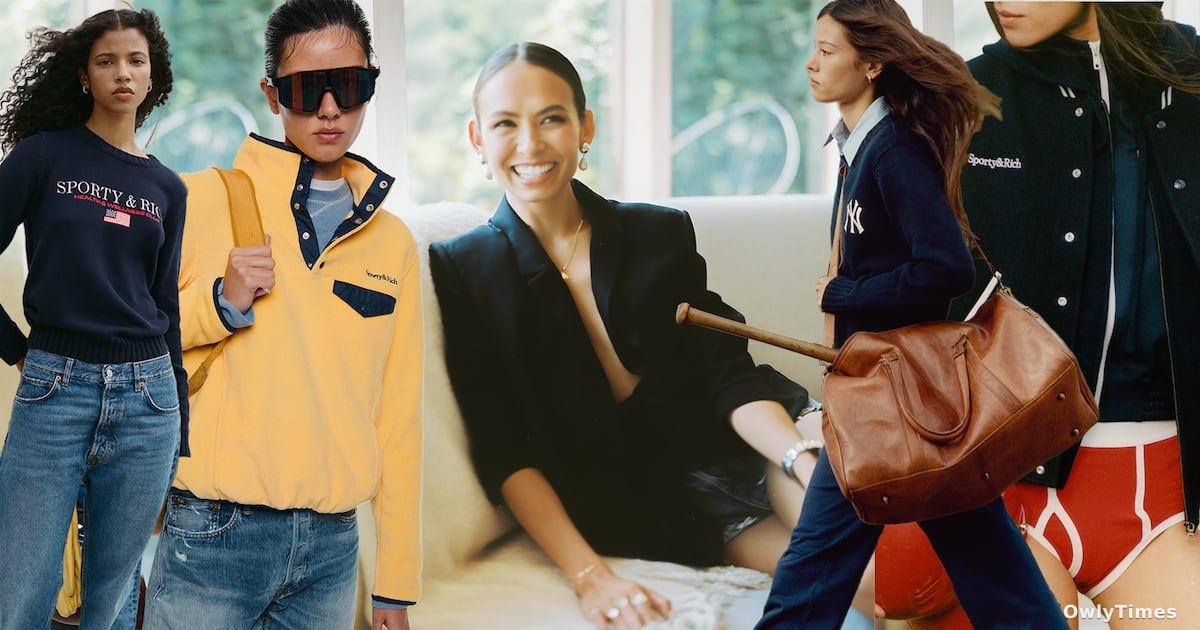

$35 million in revenue is the figure defining a critical inflection point for athleisure brand Sporty & Rich, and it’s not the topline growth that’s most telling. While a 10% year-over-year increase is healthy – placing the brand firmly within a competitive landscape alongside emerging direct-to-consumer players – the internal shift required to sustain that growth is what’s now driving a significant leadership change. Emily Oberg, founder of the Ralph Lauren-inspired brand, has replaced David Obadia as CEO, a move signaling a fundamental re-evaluation of how founder-led businesses scale beyond initial success. Follow the money, and you’ll see this isn’t simply about a change in management; it’s about a calculated bet on founder control versus operational expertise as Sporty & Rich aims for a five-year revenue target of $100 million.
The story of Sporty & Rich mirrors a broader tension within the direct-to-consumer world: the inherent conflict between a founder’s vision and the demands of a maturing business. Oberg’s decision to assume the CEO role, despite previously focusing on creative direction, wasn’t born of dissatisfaction with Obadia’s performance. Rather, it stemmed from a realization that the company’s early focus on securing wholesale partnerships – with retailers like Selfridges, Harrods, and Revolve’s Fwrd – was creating an inventory bottleneck. A 25-person team, while nimble, was prioritizing deal-making over the logistical infrastructure needed to reliably supply those partners. This imbalance, Oberg recognized, threatened to undermine the brand’s carefully cultivated image of aspirational exclusivity.
This article draws on reporting from businessoffashion.com.
This isn’t an isolated incident. The graveyard of hyped-up, founder-led brands is littered with cautionary tales. Cami Téllez’s Parade, once touted as a Victoria’s Secret disruptor, shuttered in 2023 after a rapid rise and subsequent sale. Outdoor Voices, initially propelled by Ty Haney’s vision, faced accusations of mismanagement and a period of instability before Haney’s eventual return. These examples underscore a critical point, as articulated by Brandon Yoshimura, managing director at Solomon Partners: “Your vision, conviction and self-confidence is what tends to be the magic for these brands…That exact same single-mindedness and relentless pursuit of your dream can make it challenging to take advice or be receptive to outside ideas.” The success rate isn’t simply about having a good product; it’s about recognizing when the skills that built the initial $40 million in revenue are insufficient to reach $100 million.
Oberg’s approach, informed by consultations with industry veterans like Brian Hill of Aritzia, is a deliberate attempt to avoid this fate. She’s actively building out a team of experienced executives – a VP of Finance and Operations from Ganni, a Head of Production from Favorite Daughter, and a Head of Retail and Distribution from Uniqlo, among others – to address the operational gaps. This represents a significant investment, both financially and in terms of relinquishing some control. The planned expansion into physical retail, with stores in Los Angeles and a joint venture for locations in China, Korea, and Japan, further necessitates a robust infrastructure. This isn’t simply about opening stores; it’s about establishing supply chains, managing inventory across multiple regions, and adapting to diverse consumer preferences.
The decision to remain privately funded, and avoid the pressures of venture capital, is also a key element of Oberg’s strategy. She explicitly cites the potential for conflict between founders and investors as a reason to maintain full ownership. This contrasts sharply with many high-growth brands that rely on external funding to fuel expansion, often at the cost of founder autonomy. As Marissa Lepor of The Sage Group notes, the initial appeal of the CEO title for founders is often practical – a cost-saving measure in the early stages. But as the business scales, that initial practicality can become a liability if the founder lacks the necessary skillset or willingness to delegate.
Oberg’s gamble is predicated on the belief that her deep understanding of the Sporty & Rich brand identity – “No one knows this brand better than I do,” she asserts – is irreplaceable. However, she’s also acknowledging the need for expertise she doesn’t possess. The hiring spree and the mentorship from Hill demonstrate a willingness to learn and adapt. The question now is whether this combination of founder conviction and operational reinforcement will be enough to navigate the complexities of scaling a luxury athleisure brand in a fiercely competitive market. What this means for your wallet: watch for potential price adjustments as Sporty & Rich invests in its infrastructure. More importantly, observe whether the brand can maintain its exclusivity and aspirational appeal as it expands its retail footprint – a misstep there could erode the very foundation of its success.