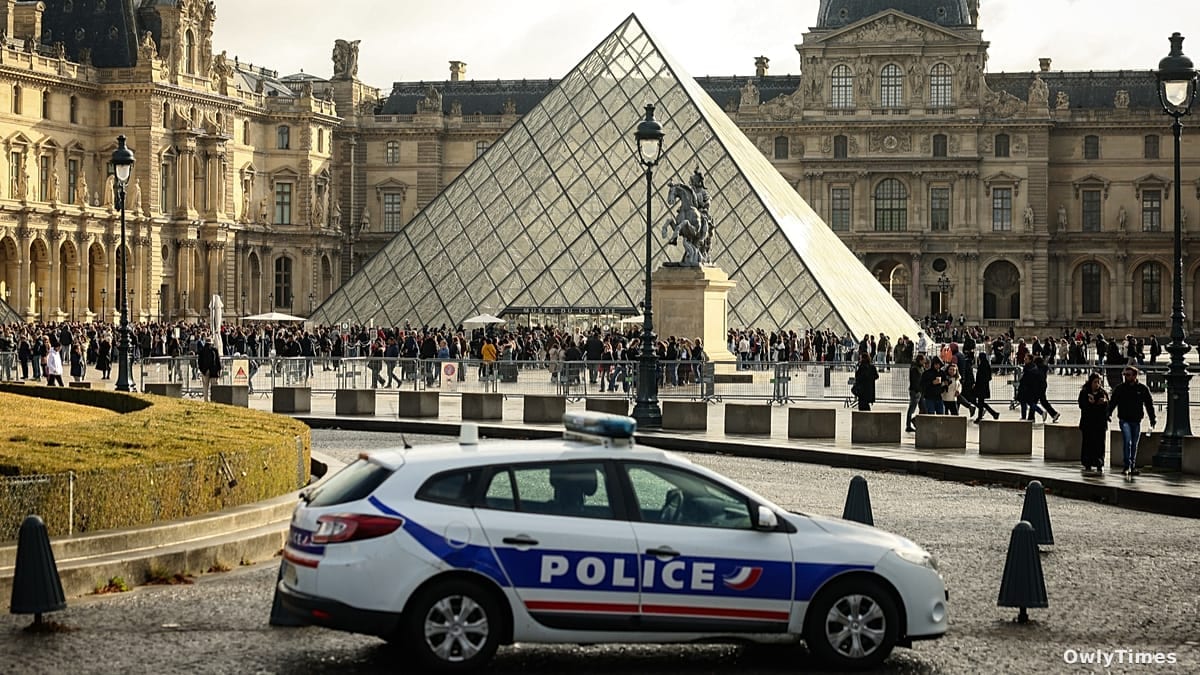

Is it possible that the world’s most sophisticated security systems are actually just paper tigers waiting for the right pair of bolt cutters? The recent revelations regarding the October 19, 2025, heist at the Louvre suggest that when it comes to protecting history’s most priceless treasures, high-tech surveillance is no match for low-tech audacity and a well-placed furniture lift.
The real story here isn't the staggering €88 million valuation of the stolen French crown jewels—it’s the chaotic, almost amateurish nature of the operation that successfully bypassed one of the most protected galleries on Earth. According to Le Monde, whose review of recent interrogation transcripts has been corroborated by The Independent and The Guardian, the two men currently in custody—identified as Abdoulaye N. and Ghelamallah A.—were recruited just days before the event. Their account paints a picture of a criminal enterprise that treated the world's most-visited museum less like a fortress and more like a poorly guarded storefront.
The mechanical reality of the theft was surprisingly blunt. The pair gained access to a first-floor balcony using a disguised boom lift, an approach that seems more suited to a suburban renovation project than a high-stakes museum heist. Once inside the Galerie d'Apollon, they spent roughly eight minutes using power tools to shatter display cases. For the average user, this is a stark reminder that even the most advanced "smart" security infrastructure has a physical blind spot: the glass window. If you can bridge the distance to the exterior, the digital alarms often become secondary to the simple physics of a hammer or a cutter.
There is, however, a notable point of contention regarding the suspects' knowledge of the crime. While Abdoulaye N., a former internet stunt rider, admitted he knew he was targeting the Louvre, Ghelamallah A. claimed he was under the impression they were merely hitting a Parisian jewelry workshop. Whether this is a legitimate misunderstanding or a coordinated legal defense remains to be seen. The Independent notes that Ghelamallah A. suffers from Diogenes syndrome, adding a layer of complexity to his involvement. Meanwhile, The Guardian highlights that the heist’s failure to secure a higher volume of goods—specifically the botched recovery of the crown of Empress Eugénie—left their mysterious "mastermind" unimpressed.
The financial motivation behind this operation was surprisingly pedestrian. The suspects were promised between €15,000 and €25,000 for a haul containing over 8,700 precious stones. Both Euronews and The Guardian report that the duo remains terrified of the mastermind, citing external threats and calls to remain silent while in detention.
We are currently witnessing a classic case of the "last mile" problem in security. You can have the most expensive motion sensors and encrypted locks in the world, but if a human can physically reach your glass, the system is only as strong as its weakest pane. As investigators continue to push for the identity of the organizer, the immediate signal to watch for is whether the silence of Abdoulaye N. and Ghelamallah A. holds, or if the pressure of their upcoming legal proceedings forces them to name the individual who thought their multimillion-euro haul wasn't quite enough.