
The strategic calculus behind the current standoff between the White House and Brussels is no longer merely a friction over trade or defense budgets; it is a fundamental test of whether the European Union can function as a sovereign power when its primary security guarantor abandons the rules-based order. By launching a unilateral war on Iran without a UN mandate or NATO authorization, President Donald Trump has inadvertently forced the EU to pivot from a collection of fragmented nation-states into a coordinated geopolitical bloc. The primary beneficiaries of this shift are the European institutions currently asserting strategic autonomy, while the losers are the populist factions that relied on American backing to disrupt the union from within.
The End of Transatlantic Automaticity
For decades, the transatlantic alliance rested on the assumption of shared strategic objectives. However, since the start of Trump’s second term in 2025, that consensus has shattered across a litany of issues, including tariffs, NATO contributions, Palestinian statehood, and the status of Greenland. The current conflict in Iran serves as a litmus test for this new reality. Because the military operation lacks institutional legitimacy, European leaders have shifted from passive alignment to active non-participation.
The refusal of Spain, Italy, Germany, France, and the United Kingdom to provide direct military support signals a hardening of European resolve. Spain and Italy have gone as far as restricting their bases for US weapon-carrying aircraft, while France maintains a cautious, case-by-case approach to airspace. This is a significant departure from historical precedents where European support for US interventions was often presumed, regardless of the diplomatic process. The EU, representing more than 450 million inhabitants and a GDP rivaling the US or China, is now leveraging its economic weight to act independently of Washington’s bellicosity.
Coordinating a New Strategic Reality
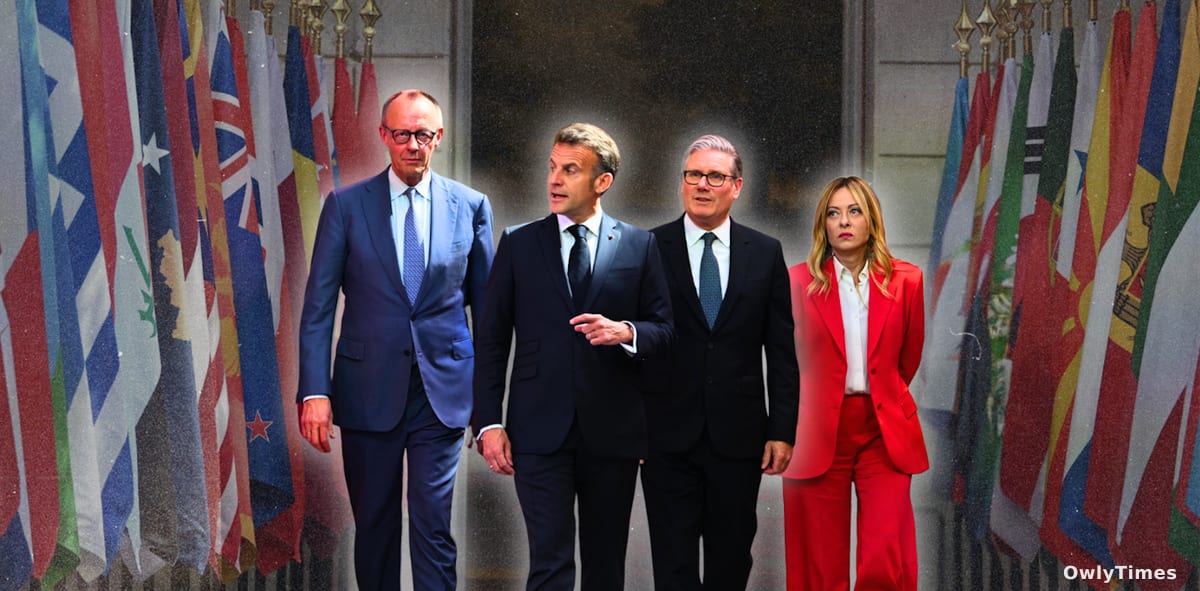
The economic shockwaves emanating from the closure of the Strait of Hormuz have acted as a catalyst for this newfound cohesion. On April 17, in Paris, the coordination moved from abstract policy to concrete action. UK Prime Minister Keir Starmer, French President Emmanuel Macron, German Chancellor Friedrich Merz, and Italian Prime Minister Giorgia Meloni co-presided over a conference on navigation in the Strait of Hormuz. Joined by 49 other nations, the coalition committed to planning a neutral mission to ensure free passage, effectively bypassing US-led command structures.
This unity is not just a reaction to the Middle East; it is an internal realignment. The electoral defeat of Viktor Orbán in Hungary and his replacement by Péter Magyar has removed a critical source of friction. For 16 years, Orbán’s iron-fist rule provided the MAGA movement with a bridgehead into European politics. His removal, combined with the cooling of the relationship between Trump and Meloni, suggests that the internal divisions Trump once exploited to weaken the EU are rapidly eroding.
Sovereignty as a Defense Mechanism
The EU’s response to Washington’s pressure is increasingly mirrored in its domestic policy. The current crisis is forcing the European Commission to accelerate the transition away from fossil fuels, prioritizing electrification through nuclear and renewable sources to mitigate energy insecurity. Furthermore, the rapprochement between leaders like Macron and Polish Prime Minister Donald Tusk—who met on April 20—points toward a more unified stance on Ukraine, a policy area previously paralyzed by internal vetoes.
The political chess move to watch next is the outcome of the mission planning scheduled to begin in London next week. The success or failure of this neutral maritime security framework will determine whether Europe can truly project power independent of the United States. If the EU successfully secures the Strait of Hormuz without US military support, it will confirm that the "new era in Europe" declared by Macron is more than rhetoric—it is the birth of a genuine, autonomous European power.





