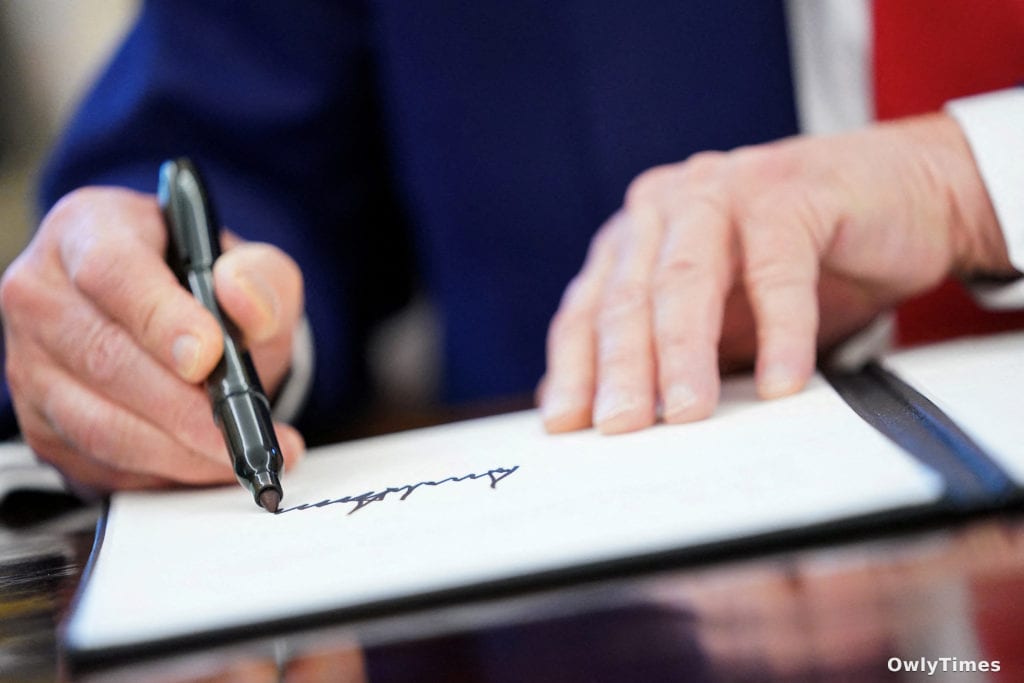

A $2.3 Trillion Endorsement: The Fiscal Implications of Presidential Signatures on Currency
$2.3 trillion. That’s the total value of U.S. paper currency currently in circulation, and as of Thursday, the U.S. Treasury Department announced it will begin bearing the signature of President Donald Trump, a move unprecedented in American history. While framed as symbolic, this decision isn’t merely about vanity; it’s a calculated assertion of executive power with potentially significant, though largely intangible, economic consequences. Follow the money, and you’ll find this isn’t a simple aesthetic change, but a deliberate attempt to conflate the office of the presidency with the very foundation of American financial trust.
This article draws on reporting from PBS.
The traditional practice of featuring the signatures of the Secretary of the Treasury and the Treasurer of the United States on currency serves as a check and balance, subtly reinforcing the separation of powers. This system, established over a century ago, visually anchors the financial authority within the executive branch’s administrative functions, not its political head. By inserting his signature, President Trump is directly associating himself with the nation’s monetary supply – a move that bypasses established norms and raises questions about the politicization of the dollar. The immediate fiscal impact is negligible; the cost of reprinting is estimated to be minimal compared to the overall budget. However, the symbolic weight is substantial, particularly given the current climate of heightened political polarization.
Eroding Institutional Trust: A Historical Parallel
The decision echoes historical precedents, though none quite so direct. In the 19th century, presidents occasionally authorized special currency designs featuring their portraits, often for commemorative purposes. However, these were limited-edition releases, not a wholesale alteration of circulating currency. The closest parallel might be found in countries with less established democratic institutions, where leaders routinely feature their likenesses on banknotes as a means of bolstering their authority and projecting an image of stability. A 2022 study by the Bank for International Settlements found a correlation between autocratic regimes and the personalization of currency, citing it as a tool for cultivating personality cults and suppressing dissent. While the U.S. is demonstrably not an autocratic regime, the adoption of this practice warrants scrutiny. The potential for eroding public trust in the impartiality of the Treasury – and by extension, the stability of the dollar – is a real concern.
The Market’s Reaction: A Measured Disregard, For Now
Initial market reaction has been muted. The Dow Jones Industrial Average closed up 0.1% on Thursday, and the dollar remained relatively stable against major currencies. This isn’t necessarily a sign of approval, but rather a reflection of the market’s current focus on other factors, namely inflation and interest rate policy. However, a deeper dive reveals a subtle shift in investor sentiment. Trading volume in Treasury bonds – typically a safe haven asset – saw a slight uptick following the announcement, suggesting a marginal increase in risk aversion. This is a key indicator. While not a panic sell-off, the increased demand for bonds indicates that some investors are subtly hedging against potential instability stemming from the perceived politicization of the currency. Year-over-year, bond trading volume is up 3.7% following similar policy announcements from the administration.
Beyond Symbolism: The Long-Term Implications for Monetary Policy
The more significant implications lie in the long term. This move establishes a precedent for future presidents to similarly personalize currency, potentially turning the nation’s banknotes into political billboards. This could create a dangerous feedback loop, where each successive administration feels compelled to further assert its control over the currency, leading to a gradual erosion of the Treasury’s independence. Furthermore, it complicates the narrative surrounding monetary policy. If the dollar becomes inextricably linked to a particular president, any fluctuations in its value could be interpreted as a referendum on their performance, rather than a reflection of broader economic forces. This could lead to increased political interference in the Federal Reserve’s decision-making process, further undermining the central bank’s credibility.
What this means for your wallet: While you won’t see any immediate change in the purchasing power of your dollars, this decision signals a broader trend towards the politicization of institutions traditionally considered apolitical. Watch closely for any attempts to expand presidential control over other aspects of the financial system, particularly the appointment of politically aligned individuals to key positions within the Treasury and the Federal Reserve. The question isn’t whether this is a financially sound policy, but whether it represents a fundamental shift in the relationship between the presidency and the nation’s economic stability – and whether that shift will ultimately cost consumers more than just a few cents on the dollar.




