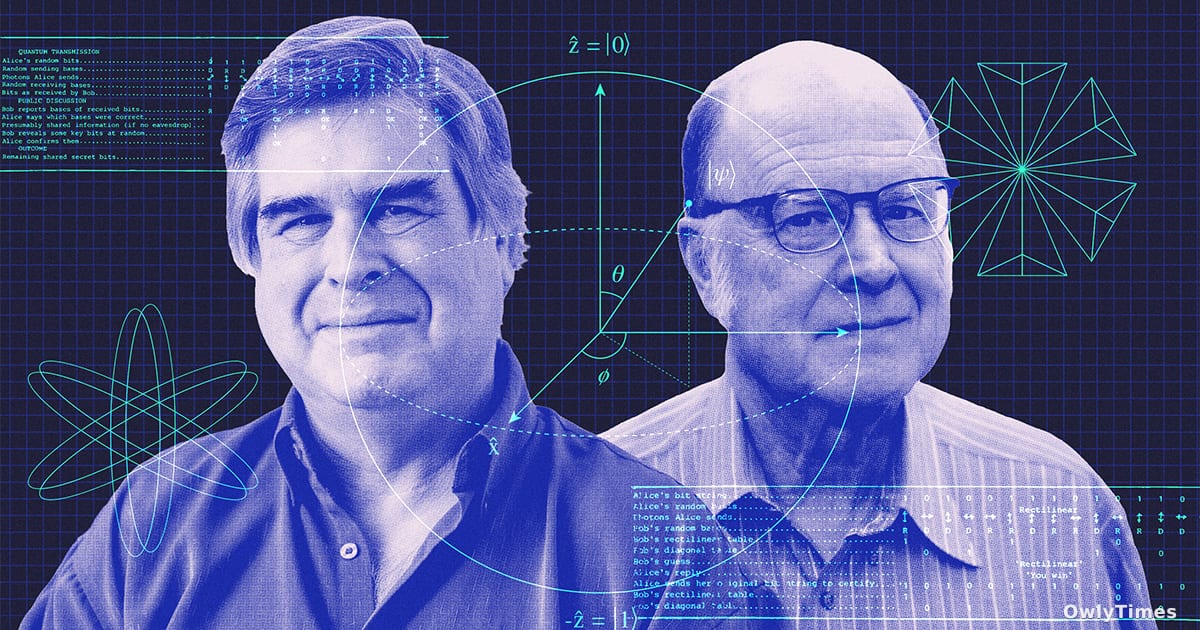

The promise of unbreakable communication isn’t a futuristic fantasy; it’s a legacy taking shape from a chance encounter on a Puerto Rican beach in 1979. This week, Charles Bennett and Gilles Brassard were awarded the A.M. Turing Award, computing’s highest honor, for their foundational work in quantum information science. While headlines tout a $1 million prize and the recognition of a burgeoning field, the story is less about a reward and more about a fundamental shift in how we understand information itself – and how we protect it. Their work didn’t just establish quantum information science; it cultivated a culture of rigorous inquiry within a field initially dismissed as speculative, a nuance often lost in celebratory coverage.
The genesis of this revolution was remarkably serendipitous. Brassard, a young computer scientist already making waves in cryptography, was approached mid-swim by a stranger with a peculiar idea: quantum money – currency impossible to counterfeit thanks to the laws of quantum physics. The stranger was Bennett, a physicist intrigued by the intersection of computation and the seemingly unrelated world of quantum mechanics. This impromptu meeting sparked a collaboration that would redefine secure communication. It’s crucial to understand that the initial idea wasn’t about building computers, but about solving a very practical problem – forgery – using the bizarre properties of the quantum realm. Bennett had been circulating a paper by his friend Stephen Wiesner detailing this quantum money scheme for nearly a decade, but it hadn’t gained traction until this chance encounter.
This article draws on reporting from quantamagazine.org.
The core principle behind their breakthrough lies in quantum measurement disturbance. Unlike classical bits, which can be copied perfectly, quantum bits – or qubits – are fundamentally altered when measured. Wiesner’s original idea exploited this: any attempt to copy a quantum banknote would inevitably disturb it, revealing the forgery. However, the scheme had a critical flaw – only the creator could verify the bill’s authenticity. Brassard recognized this limitation and, within ten minutes of meeting Bennett, proposed a solution: combine quantum principles with cryptography. This led to the development of BB84, a protocol for secure key distribution that allows two parties to establish a shared secret key without the risk of eavesdropping. The beauty of BB84 isn’t just its theoretical security; it’s that any attempt to intercept the key exchange itself introduces detectable errors, alerting the communicating parties to the intrusion.
The impact of Bennett and Brassard’s work extends far beyond secure communication. Their 1993 paper on quantum teleportation, demonstrating the transfer of quantum states between particles, laid the groundwork for future quantum computing and networking technologies. While “teleportation” evokes science fiction, it’s important to clarify that this process transmits information, not matter. This distinction is often blurred in popular accounts, leading to unrealistic expectations about the immediate capabilities of quantum technology. The field truly gained momentum in 1994 with Peter Shor’s algorithm, which demonstrated that a quantum computer could efficiently factor large numbers – a task considered intractable for classical computers and the foundation of many modern encryption methods. Shor’s algorithm wasn’t a threat to BB84, which relies on the laws of physics rather than mathematical assumptions, but it underscored the urgent need for quantum-resistant cryptography.
However, it’s vital to acknowledge the limitations of current quantum technologies. While quantum key distribution has been demonstrated over distances exceeding 1,000 kilometers using satellite links, building practical, large-scale quantum networks remains a significant challenge. Maintaining the delicate quantum states required for these technologies is incredibly difficult, susceptible to noise and environmental interference. Furthermore, the cost and complexity of quantum hardware are currently prohibitive for widespread adoption. The field is also grappling with the question of scalability – can these systems be expanded to handle the demands of real-world applications? Recent research suggests quantum techniques might extend beyond key distribution, offering broader cryptographic applications, but these findings are still preliminary.
The next crucial steps involve refining quantum error correction techniques, developing more robust and affordable quantum hardware, and exploring the full potential of quantum cryptography beyond key distribution. The question now isn’t simply if quantum technologies will revolutionize communication and computation, but how – and how quickly. Specifically, we should watch for advancements in “quantum repeaters,” devices that could overcome the distance limitations of current quantum communication systems. If researchers can successfully build and deploy these repeaters, it would dramatically accelerate the development of a truly secure, global quantum internet. The legacy of Bennett and Brassard isn’t just a solved problem; it’s a continuing invitation to explore the profound implications of a universe governed by the strange and powerful laws of quantum mechanics.