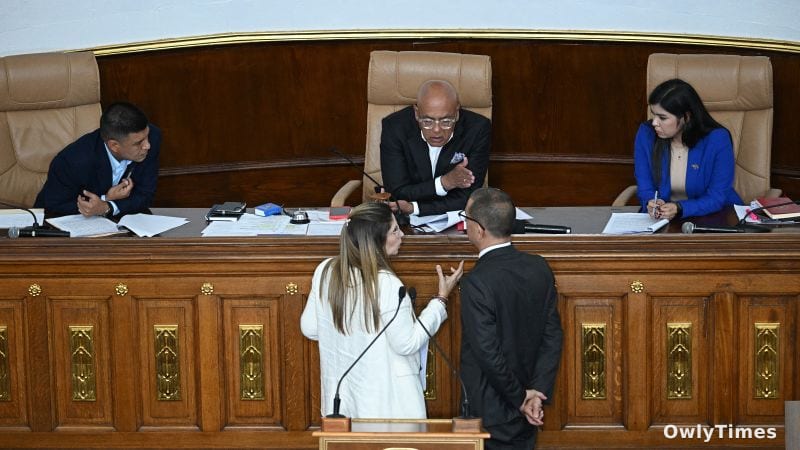

The passage of Venezuela’s amnesty law isn’t a spontaneous gesture of goodwill from Delcy Rodríguez’s acting government; it’s a calculated response to sustained pressure from the United States following the removal of Nicolás Maduro. Washington’s leverage – demonstrated by its direct intervention in regime change – is now being deployed to secure the release of political prisoners and, ostensibly, a transition towards a more stable political environment. This isn’t simply about humanitarian concerns; it’s about consolidating a post-Maduro order favorable to US interests, and the amnesty law is the opening gambit in a complex negotiation.
Who benefits and who loses from this legislation is immediately apparent. The primary beneficiaries are the hundreds, potentially thousands, of opposition figures, activists, journalists, and students detained under 27 years of Chavista rule, beginning with Hugo Chávez’s presidency in 1999. Families, like the one recently reunited with a mother and her infant born in prison, stand to gain immediate relief. However, the carefully constructed exclusions – homicide, drug trafficking, corruption, and crimes against humanity – reveal the limits of this amnesty. This isn’t a blanket pardon; it’s a targeted release designed to address the most visible and internationally condemned cases of political imprisonment, while simultaneously shielding those accused of more serious offenses from accountability. The losers, therefore, are those seeking genuine justice for victims of violence and corruption, and potentially, activists in exile who may be excluded by amendments to the bill.
The historical parallel to consider is the post-Pinochet transition in Chile. While the Chilean amnesty law of 1991 initially offered broad protection to those accused of human rights abuses, it was later amended and challenged, ultimately leading to prosecutions in some cases. The Venezuelan situation differs in that the impetus for amnesty originates not from within the country’s political system, but from external pressure. This external imposition creates a fundamental instability: the law lacks the legitimacy that comes from genuine national reconciliation. The cautious welcome from rights groups like Foro Penal, led by Alfredo Romero, underscores this point – they acknowledge the potential benefits but demand transparency and accountability, recognizing the risk of a superficial solution. Gonzalo Himiob of Foro Penal rightly points out that amnesty isn’t an admission of guilt, but the context in Venezuela suggests it’s a pragmatic concession extracted under duress.
Source material: CNN.
The re-arrest of Juan Pablo Guanipa hours after his initial release, on the grounds of “calling people to the streets,” is a stark illustration of the fragility of this new landscape. Diosdado Cabello’s swift action demonstrates that the underlying power dynamics haven’t fundamentally shifted. The amnesty law may open prison doors, but it doesn’t dismantle the mechanisms of political control. This incident, denounced by Alianza Bravo Pueblo, casts a long shadow over Rodríguez’s assurances of a “door for Venezuela to reunite,” revealing a pattern of conditional liberty and continued repression. The closure of El Helicoide, the notorious detention center, is similarly symbolic. Transforming it into a “center of social, sports, cultural and commercial services” is a superficial attempt to erase the memory of abuse, and critics rightly argue it should be preserved as a memorial.
The current release rate – over 400 according to Foro Penal, lagging behind the government’s claim of over 800 – highlights a critical point: the implementation of the amnesty law will be the true test of its sincerity. María Corina Machado’s skepticism regarding Rodríguez’s commitment to a genuine transition is well-founded. The lack of a public list of released individuals, despite Rodríguez’s offer to allow UN verification, raises concerns about transparency and potential manipulation of the process. The United States will be closely monitoring these releases, not just for the sake of the individuals involved, but as a barometer of the acting government’s willingness to comply with its demands.
The political chess move to watch next isn’t simply whether more prisoners are released, but which prisoners are released, and under what conditions. Specifically, will the government prioritize the release of high-profile political opponents like those targeted during the 2014, 2017, and 2019 protests, or will it continue to selectively apply the amnesty, maintaining control over key figures while offering symbolic concessions? The answer to that question will reveal whether this law is a genuine step towards democratic transition, or merely a tactical maneuver to appease Washington and consolidate power.





