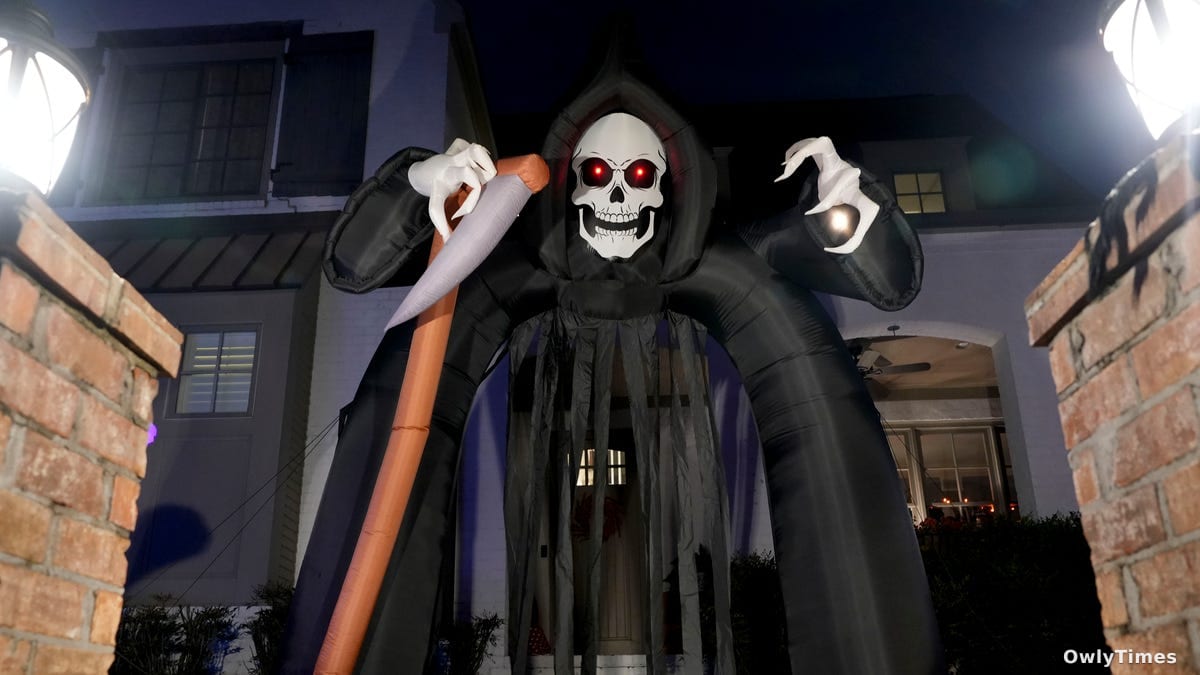

The air smelled like woodsmoke and regret. Not the cozy, autumnal kind, but the lingering scent of something burned, something lost. It was October 2022, and I was standing outside Sloss Furnaces in Birmingham, Alabama, a hulking monument to industry and, for one month each year, expertly crafted terror. Beside me, Anna Maria Della Costa, a colleague and a fearless spirit, was practically vibrating with anticipation. We were there to review haunted houses, a tradition she’d championed, and one that, if I’m honest, always left me clutching her arm a little tighter than strictly professional. It wasn’t the jump scares that got to me, though; it was the realization, standing in the manufactured darkness, that our collective hunger for fear says something profound about where we are, and where we’ve been.
I wrote about fear back in Halloween 2019, digging into why we willingly subject ourselves to experiences designed to make our hearts race. It’s not simply about the adrenaline, the evolutionary advantage of a quickened response to a perceived threat – because nine times out of ten, it is just the wind rustling the brush, not a tiger. But when it is a tiger, we need to be ready. And, crucially, we need a space to practice that readiness. That column came at the tail end of a particularly fraught administration, just before the world began to grapple with a pandemic, and years before we’d fully understand how easily critical thinking could be eroded by misinformation. It feels almost naive now, that focus on the primal, individual fear response. Because what’s become terrifyingly clear is that we’re living in an age where the monsters aren’t lurking in haunted houses, but are manufactured and amplified by forces far more insidious.
Source material: tuscaloosanews.com.
Even as a child, I was a connoisseur of controlled frights. “Twilight Zone” reruns and Saturday Night Creature Features were staples, but only when accompanied by Robbi, the babysitter, because even then I understood the power of shared vulnerability. It wasn’t about bravery, it was about the comfort of a hand to hold. That early fascination with the fantastical, with the possibility of the impossible, culminated in a childhood triumph: single-handedly repelling an alien invasion of Stonebridge Estates, a feat accomplished in a dream filled with purple skies and a crystalline phaser. The details are vivid, a swirling mix of Channel 18’s sci-fi flicks and the dizzying colors of Panama City Beach’s Miracle Strip Amusement Park. But even then, the real fear wasn’t the aliens themselves, it was the cloaked figure in the Haunted Castle’s “Old House,” a suggestion of something lurking beneath the surface.
That’s the core of it, isn’t it? The fear of the unknown, the fear of what’s hidden. And the more we try to control our environment, to rationalize the irrational, the more potent that fear becomes. Stephen Wagner, writing for About.com, suggests fear-driven adrenaline sharpens our senses, while Kenneth Melvin, a University of Alabama professor emeritus of psychology, points to its evolutionary roots in survival. But Bob Halli Jr., dean of UA’s Honors College, cuts to the heart of the matter: fear is often about performance, about the dynamic between people. “The girlfriend might want to be more afraid so she can clutch her guy’s arm; the guy might want to be more macho, play the hero.” But with Anna Maria, it wasn’t about roles. It was about shared experience, a mutual willingness to confront the darkness, even if I was mostly just bracing for impact.
Anna Maria wasn’t seeking a hero; she was seeking a thrill, a visceral connection to something beyond the mundane. She approached life with a relentless curiosity, a willingness to dive headfirst into experiences that most of us would avoid. And that’s what made her loss, earlier this year, so devastating. It wasn’t just the loss of a colleague, but the loss of a vital force, a reminder that even in the midst of manufactured scares, real vulnerability exists. I’ve written tributes for countless people, from local characters like Nick Del Gatto to cultural icons like Johnny Cash and Mr. Rogers, but Anna Maria’s passing hit differently. It was a gut-sick reminder that the things we fear most aren’t always the monsters under the bed, but the fragility of life itself, the inevitability of loss.
We crave the controlled chaos of haunted houses, the jump scares and the fog machines, because they offer a temporary escape from the real anxieties that plague us. But what happens when the real world becomes more terrifying than any haunted house? What happens when the monsters are no longer fictional, but are fueled by misinformation, division, and a collective failure of empathy? The industry, and our culture, are now facing a reckoning. Will the appetite for manufactured fear wane as real-world anxieties escalate? Or will we continue to seek out these spaces of controlled terror, clinging to the illusion of safety in a world that feels increasingly unsafe? The question isn’t whether we’ll be scared, but what we’ll do with that fear. Will we use it to connect, to empathize, to build a more resilient and compassionate world? Or will we let it consume us, driving us further into isolation and division?