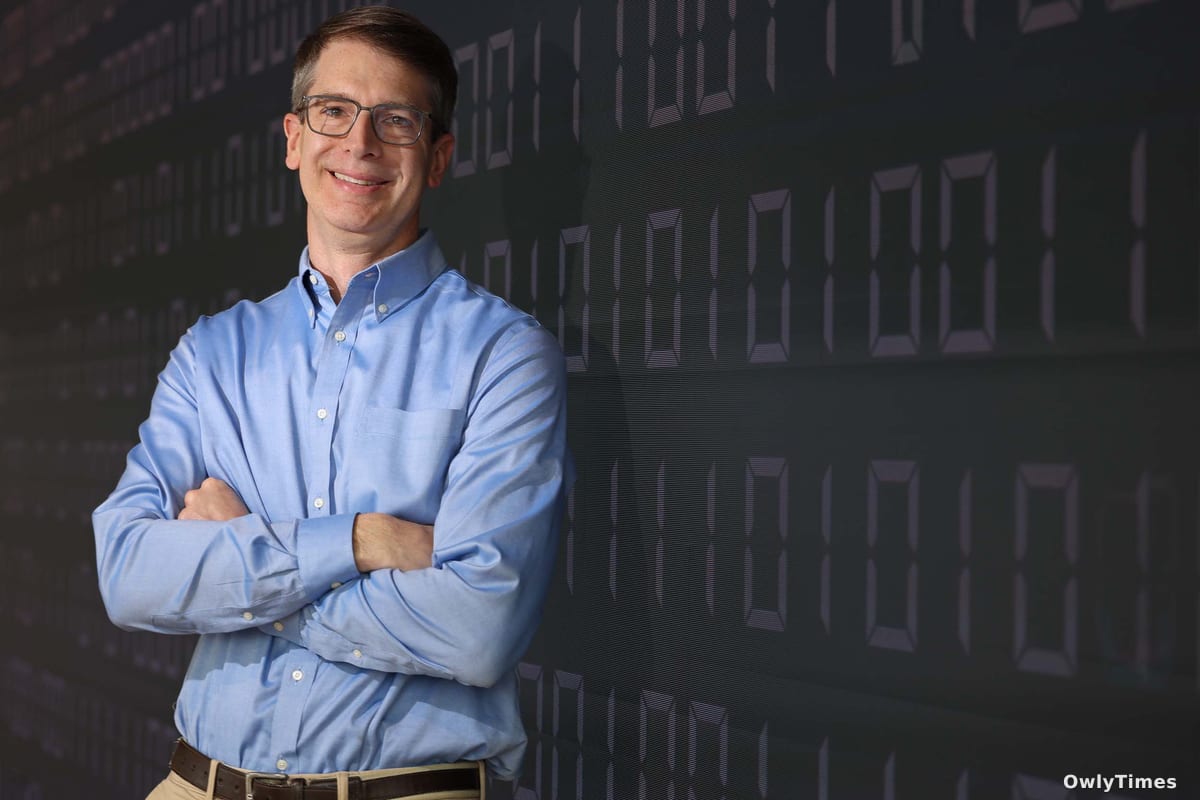

From Pentagon Analyst to Data Science Pioneer: The Unexpected Trajectory of Brian Wright
The current fervor around artificial intelligence often focuses on the technology itself – the algorithms, the processing power, the potential for disruption. Less discussed is the crucial role of educators in shaping not just how we use these tools, but who gets to build them. The story of Brian Wright, now a central figure at the University of Virginia’s School of Data Science, illustrates this point vividly. His path, diverging sharply from a traditional academic ascent, reveals a growing need for diverse perspectives within the field and a deliberate effort to broaden access to data science education. Wright’s journey isn’t simply about one man’s career change; it’s a microcosm of the field’s own evolution, moving from a niche technical discipline to a broadly applicable skillset.
Wright’s background is, as he describes it, “nontraditional.” Graduating with a bachelor’s in economics from the University of Tennessee in 2002, followed by a master’s in public administration in 2005, he initially pursued a career in consulting and numerical analysis for the U.S. Department of Defense and other federal agencies in Washington D.C. This isn’t the typical profile of a data science professor. He wasn’t steeped in computer science from the start; instead, he encountered the burgeoning field of machine learning through practical application. This experience, beginning in the early 2010s, proved pivotal. He returned to the University of Tennessee to pursue a doctorate in higher education, finding himself drawn to the academic environment while simultaneously exploring the potential of these new analytical techniques. This timing is significant – the early 2010s represent a critical period where machine learning transitioned from theoretical possibility to demonstrable capability, and individuals with real-world problem-solving experience were uniquely positioned to capitalize on it.
His expertise quickly became valuable. Recruited back to the University of Tennessee with a major grant tied to his Pentagon work, Wright then moved to George Washington University to build their master’s program in data science. That program’s rapid growth – becoming the university’s fastest-growing graduate degree – underscores the escalating demand for data science skills across industries. However, it was a conversation with the late Philip Bourne, founding dean of UVA’s School of Data Science, that brought Wright to Charlottesville in 2019. Bourne’s vision, Wright explains, was to build a data science school from the ground up, a challenge he likened to “building the plane while we’re flying.” This analogy isn’t hyperbole. Launching a new school within a historic institution like UVA requires navigating established structures while simultaneously forging a new academic identity. Since 2019, Wright has overseen the creation of undergraduate and doctoral programs, the launch of a data science minor (which became UVA’s largest within two years), and the recruitment of over a dozen faculty members.
Based on the original news.virginia.edu report.
What distinguishes Wright’s approach, and the UVA program he’s helped build, is a conscious effort to move beyond the traditional computer science and statistics foundations of data science. This isn’t a rejection of those disciplines, but rather a recognition that data science is inherently interdisciplinary. The program aims to attract students from diverse backgrounds – the humanities, social sciences, and arts – and equip them with the analytical skills needed to address complex problems in their respective fields. This is a crucial shift. Headlines often portray data science as a domain for coding prodigies, potentially excluding talented individuals who might approach data analysis with different strengths and perspectives. Wright’s work suggests a more inclusive model, one that values critical thinking, communication, and ethical considerations alongside technical proficiency. He received UVA’s All-University Teaching Award last year for his work teaching machine learning and a foundational data science course, the sole prerequisite for the major, further demonstrating his commitment to accessible education.
However, it’s important to acknowledge the limitations of even successful initiatives. While UVA’s program is demonstrably growing and attracting a diverse student body, the broader field of data science still faces significant challenges regarding representation. The tech industry, where many data scientists ultimately find employment, remains overwhelmingly male and white. Increasing access to education is only one piece of the puzzle; systemic barriers to entry and retention within the profession must also be addressed. Furthermore, the rapid pace of technological advancement means that curricula must constantly evolve to remain relevant. The skills taught today may be obsolete tomorrow, requiring a commitment to lifelong learning for both students and faculty. Looking ahead, the critical question isn’t simply whether we can train enough data scientists, but whether we can cultivate a generation of data practitioners who are not only technically skilled but also ethically grounded and capable of addressing the complex societal challenges that lie ahead. Will programs like UVA’s, with their emphasis on interdisciplinary thinking and inclusive access, be able to scale and influence the broader field? That’s the experiment we should be watching closely.





