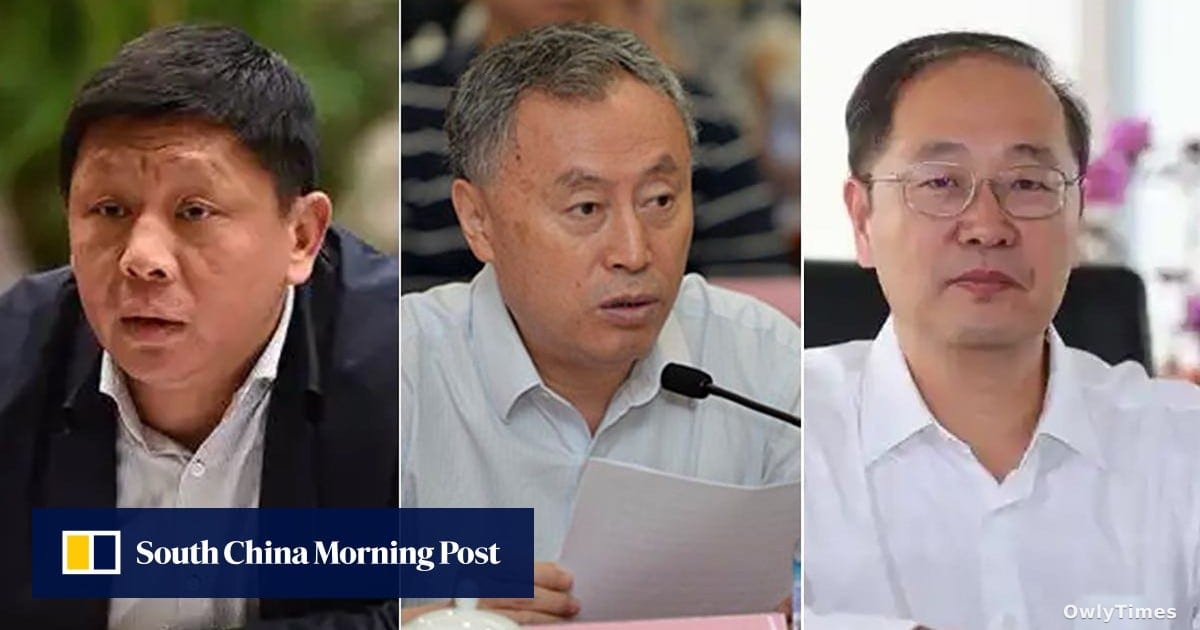

The quiet erasure of prominent scientists from the official record in China isn’t a sign of scientific failure, but a calculated move in a long-running internal power struggle—and a demonstration of control as the nation navigates increasingly complex geopolitical pressures. The removal of Zhao Xiangeng, a nuclear weapons expert, along with Wu Manqing and Wei Yiyin, from the Chinese Academy of Engineering (CAE) website isn’t simply about individual disgrace; it’s about redrawing the lines of influence within the People’s Liberation Army (PLA) and the broader scientific establishment, signaling a potential shift in priorities regarding weapons development and technological advancement. This isn’t an isolated incident, but echoes historical precedents of political purges disguised as institutional housekeeping.
The Calculus of Disappearance
The timing of these removals, noted by Chinese media on Saturday, is critical. While no official explanation has been offered, the CAE’s website is meticulously curated, making the sudden disappearance of three high-ranking academicians highly unusual. Zhao Xiangeng, 72, held a position within the nation’s highest academic body for engineering, suggesting his work was considered strategically vital. The fact that his profile, alongside those of radar specialist Wu Manqing, 60, and missile designer Wei Yiyin, 63, have been scrubbed simultaneously points to a coordinated action, not individual failings. This isn’t a case of correcting minor inaccuracies; it’s a deliberate act of institutional memory editing. The question isn’t if this was politically motivated, but what specific political currents drove it.
Reporting from scmp.com informs this analysis.
Who Benefits and Who Loses in a Scientific Purge?
The immediate losers are, of course, Zhao, Wu, and Wei themselves. Their reputations are damaged, their access to resources curtailed, and their influence within the scientific community effectively neutralized. However, the beneficiaries are less obvious, and more strategically significant. The most likely beneficiaries are factions within the PLA and the Communist Party of China (CPC) seeking to consolidate control over the direction of military technology. China’s military modernization program is not monolithic; competing schools of thought exist regarding the optimal path forward, particularly concerning nuclear doctrine and the development of advanced radar and missile defense systems. Removing figures associated with potentially dissenting viewpoints clears the path for alternative approaches. This also serves as a warning to others within the CAE: loyalty and adherence to the prevailing political line are paramount, even above scientific achievement.
Historical Echoes of Control
China’s history is replete with examples of political purges disguised as campaigns for ideological purity. The Cultural Revolution, launched by Mao Zedong in 1966, saw the systematic persecution of intellectuals and scientists deemed insufficiently revolutionary. While the current situation is far less violent, the underlying principle remains the same: the Party’s control over all aspects of society, including scientific inquiry, is absolute. More recently, the anti-corruption campaigns initiated by Xi Jinping have also been used to eliminate political rivals, often with little regard for due process. The removal of these scientists fits neatly into this pattern – a demonstration of power intended to intimidate potential dissenters and reinforce the Party’s authority. The scale is smaller, but the message is identical: challenge the established order at your peril.
The Implications for China’s Technological Ambitions
China has invested heavily in its scientific and technological capabilities, aiming to become a global leader in fields like artificial intelligence, quantum computing, and aerospace. The CAE plays a crucial role in this effort, providing expertise and guidance to policymakers. Undermining the integrity of the CAE through politically motivated purges risks damaging China’s long-term technological ambitions. While short-term control may be achieved, the chilling effect on innovation and the potential loss of valuable expertise could have significant consequences. The removal of Wu Manqing, a radar specialist, is particularly concerning given the importance of radar technology in modern warfare and the ongoing tensions in the South China Sea. A disruption in this field could weaken China’s defensive capabilities.
The Next Move: Watching for Personnel Shifts
The immediate political chess move to watch isn’t another disappearance from the CAE website, but rather the appointments that follow. Will the positions vacated by Zhao, Wu, and Wei be filled by individuals known for their unwavering loyalty to the Party line, even at the expense of scientific rigor? Or will Xi Jinping attempt to project an image of impartiality by selecting candidates based on merit? The composition of the CAE in the coming months will reveal the true extent of this power play and provide a clearer indication of the direction China’s military technology is heading. The question isn’t whether these removals were a political statement, but whether they represent a fundamental shift in how China balances scientific advancement with political control.





