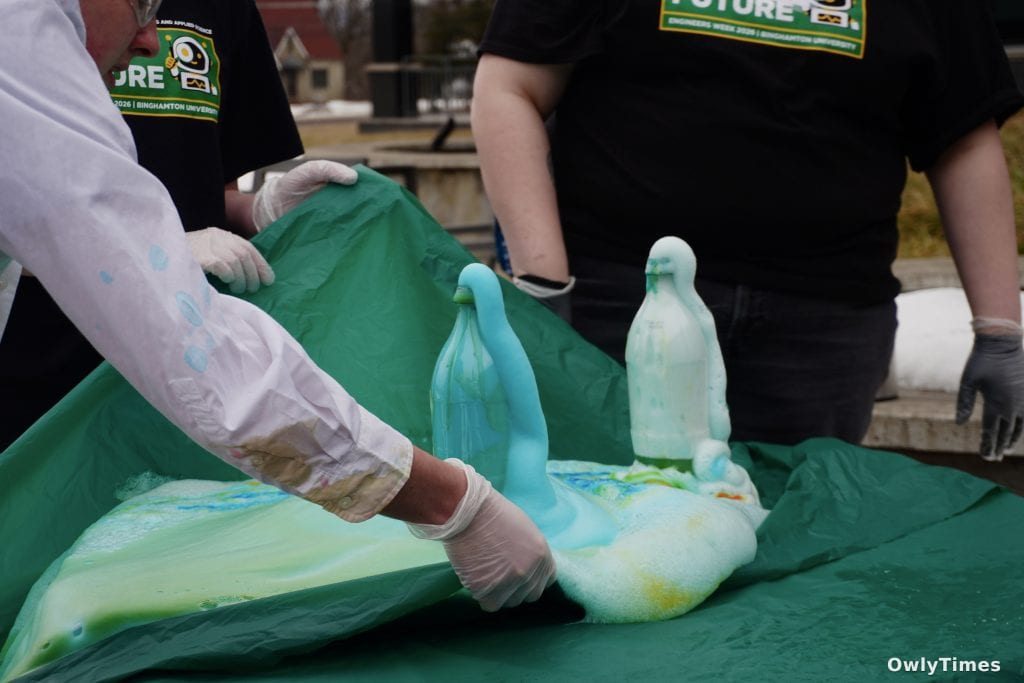

The persistent narrative around STEM education often focuses on filling future job quotas – a pipeline problem for tech companies and defense contractors. But last Saturday’s Community Day at the Thomas J. Watson College of Engineering and Applied Science at Binghamton University revealed a more fundamental, and arguably more important, purpose: igniting genuine curiosity in young minds. While headlines might tout the event as a recruitment tool, the real story lies in the observed enthusiasm of children engaging with complex concepts, and the recognition from students and educators that early exposure is transformative, regardless of eventual career path. More than 400 children and their families participated in the event, a kickoff to National Engineers Week, filling the Innovative Technologies Complex with the buzz of experimentation.
Beyond the Pipeline: Cultivating Early Curiosity
The event, held in two sessions on Saturday, wasn’t a lecture series or a passive science fair. Attendees actively built, tested, and problem-solved. Activities ranged from the classic egg-drop challenge – hosted by the University’s chapter of Pi Tau Sigma, a mechanical engineering honor society – to constructing miniature houses designed to withstand simulated flash floods, a direct nod to the increasing relevance of climate resilience in engineering design. This hands-on approach is crucial, according to McKenzie Viersma, chairperson of the Watson Combat Robotics League and a senior majoring in mechanical engineering. “I was never really exposed to stuff like this as a kid and I kind of had to figure it out as I got to college and grew up,” she explained. Viersma’s experience highlights a systemic inequity: access to early STEM experiences isn’t universal, and those who lack it may arrive at higher education feeling unprepared or discouraged. The Community Day actively attempts to address this gap.
See the original bupipedream.com story for the full account.
Rover Design and Unexpected Sophistication
The presence of Binghamton University’s Rover Team offered a glimpse into the advanced projects students are already undertaking. The team, which competes annually in the University Rover Challenge hosted by the Mars Society, demonstrated the complexities of designing a robotic machine for extraterrestrial exploration. What was particularly striking, according to team chief engineer Matthew Stancampiano, a senior majoring in mechanical engineering, was the level of engagement from the younger attendees. “There’s a lot of kids that are asking way more advanced questions than I would have been asking at their age,” he noted. This isn’t simply precociousness; it suggests a growing awareness of space exploration and robotics fueled by media coverage and accessible educational resources. The Rover Team’s participation wasn’t about inspiring future rover engineers, but about validating the existing curiosity of a generation already captivated by these fields.
A Collaborative Ecosystem of STEM Outreach
The success of Community Day wasn’t solely a University effort. Sponsorship from local organizations like the Roberson Museum and Science Center, alongside larger businesses such as BAE Systems and IBM, demonstrates a broader commitment to STEM outreach within the community. Amy Marcho, education director at the Roberson Museum, emphasized the importance of accessible learning opportunities, stating that the event reinforced the need to “create accessible learning opportunities that encourage exploration, build confidence, and help students see themselves as capable thinkers and innovators.” This collaborative model is significant. While corporate sponsorship often raises questions about influence, in this case, it appears to be genuinely aligned with fostering a broader interest in STEM, rather than solely targeting future employees. The event’s funding structure, however, remains largely opaque, and future reporting should investigate the specific terms of these sponsorships.
Looking Ahead: Measuring Long-Term Impact
Dean Atul Kelkar of the Watson College framed the event’s theme as ‘Transform Your Future,’ and while inspiring a love for science is undoubtedly valuable, the true measure of success won’t be immediate enrollment numbers in engineering programs. The critical question is whether these early experiences translate into sustained interest and confidence in STEM fields throughout a child’s education. Future research should focus on tracking the academic trajectories of participants – not to assess whether they become engineers, but to determine if their engagement with STEM at a young age correlates with increased participation in science and math courses in middle and high school, and a greater sense of self-efficacy in these subjects. Will these students, years from now, be more likely to approach complex problems with a sense of agency and innovation, regardless of their chosen profession? That’s the transformation worth measuring.