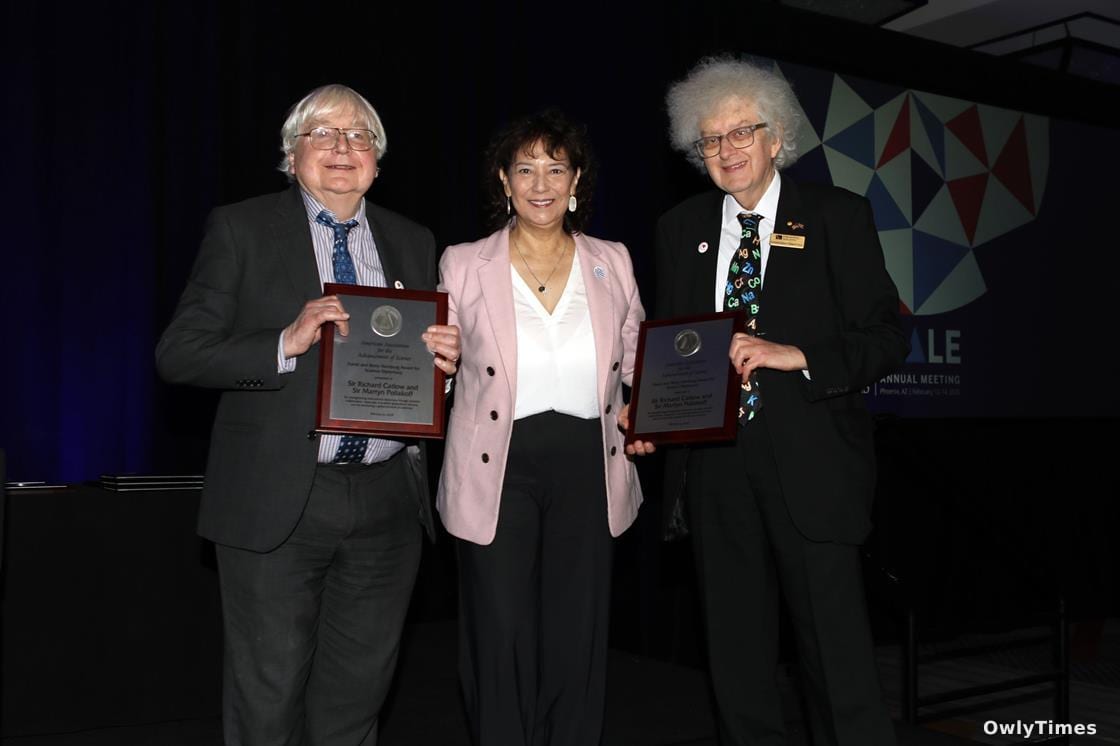

The pursuit of scientific advancement isn’t conducted in a vacuum. Increasingly, the most pressing questions facing humanity – climate change, resource scarcity, global health – demand collaborative solutions that transcend geopolitical boundaries. This isn’t merely a matter of goodwill; it’s a pragmatic necessity. The recent recognition of Martyn Poliakoff and Richard Catlow with the American Association for the Advancement of Science’s (AAAS) David and Betty Hamburg Award for Science Diplomacy underscores this point, but the story behind the award reveals a more nuanced reality than headlines suggest. While widely reported as a celebration of successful international scientific partnerships, a closer look at their work, and the current global landscape, highlights both the enduring power and the escalating fragility of science as a diplomatic tool.
Poliakoff, a chemist at the University of Nottingham perhaps best known for his engaging “Periodic Table of Videos” YouTube series, and Catlow, from University College London and Cardiff University, were honored for their consecutive tenures as foreign secretary of the Royal Society – a period spanning 2011 to 2021. During this time, they facilitated collaborations ranging from joint research projects between scientists in North Korea, Britain, and the US, to capacity-building initiatives in sub-Saharan Africa and support for early-career researchers in countries like China, Cuba, and Ukraine. These achievements are significant, but the award’s timing feels particularly poignant given the current state of international relations. As Catlow himself noted at the AAAS annual meeting in Phoenix, Arizona, “It has become much more difficult than it used to be, but it is more important than ever.” He draws a stark contrast to the Cold War era, stating, “During the Cold War we were able to have quite good scientific relations with Russia, but we cannot any longer. The Cold War was a ‘cold’ war, and now we have a ‘hot’ war.” This isn’t simply nostalgia for a bygone era; it’s a recognition that the conditions enabling scientific exchange are actively eroding.
The award acknowledges a specific model of science diplomacy – one where established scientific societies like the Royal Society act as neutral conveners, fostering relationships that might be impossible through formal diplomatic channels. Poliakoff emphasized the advantage of representing “all UK science” during his time as foreign secretary, allowing for a broader appeal than advocating solely for chemistry. This approach proved effective in navigating complex political landscapes, but it relies on a degree of trust and mutual respect that is increasingly scarce. The success of these initiatives wasn’t solely about overcoming political hurdles; it was also about recognizing the inherent value of scientific exchange. Catlow’s research, focused on computational materials chemistry and its applications in renewable energy and catalysis, exemplifies this. Similarly, Poliakoff’s early work in “green chemistry,” particularly utilizing supercritical fluids and flow chemistry, demonstrates a commitment to sustainability that underpins much of their diplomatic work.
This article draws on reporting from chemistryworld.com.
However, the narrative of unbridled success needs tempering. While international collaborations flourished under their leadership, both scientists acknowledge current challenges within the UK and the US. Catlow described the US scientific community as being “in a state of shock” and “struggling to cope” with what he characterized as a hostile attitude towards scientific facts from the current administration. Simultaneously, the UK faces its own internal pressures. Poliakoff pointed to consistently flat budgets for chemistry departments, threatening the future of chemistry education and the pipeline of skilled graduates needed for the chemical industry. This internal strain complicates the UK’s ability to project soft power through science diplomacy. The impact of Brexit is also acutely felt, with EU student numbers plummeting due to increased visa costs and tuition fees – a trend Catlow directly attributes to a loss of “absolutely first-rate PhD students” from European countries. The financial burden placed on international researchers seeking to work in the UK is, in his view, “completely unjustified” and actively detrimental to attracting global talent.
Beyond the immediate political and economic headwinds, a deeper, systemic challenge looms: the sheer scale of global problems. Poliakoff highlighted the exponential growth of the global population – a threefold increase during his and Catlow’s careers – and the unsustainable resource demands that accompany it. He and colleagues have even proposed a “Moore’s law for chemistry,” aiming to halve the amount of starting materials and chemicals needed for production every five years, a testament to the urgency of finding more sustainable practices. This drive for sustainability is exemplified by initiatives like Great British Chemicals, a UKRI-funded project aiming to “defossilise” the UK chemical industry, and the UK Catalysis Hub, focused on net-zero technologies. These efforts are crucial, but they also underscore the limitations of incremental progress in the face of accelerating environmental crises.
Looking ahead, the next steps in this field aren’t simply about forging more international partnerships, but about fundamentally rethinking how those partnerships are structured. Poliakoff advocates for establishing a network of African scientists empowered to identify their own challenges and seek targeted expertise from around the world, rather than imposing solutions from outside. This emphasis on local ownership and capacity-building is critical. Equally important is recognizing and valuing the contributions of scientific technicians, as both Poliakoff and Catlow demonstrated by proudly wearing “I ❤️ Technicians” badges at the AAAS meeting. But perhaps the most pressing question is this: as geopolitical tensions continue to rise and funding for science remains precarious, how can we ensure that the pursuit of knowledge remains a bridge, rather than another casualty, of a fractured world? Will future generations of scientists have the same opportunities for international collaboration, or will the current erosion of trust and resources irrevocably alter the landscape of science diplomacy?





