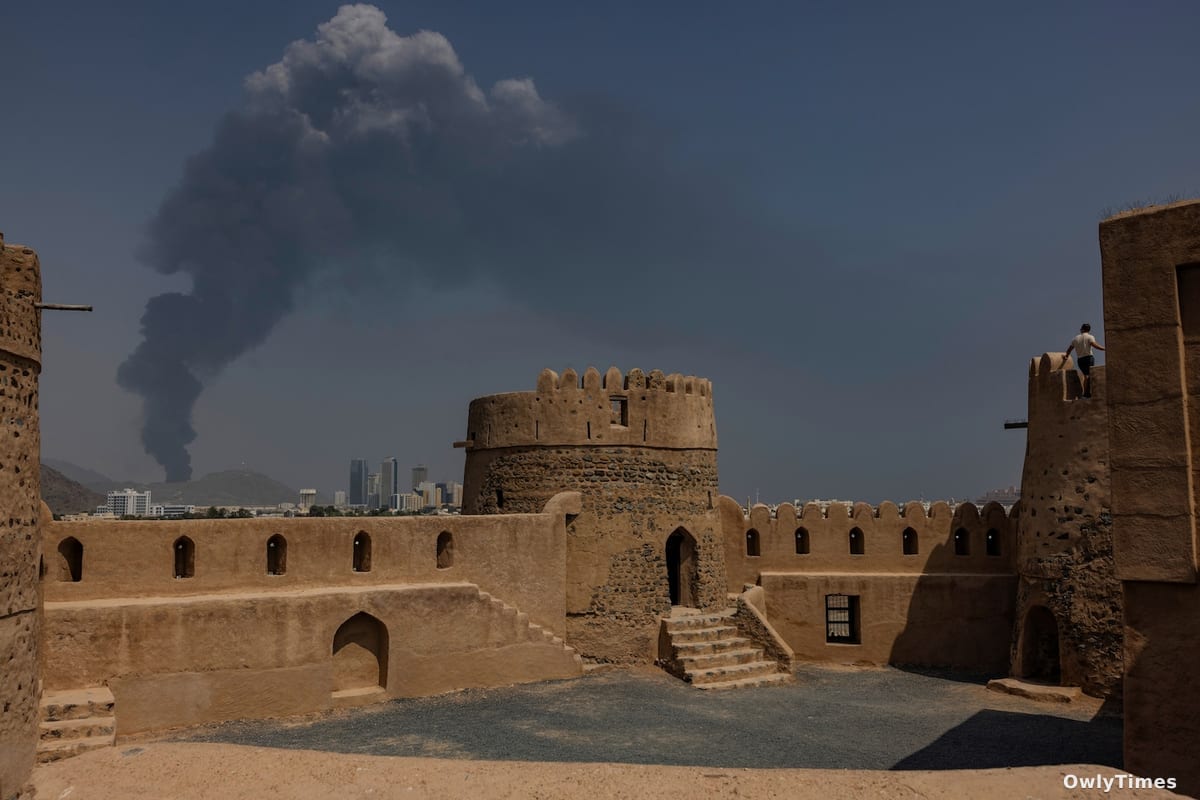

Are we sleepwalking into a world where “safe” is simply a historical concept? The images coming out of Fujairah – smoke billowing from an oil facility struck by Iranian drone debris – aren’t just about escalating tensions in the Middle East. They’re a stark illustration of a fundamental shift in the nature of conflict, and a chilling preview of what everyday security will look like for everyone, everywhere. The real story here isn’t Iran’s aggression – it’s the erosion of the physical sanctuary, the dissolving of the line between warzone and homefront, thanks to the proliferation of drone technology.
Nolan Peterson, a former U.S. Air Force pilot and now a senior fellow at the Atlantic Council, frames this shift with a personal anecdote. He recalls the feeling of relative safety returning to base after missions in Iraq and Afghanistan. A Subway sandwich, a plywood hut for a movie night – these were the markers of a secure environment, a respite from the dangers of active combat. That sense of separation, that ability to leave the war behind, is rapidly disappearing. Peterson’s experience isn’t nostalgia; it’s a lament for a disappearing baseline of security that most of us have always taken for granted. The assumption that home is inherently safer than a battlefield is now demonstrably false.
The Democratization of Asymmetric Warfare
The problem isn’t just drones themselves, but their accessibility. For decades, projecting power required massive investment in aircraft carriers, fighter jets, and complex logistical networks. Now, a relatively small actor – a nation-state like Iran, or even a well-funded non-state group – can inflict significant damage with a swarm of comparatively inexpensive drones. This isn’t about matching the U.S. military’s capabilities; it’s about circumventing them entirely. In 2025, the estimated cost of a sophisticated military drone ranged from $2 million to $20 million. By early 2026, commercially available drones, easily modified for military purposes, can be acquired for under $5,000. That price difference isn’t just a matter of economics; it’s a fundamental power shift.
See the original The Washington Post story for the full account.
This “democratization” of asymmetric warfare has profound implications for civilian infrastructure. The attack in Fujairah wasn’t a precision strike on a military target. It was a demonstration of the ability to disrupt a critical energy hub, sending shockwaves through global markets and, more importantly, instilling fear. Consider the vulnerability of power grids, water treatment plants, or even major sporting events. These aren’t hypothetical targets; they’re increasingly within reach of actors willing to exploit the weaknesses created by this new technology. The fact that intercepted drones still caused damage highlights a critical flaw: even robust defense systems aren’t foolproof.
Beyond the Battlefield: The Everyday Impact
The conversation around drones often remains fixated on military applications and geopolitical strategy. But the real impact will be felt by ordinary people, in ways that are far more insidious than a single attack on an oil facility. Think about the implications for insurance rates. As the risk of drone-related damage increases, premiums for property and liability insurance will inevitably rise. Consider the potential for disruption to supply chains. A coordinated drone attack on a major port could cripple the flow of goods, leading to shortages and price increases.
And then there’s the psychological toll. The constant awareness of potential aerial threats will create a climate of anxiety and distrust. The skies, once a symbol of freedom and possibility, will become a source of apprehension. This isn’t alarmism; it’s a logical consequence of a world where anyone with a few thousand dollars and a willingness to take risks can potentially weaponize the airspace above our heads. The FAA reported a 67% increase in unauthorized drone flights between 2023 and 2025, a trend that foreshadows the challenges of maintaining airspace security.
The Illusion of Control and the Limits of Defense
The current response to the drone threat largely revolves around developing counter-drone technology – lasers, jamming systems, and kinetic interceptors. While these technologies are undoubtedly important, they represent a reactive approach to a fundamentally proactive problem. They’re essentially an arms race, with attackers constantly finding new ways to circumvent defenses. The focus on technological solutions also distracts from the underlying issue: the lack of clear international norms and regulations governing the use of drones.
The international community has been slow to address this gap, hampered by political divisions and competing interests. Existing treaties governing aerial warfare were designed for a world of manned aircraft, not swarms of autonomous drones. The absence of a clear legal framework creates a permissive environment for malicious actors, emboldening them to push the boundaries of acceptable behavior. The fact that Iran felt comfortable launching drones into a neighboring country, despite the potential for escalation, speaks volumes about the current state of affairs.
What Comes Next: The Rise of "Preemptive Security"
We’re entering an era of “preemptive security,” where the focus shifts from responding to threats to anticipating and preventing them. This will involve a significant expansion of surveillance capabilities, both physical and digital. Expect to see more sophisticated sensor networks deployed in urban areas, coupled with advanced data analytics to identify potential drone threats. This, of course, raises serious privacy concerns. The trade-off between security and liberty will become increasingly fraught, forcing us to confront difficult questions about the kind of society we want to live in.
But the most significant change will be a fundamental recalibration of our expectations about safety. The illusion of a secure perimeter is shattered. The next major incident won’t be if but when – and it won’t be limited to the Middle East. Watch for a surge in demand for “drone shelters” – reinforced structures designed to protect against aerial attacks – initially marketed to high-net-worth individuals, but eventually becoming a mainstream feature of new construction. That’s when we’ll truly understand that the world has changed, and that the age of effortless security is over.