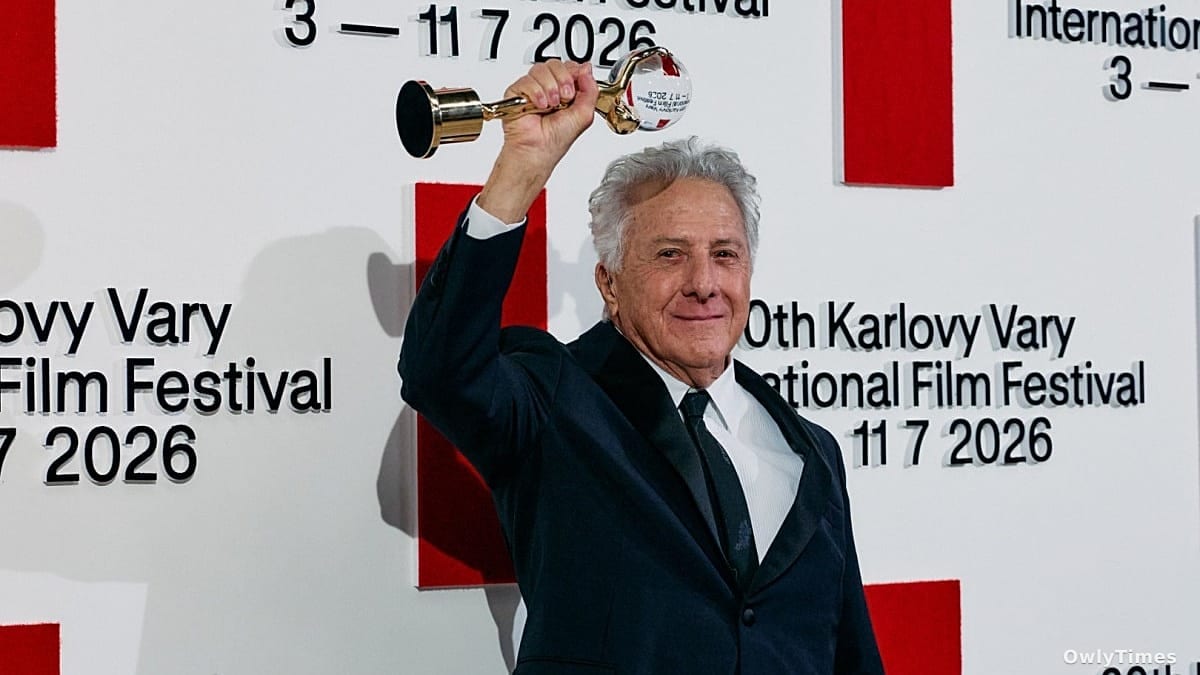

The Grand Hall of the Hotel Thermal erupted into a thunderous standing ovation this weekend, as a legendary face of American cinema took the stage in the Czech Republic. Dustin Hoffman, the man whose career was launched by a whispered "plastics," found himself at the center of the 60th edition of the Karlovy Vary International Film Festival, an event currently celebrating its 80th anniversary. While the festival is famous for its "Art Nouveau cakes" and the dedicated "backpackers" who sleep in tents to catch as many of the 200 scheduled films as possible, the focus shifted sharply from the red carpet to the turbulent state of the modern world when Hoffman addressed his audience on Saturday.
According to The Hollywood Reporter, Hoffman’s appearance came just one day after he was presented with the Crystal Globe for Outstanding Artistic Contribution to World Cinema at the festival's opening ceremony. The actor was present to introduce a special screening of his 1967 breakout hit, The Graduate. When prompted by festival artistic director Karel Och to discuss how that iconic film resonates with today’s twenty-somethings, Hoffman drew a stark, somber parallel between the 1960s and the present day.
"It’s actually the same," Hoffman told the crowd, as reported by Variety. He argued that the novella by Charles Webb, written in 1964, captured a pre-Vietnam tension that mirrors current political polarization. Hoffman posited that the parents depicted in The Graduate—traumatized by the Great Depression—prioritized material wealth over emotional connection, creating a generation "given objects" rather than love. He suggested that this historical cycle of societal fracture and internal identity crisis remains a universal, recurring struggle.
Beyond the cultural commentary, the festival itself is navigating a pivotal era. As Euronews notes, the event has evolved from its origins as the only Category A festival in the Eastern Bloc—forced to alternate with Moscow during the Cold War—into a powerhouse funded by a unique financial model. Unlike many peer institutions, roughly 70 percent of the festival's €10 million budget comes from private sponsors, a legacy of the late festival president Jiří Bartoška, who once signed a personal promissory note to keep the event alive after the fall of communism.
The star power currently descending on the spa town is significant. While Hoffman was the primary draw for the weekend, Euronews and The Hollywood Reporter confirm that Maggie Gyllenhaal and Jesse Eisenberg also received honors, with Juliette Binoche, Jeffrey Wright, Harvey Keitel, Kevin Bacon, and Kyra Sedgwick among those slated to appear throughout the week. For Hoffman, the reflection on his own life was equally candid; he admitted that landing his most pivotal role was purely an "accident" of timing, noting that had he auditioned two years earlier, he would have been passed over.
As the festival continues through July 11, the event stands as a testament to the resilience of independent cinema in an era of global volatility. By maintaining a pricing model where tickets cost less than 3 Euros, the organizers ensure that the "backpackers" and film students remain the heartbeat of the event, preventing the "dilution" of the festival experience that Bartoška once feared. Whether the films on display offer a mirror to our current "divided" reality or a temporary escape, the high turnout suggests that the appetite for shared, in-person storytelling remains as strong as it was in 1967.