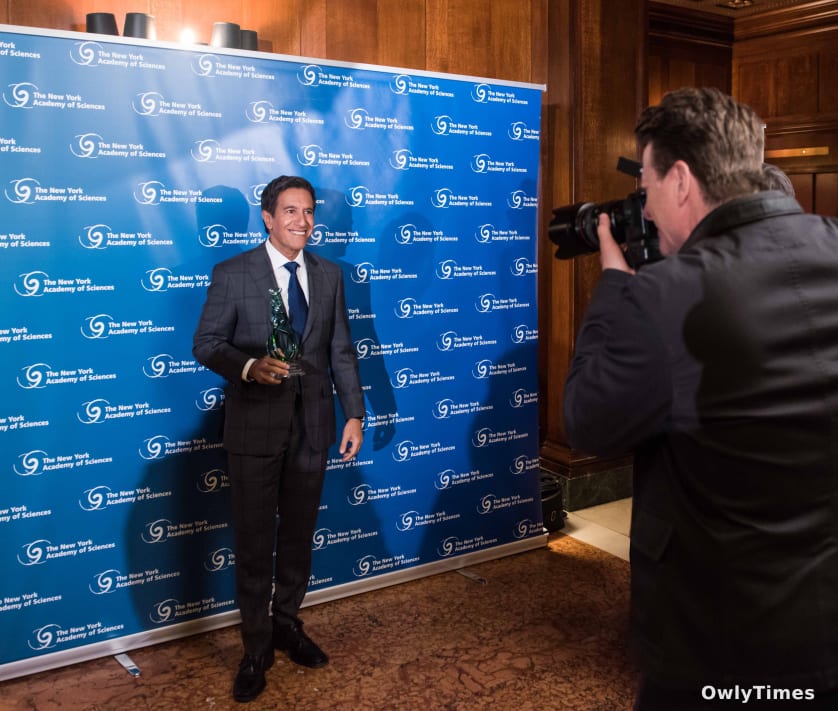

In an era defined by rapid-fire digital cycles and deep-seated public skepticism, the mechanism by which we translate technical data into actionable knowledge has become a critical public health infrastructure. It is no longer enough for research to exist in a vacuum; it must be interpreted for a public that is increasingly detached from the scientific process. This challenge serves as the backdrop for the New York Academy of Sciences’ recent recognition of Sanjay Gupta, MD, who was honored with the organization’s 2026 Science Communicator Award.
The accolade, presented during the second annual Spring Soirée on April 21, 2026, at the University Club in New York City, highlights the growing importance of "translational" communication. While headlines often focus on the prestige of such awards, the substantive question at play is how a practicing clinician successfully bridges the divide between the laboratory and the living room. For Dr. Gupta, who has maintained a dual career as a CNN medical correspondent since 2001 and a neurosurgeon at Emory University Hospital, the methodology is rooted in a specific, empathetic framework provided by his wife, Rebecca Gupta.
The study of effective communication often centers on the "deficit model"—the assumption that the public lacks information and simply needs more of it. However, Dr. Gupta’s approach suggests that the barrier is not a lack of data, but a lack of connection. During his acceptance remarks, he noted that his most significant professional evolution occurred when he began to treat the camera lens as a patient. By reframing the broadcast as an act of bedside care rather than a lecture, he has managed to maintain a consistent audience presence across volatile reporting environments, from the 2004 tsunamis in Sri Lanka to the 2014 Ebola outbreak in West Africa.
While the award celebrates his career, it also underscores a sobering statistic: approximately 80 percent of Americans cannot name a single living scientist. This gap between the scientific community and the public consciousness is where the tension identified by Dr. Gupta resides. He argues that science communication cannot be treated as an elective secondary step once the research is finished; it must be integrated into the scientific process itself to be effective. This perspective is informed by his own background, particularly his mother, Damyanti, who in the 1960s became the first woman hired as an engineer at the Ford Motor Co.
There are limitations to considering this model of communication as a panacea for public skepticism. High-profile science communication often relies on individual personalities, which can inadvertently create a dependency on specific figures to validate scientific consensus. When the messenger becomes the primary vehicle for trust, the message itself may become vulnerable to the same partisanship that currently affects other institutional pillars. Furthermore, the "lab-to-living-room" approach requires a level of access to media platforms that is not available to the vast majority of researchers working in academia today.
Moving forward, the effectiveness of this communication strategy will be measured by its ability to withstand the ongoing polarization of public health discourse. The next readings on public trust in scientific institutions, as tracked by national longitudinal surveys, will provide a barometer for whether this shift toward empathetic, narrative-driven reporting is successfully mitigating the rise of misinformation. As the New York Academy of Sciences continues its fundraising efforts, the focus remains on whether the broader scientific community can adopt these communication techniques to bridge the widening gap between technical expertise and the public it serves.