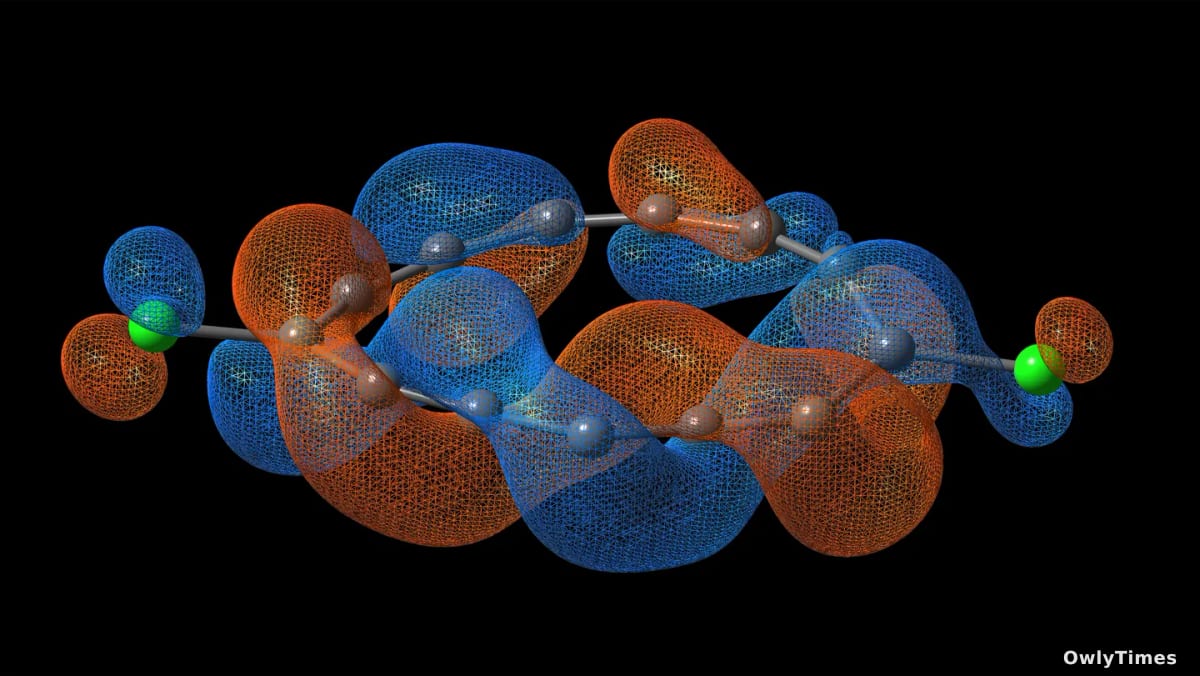

The pursuit of novel molecular structures isn’t simply an academic exercise; it’s a foundational quest in materials science, with implications for everything from drug design to advanced computing. For decades, chemists have been captivated by the Möbius strip – a surface with only one side and one boundary – and its potential to inspire new molecular geometries. But the recent creation of “half-Möbius” molecules, reported March 5th in Science, represents a departure from this established line of inquiry, revealing a previously unconsidered level of topological complexity and challenging our understanding of how electrons behave within these structures. This isn’t about building a better Möbius strip; it’s about discovering a fundamentally new way molecules can be shaped, and the unexpected properties that arise from that shape.
The concept of a Möbius strip, easily demonstrated by twisting a loop of paper 180 degrees before joining the ends, has intrigued scientists since the 1960s. Researchers have successfully synthesized molecules exhibiting full Möbius topology, where electrons travel a continuous path around the loop without crossing an edge. However, the team led by researchers at IBM Research and the University of Manchester has now demonstrated a molecule with a 90-degree twist – half the twist of a traditional Möbius strip. This means an electron must traverse four complete circuits to return to its starting point, a behavior previously unobserved in molecular structures. Igor Rončević, a chemist at the University of Manchester, succinctly captures the surprise: “No one really thought that this sort of thing could exist.”
The molecules themselves are relatively simple, constructed from a 13-carbon ring with two chlorine atoms attached. It’s the strategic placement of these chlorine atoms that imparts the crucial twist, forcing the molecule into this unique half-Möbius configuration. Crucially, this wasn’t a theoretical prediction alone. The team employed a combination of advanced techniques – atomic force microscopy, scanning tunneling microscopy, and, notably, quantum computing – to not only visualize the molecule’s structure but also to map the wave function of electrons within it. A wave function, a core concept in quantum mechanics, describes the probability of finding an electron in a specific location. The visualizations revealed that electrons in the half-Möbius molecule are constrained to move along this twisted path, a direct consequence of the molecule’s topology.
It’s important to clarify what this study actually found versus how it’s being portrayed. Headlines proclaiming a “half-Möbius strip molecule” are technically accurate, but potentially misleading. The molecule isn’t a macroscopic strip like the paper demonstration; it’s a three-dimensional arrangement of atoms exhibiting a specific topological property. Furthermore, the researchers demonstrated the ability to manipulate this topology. By introducing energy into the system, they could reversibly switch the molecule between the half-Möbius configuration and a non-twisted state. This dynamic control over molecular topology is a significant achievement, hinting at potential applications in molecular electronics or responsive materials.
Source material: sciencenews.org.
However, several limitations to consider temper immediate excitement. The synthesis of these molecules is currently complex and yields are low. Scaling up production for practical applications remains a significant hurdle. Moreover, the potential applications are, as Rončević acknowledges, “distant and unclear.” While the altered electron pathways suggest possibilities for novel electronic properties, these have yet to be fully explored. The current research primarily establishes the possibility of half-Möbius molecules, rather than demonstrating a specific, tangible benefit. The team also focused on a single molecule; the behavior of more complex systems incorporating this topology remains unknown.
The next crucial step involves investigating how this half-Möbius topology influences the molecule’s reactivity and its interactions with other molecules. Will these molecules exhibit enhanced catalytic activity? Could they serve as building blocks for new types of polymers with unique properties? Perhaps most intriguingly, researchers will need to explore whether this principle of “partial twisting” can be extended to even more complex molecular architectures. The question now isn’t simply if we can create these structures, but what will happen when we begin to integrate them into functional materials. Watch for research in the coming years focused on incorporating half-Möbius structures into organic semiconductors – if the altered electron pathways translate to improved charge transport, it could signal a major advance in the development of more efficient electronic devices.