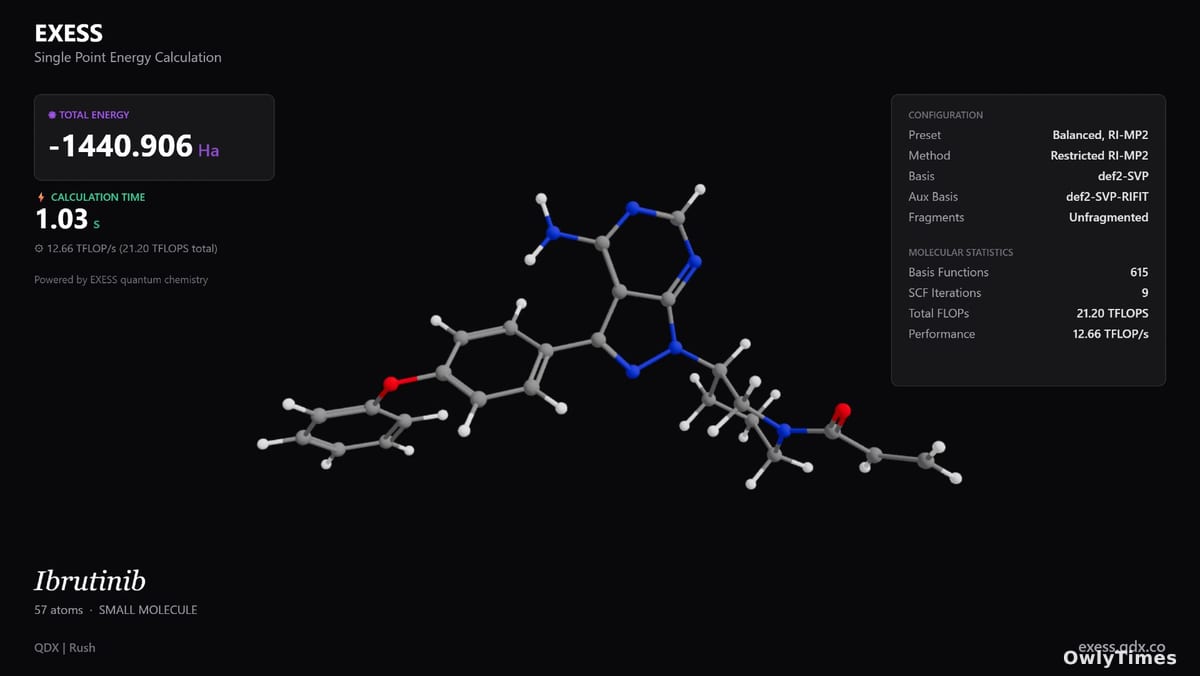

The Speed of Understanding: How a New Computing System is Rewriting the Rules of Molecular Modeling
For decades, a fundamental bottleneck has constrained progress in fields ranging from medicine to materials science: the sheer computational difficulty of accurately modeling molecules. Predicting how a drug will bind to a protein, or how a new material will behave under stress, requires solving the complex equations of quantum chemistry – a task that historically demands exponentially increasing computing power as the size of the molecule grows. Now, Loong Wang, CEO of QDX, and his team have unveiled the Extreme-scale Electronic Structure System (EXESS), a software package capable of performing over 1 quintillion calculations per second, promising to dramatically accelerate these crucial simulations. But the story isn’t simply about faster computers; it’s about a fundamental shift in how we approach these calculations, and a cautious optimism about the possibilities that unfold when theoretical limits are challenged.
See the original Live Science story for the full account.
The core problem lies in the nature of quantum chemistry itself. Unlike classical physics, where we can often approximate solutions, accurately describing the behavior of electrons within a molecule requires a level of precision that quickly overwhelms even the most powerful supercomputers. As Wang explained to Live Science, “It’s actually, in many situations, genuinely faster to synthesize a compound and test it over the course of several weeks than to try and do a calculation on that compound.” This isn’t a matter of hardware limitations alone; it’s that the algorithms themselves were structured in a way that prevented efficient scaling. EXESS doesn’t rely on futuristic quantum computing – it operates on conventional hardware – but instead achieves its speed through a series of carefully orchestrated optimizations.
QDX claims EXESS operates 3,000 to 4,000 times faster than existing quantum chemistry software, a claim substantiated by initial results showing calculations that previously took a month now completed in approximately 12 minutes. This leap in efficiency isn’t attributable to a single breakthrough, but rather a holistic redesign of the computational process. The team recognized that simply throwing more processing power at the problem – the “nine chefs” analogy Wang used – wouldn’t suffice. Instead, they focused on enabling parallel processing, allowing multiple operations to occur simultaneously. A key technique employed was molecular fragmentation, breaking down complex molecules into smaller, manageable pieces, calculating the properties of each fragment concurrently, and then reassembling the results. This approach mirrors optimizing a manufacturing process, transforming a sequential workflow into a streamlined, parallel operation.
However, it’s crucial to understand what EXESS doesn’t do. It doesn’t magically solve all the challenges of quantum chemistry. The underlying mathematical complexity remains, and approximations are still necessary, particularly when dealing with extremely large systems. The speed increase allows for more extensive calculations, enabling researchers to explore a wider range of possibilities and refine their models with greater accuracy, but it doesn’t eliminate the need for careful validation and interpretation. Furthermore, the software is still relatively new, and its performance across diverse chemical systems hasn’t been fully characterized. While QDX is offering free access for approved research projects and a limited version to the public, widespread adoption will require rigorous testing and benchmarking by the broader scientific community.
Beyond Drug Discovery: The Potential Ripple Effects
QDX is initially focusing EXESS on drug discovery, specifically on understanding drug-body interactions and combating drug resistance. This is a logical starting point, given the high cost and lengthy timelines associated with traditional drug development. The ability to rapidly screen potential drug candidates and predict their efficacy could significantly accelerate the process, potentially leading to new treatments for a wide range of diseases. But the implications extend far beyond pharmaceuticals. Materials science, for example, could benefit from the ability to design and optimize new materials with specific properties, such as increased strength, conductivity, or catalytic activity. The software could also be applied to areas like environmental chemistry, helping to understand and mitigate pollution, or to energy research, aiding in the development of more efficient solar cells or batteries.
Limitations to Consider: Access, Validation, and the Algorithm Itself
Despite the excitement surrounding EXESS, several limitations warrant consideration. While QDX is making the software accessible, the computational resources required to run it effectively remain substantial. Access to high-performance computing infrastructure may be a barrier for some researchers, potentially exacerbating existing inequalities in scientific research. Secondly, the results generated by EXESS, like any computational model, require careful validation. Comparing predictions with experimental data is crucial to ensure accuracy and identify potential biases. Finally, the algorithms employed by EXESS, while optimized for speed, may introduce their own set of approximations and limitations. Understanding these limitations is essential for interpreting the results and avoiding erroneous conclusions. The molecular fragmentation technique, for example, relies on assumptions about how the fragments interact, and inaccuracies in these assumptions could propagate through the calculation.
The next crucial step is broader, independent validation of EXESS’s performance across a diverse range of chemical systems. Researchers need to systematically compare its predictions with experimental results and benchmark its accuracy against existing software packages. Beyond validation, the focus will likely shift towards further algorithm optimization and the development of new theoretical approaches that can exploit the increased computational power. A particularly intriguing question is whether EXESS can be used to tackle problems that were previously considered intractable, such as accurately modeling the behavior of enzymes or predicting the folding of proteins. Will the increased speed allow researchers to finally bridge the gap between theory and experiment in these complex areas, or will new limitations emerge as we push the boundaries of what’s computationally possible? The coming years will reveal whether EXESS truly represents a paradigm shift in quantum chemistry, or simply a significant, but incremental, advance.