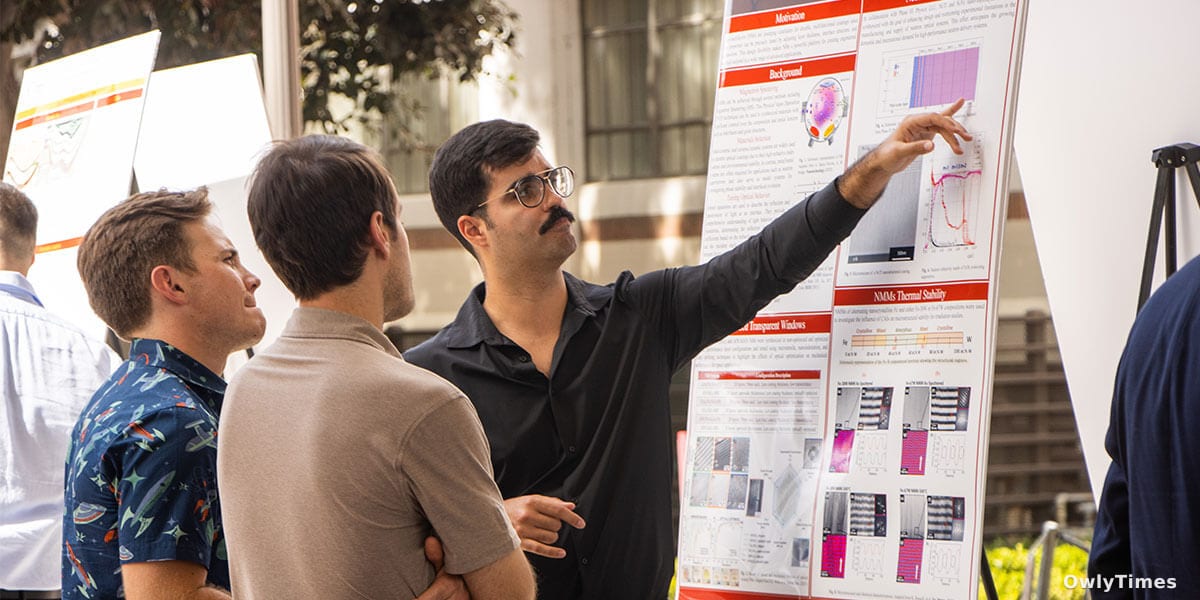

The pursuit of efficient carbon capture and targeted drug delivery, seemingly disparate fields, share a common thread: the critical need to overcome fundamental barriers at the interface of materials science and biological systems. This year’s annual Student Symposium and Showcase at the Mork Family Department of Chemical Engineering & Materials Science at USC Viterbi didn’t just present solutions to these challenges – it highlighted a shift in approach, moving beyond incremental improvements toward designs informed by a deeper understanding of underlying mechanisms. While headlines often focus on “breakthroughs,” the true value of this event, now in its 20th year, lies in the rigorous testing of research, the honing of communication skills, and the forging of connections between academic inquiry and real-world application, as evidenced by the diverse judging panel featuring experts from The Aerospace Corporation, Boeing, SpaceX, and UCLA.
The symposium, a cornerstone of the department’s community building efforts according to Fluor Professor in Engineering Andrea Hodge, isn’t simply a celebration of completed work. It’s a crucial step in the development of future leaders, as many graduates who’ve gone on to innovate in areas like renewable energy and biomaterials first presented their research within these walls. This year’s projects, spanning from novel reactor designs to nanoparticle engineering, demonstrate the breadth of the department’s research and, importantly, the potential for cross-disciplinary collaboration. The winning projects weren’t necessarily the most immediately “marketable,” but those that demonstrated a particularly strong grasp of fundamental principles and a clear articulation of their work’s implications.
This piece references the viterbischool.usc.edu report.
One particularly compelling example is the work of PhD candidate Sairaj Patil, advised by Leslie Gilliard-AbdulAziz and Jay H. Lee, on a novel Joule heated reactor for integrated carbon capture and utilization. The urgency surrounding carbon emissions reduction is well-documented, with global efforts falling short of targets needed to limit warming to 1.5°C. Patil’s research doesn’t offer a silver bullet, but it addresses a key bottleneck in carbon capture technology: the energy intensity and cost of separating and converting CO₂. Existing methods often require multiple steps – capturing the gas, compressing it, transporting it – each consuming significant energy. Patil’s reactor combines capture and conversion into a single step, utilizing a process akin to Joule heating to drive chemical reactions without the need for massive furnaces. This isn’t simply about reducing energy consumption; it’s about fundamentally rethinking the process, leveraging dual-function materials that both absorb CO₂ and catalyze its transformation. The innovation lies in the efficiency gained by eliminating intermediate steps, potentially making low-carbon chemical production economically viable.
However, it’s crucial to understand what this study actually found, versus what a simplified headline might suggest. Patil’s work demonstrates the potential of this electrothermal approach, achieving promising results in a controlled laboratory setting. Scaling this technology to industrial levels will require addressing challenges related to material durability, reactor design, and the long-term stability of the catalytic materials. The system’s performance will also be heavily dependent on the specific composition of the industrial exhaust stream, requiring tailored material selection for different applications.
Similarly, the research of PhD candidate Brandon Pizarro, under the guidance of Wade Zeno, tackles a long-standing challenge in medicine: delivering therapeutics effectively into cells. The cell membrane acts as a formidable barrier, blocking most molecules from entering. Pizarro’s project focuses on engineering nanoparticles – specifically, nanodiscs modified with amphipathic peptides – to enhance cellular uptake. The key here isn’t just that the nanoparticles enter cells, but how they do so. By carefully controlling the design of the peptides, Pizarro’s team can study the relationship between nanoparticle structure and cellular uptake in real-time using live-cell fluorescence microscopy. This level of detail is critical, as it moves beyond simply observing a phenomenon to understanding the underlying mechanisms. Many emerging treatments, like RNA therapies, rely on successful intracellular delivery, making this research particularly relevant.
It’s important to note, however, that this research is still in its early stages. While the team has identified design principles for improving uptake, translating these findings into clinically viable drug delivery systems will require extensive testing for biocompatibility, toxicity, and long-term efficacy. The behavior of nanoparticles in vitro (in a lab setting) doesn’t always translate directly to in vivo (in a living organism) conditions, where the complex biological environment can significantly alter their behavior.
Looking beyond carbon capture and drug delivery, projects from Arun Saji on ceramic ductility, Nicoletta Bouzos on clathrin-mediated endocytosis, Jodel Cornelio on machine learning for oil and gas forecasting, and Murat Pamuk on atomic-scale imaging of magnetic materials all demonstrate a common thread: a move towards understanding materials and processes at increasingly granular levels. These investigations aren’t simply about finding solutions; they’re about building a foundational knowledge base that will enable future innovation. The undergraduate winners, Kaden Corrow-Webb and Brian Kim, further exemplify this trend, applying computational modeling and fluorescence microscopy, respectively, to tackle complex biological problems.
The next crucial research step isn’t simply to refine these individual projects, but to explore the potential for synergistic interactions between them. For example, could the insights gained from Pizarro’s work on nanoparticle delivery be applied to deliver catalysts for Patil’s carbon capture reactor directly to industrial emission sources? Or could Cornelio’s machine learning models be used to optimize the design of materials for Saji’s ceramic applications? The true power of the Mork Family Department’s research lies not just in its individual discoveries, but in its ability to foster a collaborative environment where these discoveries can be combined and amplified. The question now is: will the department actively prioritize and fund these interdisciplinary collaborations, and will industry partners recognize the value of supporting research that transcends traditional disciplinary boundaries?