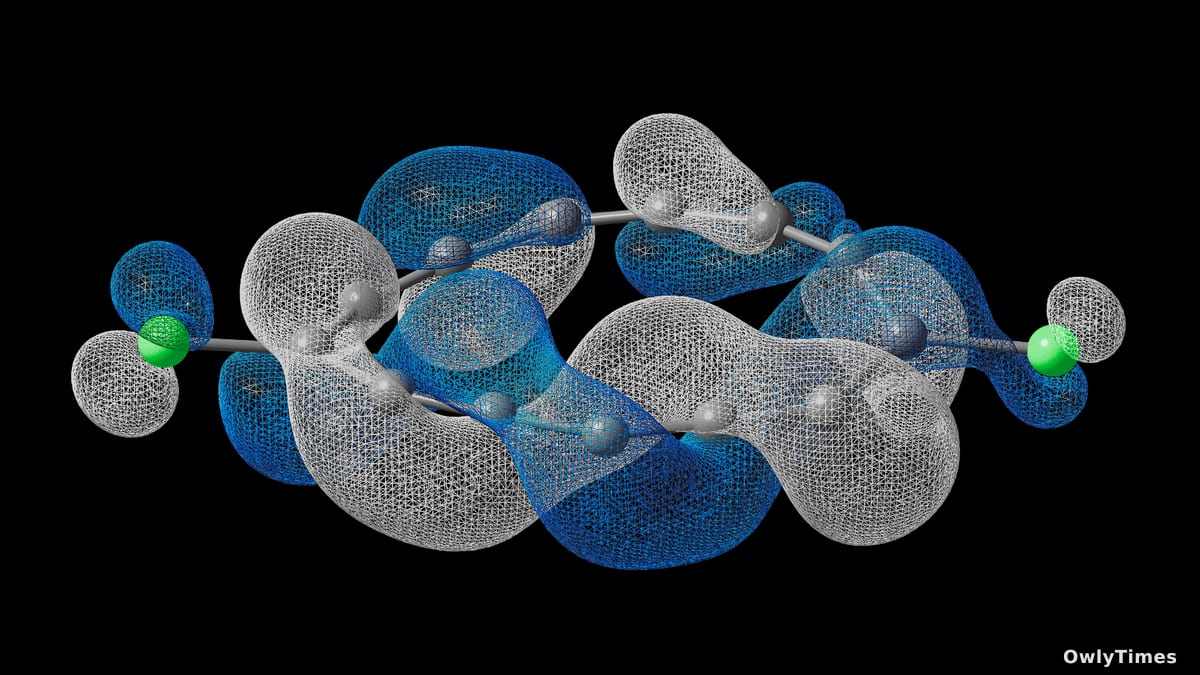

The pursuit of controlling quantum behavior at the molecular level has long been a central ambition in physics and chemistry. Recent work from a collaboration between IBM Quantum scientists and researchers at the University of Manchester doesn’t just demonstrate a novel quantum state – it reveals a new degree of freedom in molecular design, one that could reshape our understanding of how electrons behave and, ultimately, how we build future technologies. The team has successfully synthesized and imaged a molecule exhibiting a “half-Möbius” topology, a subtle but significant twist in the arrangement of its electrons, and crucially, demonstrated the ability to reversibly switch between this state and more conventional configurations. While headlines have proclaimed a breakthrough in “quantum computing,” the reality is more nuanced: this isn’t a new quantum bit, but a new way to study and potentially manipulate the fundamental quantum properties of matter.
The foundation of this research lies in understanding the concept of topology, a branch of mathematics dealing with properties preserved under continuous deformation. Most people are familiar with the Möbius strip – a surface with only one side created by twisting a strip of paper 180 degrees and joining the ends. In chemistry, this idea translates to how electrons arrange themselves within ring-shaped molecules. Traditional aromatic molecules, like benzene, have electrons circulating in a simple, untwisted loop. In the early 2000s, scientists created molecules with a full Möbius twist, where the electron cloud completes a 180-degree twist in one circuit. This new study, published in Science, pushes the boundary further, achieving a 90-degree twist – a “half-Möbius” – and demonstrating control over this quantum arrangement. This isn’t merely an academic exercise; the degree of twist fundamentally alters the molecule’s electronic and magnetic properties, opening doors to designing materials with tailored functionalities.
The team didn’t simply stumble upon this molecule; it was a carefully orchestrated construction. Rather than traditional solution-based synthesis, the molecule – a 13-carbon ring with two chlorine atoms – was built atom by atom on an insulating surface using a scanning probe microscope. This technique allowed for precise control over the molecular structure. By applying controlled voltage pulses, researchers selectively removed chlorine atoms from a precursor molecule, ultimately forming the desired carbon ring. The resulting structure wasn’t flat, but subtly distorted, a key indicator of the twisted electron cloud. Using atomic force microscopy and scanning tunneling microscopy, they mapped the molecule’s lowest unoccupied molecular orbital, revealing a helical pattern confirming the half-Möbius topology. Critically, they observed that the molecule could be switched between this twisted state, and a planar, untwisted configuration by adjusting the applied voltage.
The significance of this switching ability cannot be overstated. In a full Möbius system, the electron wavefunction flips sign after one circuit around the ring. In the half-Möbius system, this flip occurs only after two circuits, meaning the electrons “remember” their previous location in a way not seen in conventional molecules. This memory, coupled with the ability to toggle between states, creates a system where quantum properties can be actively controlled. To validate their findings, the researchers employed a sophisticated approach: they used an IBM quantum computer, leveraging 72 qubits, to model the molecule’s electronic structure. The quantum simulations corroborated the experimental results and classical calculations, solidifying the conclusion that the molecule genuinely exhibits the predicted half-twisted topology. Alessandro Curioni, IBM Fellow and Director of IBM Research Zurich, framed the work as a step towards Richard Feynman’s vision of building computers capable of simulating quantum physics, stating, “This is a leap towards the dream…and a demonstration where, as he said, ‘There’s plenty of room at the bottom.’”
This article draws on reporting from thequantuminsider.com.
However, it’s crucial to acknowledge the limitations. The half-Möbius molecule is currently only stable under highly controlled conditions – ultra-high vacuum, cryogenic temperatures, and the specialized environment of the scanning probe microscope. The topology isn’t inherent to the molecule’s structure, but rather a delicate balance of electronic interactions and substituent effects, making it susceptible to disruption. This fragility prevents immediate practical applications. Furthermore, while the quantum computer simulations confirmed the theoretical predictions, the calculations themselves are computationally intensive and still rely on approximations. The 72-qubit simulation, while substantial, represents a simplified model of the molecule’s complex behavior.
The next steps in this research will focus on stabilizing the half-Möbius topology in more robust molecular frameworks. Researchers will likely explore incorporating this twisted structure into larger molecular networks or materials, aiming to observe how it influences macroscopic properties like magnetism or conductivity. A key question is whether these topological features can be harnessed to create novel electronic devices or materials with enhanced quantum properties. Will we see a future where molecular-scale twists are engineered to control electron flow, leading to more efficient and powerful technologies? The answer remains uncertain, but this work provides a crucial foundation for exploring that possibility.





