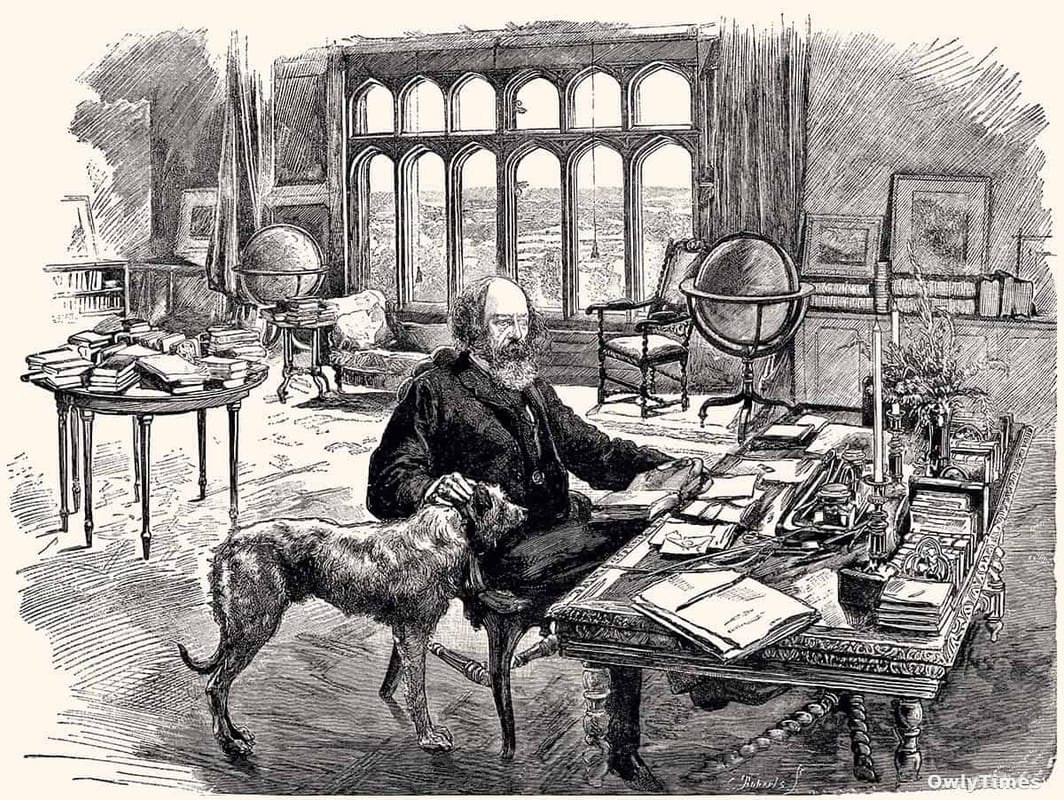

How does the human mind reconcile the cold, expansive indifference of the universe with the intimate, searing pain of personal loss? This is the central scientific and existential question explored in Richard Holmes’s new book, The Boundless Deep: Young Tennyson, Science and the Crisis of Belief. While popular narratives often frame the 19th century as a clean break between faith and empirical discovery, Holmes’s research suggests a far more complex psychological entanglement for one of England’s most famous poets.
A Poet Immersed in the Laboratory
Alfred Tennyson, born in 1809—the same year as Charles Darwin—is often remembered for his lyrical mastery, yet his intellectual life was deeply intertwined with the rapid scientific advancements of his youth. Thomas Huxley, the noted biologist, famously remarked at Tennyson’s burial in Westminster Abbey on 12 October 1892, that the poet was the only writer since Lucretius to truly grasp the work and tendencies of scientific minds. Holmes illustrates that this was no mere poetic affectation; as a teenager, Tennyson was an avid observer of the natural world, keeping notebooks that blended verse with meticulous sketches of birds, plants, and geological phenomena.
The scientific context of Tennyson's development is often misunderstood. Many assume the poet was a passive observer of the Victorian scientific revolution, but the evidence presented by Holmes shows a young man actively engaging with the tools of the trade. In 1833, Tennyson and his close companion Arthur H. Hallam undertook a dedicated "science week" in London. During this time, they visited the London Zoo and the Gallery of Practical Science, viewing displays of steam cannons, microscopes, and magnets. It was a period where the very definition of a "scientist" was being solidified, a term coined by Tennyson’s own Cambridge tutor, William Whewell.
The Collision of Deep Time and Grief
The primary tension in the book centers on the autumn of 1833, when Hallam died suddenly of a brain haemorrhage at the age of 22. This event is the pivot point for Tennyson’s In Memoriam A H H, published in 1850. While common headlines regarding Tennyson’s work often highlight his anticipation of evolution—specifically the famous line "Nature red in tooth and claw"—Holmes and the evolutionary biologist Stephen J. Gould provide a more cautious reading.
The study clarifies that while many scholars assume this phrase provided Tennyson with a Darwinian framework for consolation, the reality is more stark. As Gould noted in his 1995 book Dinosaur in a Haystack, Tennyson likely recognized that science offered no solace for the premature death of a loved one. The findings suggest that Tennyson’s grief was intensified, not assuaged, by his scientific knowledge. He was caught in a "state of hovering," aware that the geological "deep time" revealed by the science of the era rendered the individual life seemingly insignificant against a backdrop of extinction.
Limitations to the Romantic Narrative
A notable limitation in the historical record, which Holmes highlights, is the systemic exclusion of the women who fueled this scientific atmosphere. While Tennyson was inspired by the books of Jane Marcet and the polymath Mary Somerville, these women were barred from formal recognition. Marcet, who influenced figures like Charles Lyell and Michael Faraday, would have been eligible for the Royal Society had its doors not been closed to women until 1921. Consequently, our understanding of Tennyson’s influences is filtered through an era that actively suppressed the contributions of the very people who taught the poets about physics and chemistry.
The next phase of understanding Tennyson’s legacy will likely hinge on how modern readers navigate the intersection of his poetic output and the evolving "deep space" and "deep time" theories of his day. As we continue to study the history of science, the next reading of the scholarly discourse surrounding The Boundless Deep will indicate whether this nuanced, "hovering" view of faith and empirical evidence replaces the simplified narrative of a poet who merely surrendered to the rising tide of rationalism.