
The Ghost in the Machine: How Globular Clusters Reveal a Galaxy Almost Entirely Made of Dark Matter
For decades, the search for dark matter has largely focused on direct detection – building incredibly sensitive instruments to catch the faint interactions between dark matter particles and ordinary matter. But a recent discovery, detailed in The Astrophysical Journal Letters, suggests we may be overlooking a crucial piece of the puzzle: galaxies almost entirely made of dark matter. This isn’t a question of finding dark matter within galaxies, but of finding galaxies where dark matter isn’t just a dominant component, but the very structure itself. The newly identified galaxy, dubbed CDG-2, challenges our understanding of galaxy formation and highlights the power of indirect detection methods – finding the shadows cast by the invisible.
Based on the original science.nasa.gov report.
The core of this finding isn’t a new sensor or a theoretical breakthrough, but a clever application of existing data and statistical analysis. David Li of the University of Toronto and his team weren’t looking for a dark galaxy; they were looking for patterns. They hypothesized that tight groupings of globular clusters – dense collections of stars – could act as beacons, signaling the gravitational influence of a faint, otherwise undetectable galaxy. By analyzing data from 10 previously known low-surface-brightness galaxies, they identified two promising candidates. What followed was a coordinated observational effort utilizing the resolving power of NASA’s Hubble Space Telescope, the wide-field view of ESA’s Euclid space observatory, and the ground-based Subaru Telescope in Hawaii. This multi-pronged approach wasn’t about confirming a single observation, but building a robust case through converging evidence.
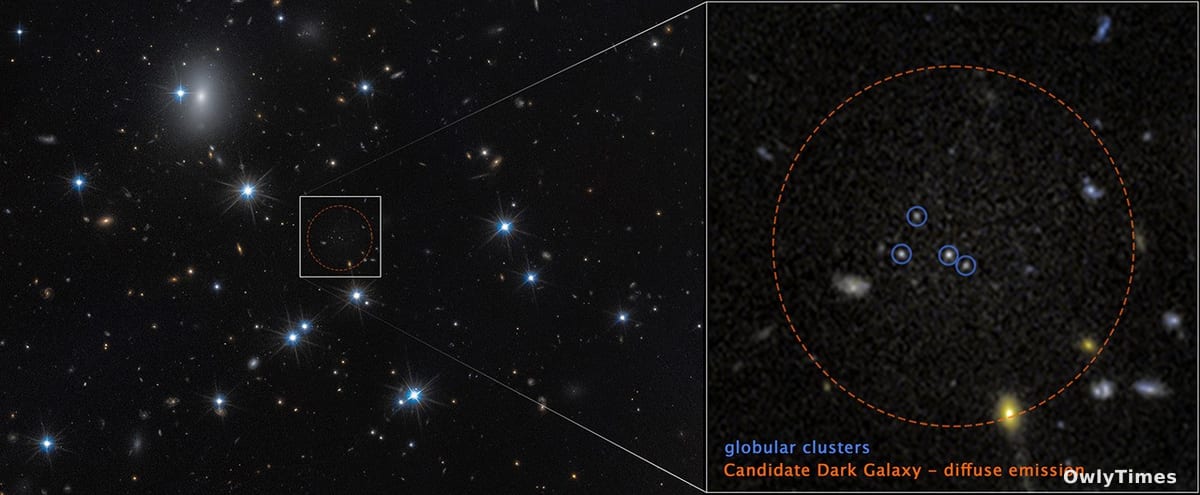
The confirmation of CDG-2, located 300 million light-years away in the Perseus galaxy cluster, is remarkable for its simplicity. Hubble’s imaging revealed four globular clusters clustered tightly together. This isn’t unusual in itself – globular clusters often orbit galaxies. However, further analysis revealed a faint, diffuse glow surrounding these clusters, a subtle indication of an underlying galaxy. As Li stated, “This is the first galaxy detected solely through its globular cluster population.” The team estimates CDG-2 contains roughly 6 million Sun-like stars, but this represents only a tiny fraction of its total mass. Preliminary calculations suggest a staggering 99% of CDG-2’s mass is dark matter. To put that in perspective, typical galaxies are thought to be around 85% dark matter; CDG-2 is an extreme outlier.
It’s crucial to understand what this study doesn’t claim. Headlines proclaiming the discovery of a “dark galaxy” can be misleading. CDG-2 isn’t invisible; it has stars, and those stars emit light. It’s a low-surface-brightness galaxy, meaning its light is incredibly faint and spread out, making it difficult to detect with traditional methods. Furthermore, the team’s estimate of 99% dark matter relies on “conservative assumptions” about the galaxy’s structure and the number of globular clusters it contains. It’s possible, though considered unlikely, that additional, fainter stars exist within CDG-2 that haven’t yet been detected. The galaxy also appears to have lost much of its hydrogen gas, the raw material for star formation, likely stripped away by interactions within the dense Perseus cluster. This explains its low luminosity and sparse stellar population.
Limitations to Consider: The Challenge of Counting Ghosts
The very nature of this discovery necessitates a cautious interpretation. Globular clusters are relatively robust to gravitational disruption, making them good tracers of underlying dark matter halos. However, relying solely on cluster counts introduces inherent uncertainties. We assume a relatively constant ratio of globular clusters to galaxy mass, but this ratio could vary depending on the galaxy’s formation history and environment. The team acknowledges this, emphasizing their use of “conservative assumptions.” Another limitation is the difficulty of distinguishing between genuine galaxy signals and background noise, particularly in crowded regions like the Perseus cluster. The faint glow detected around the globular clusters could, in theory, be caused by unresolved stars or other faint sources.
The Future of Dark Galaxy Hunting
This discovery isn’t an endpoint, but a starting point. The success of this method – using globular clusters as tracers – opens up exciting new avenues for dark galaxy research. As larger sky surveys like NASA’s upcoming Nancy Grace Roman Space Telescope and the Vera C. Rubin Observatory come online, the volume of data available will increase exponentially. This will necessitate the development of more sophisticated machine learning algorithms to sift through the data and identify potential dark galaxy candidates. The question now isn’t simply if more dark matter-dominated galaxies exist, but how many are lurking undetected in the vastness of space. More importantly, understanding the formation and evolution of galaxies like CDG-2 could provide crucial insights into the nature of dark matter itself. If these galaxies are common, it suggests our current models of galaxy formation are incomplete and need to be revised to account for the dominant role of dark matter in shaping the universe. Will future observations reveal a population of these “ghost galaxies,” or is CDG-2 a rare anomaly? The next few years promise to be a pivotal time in our quest to understand the invisible universe.