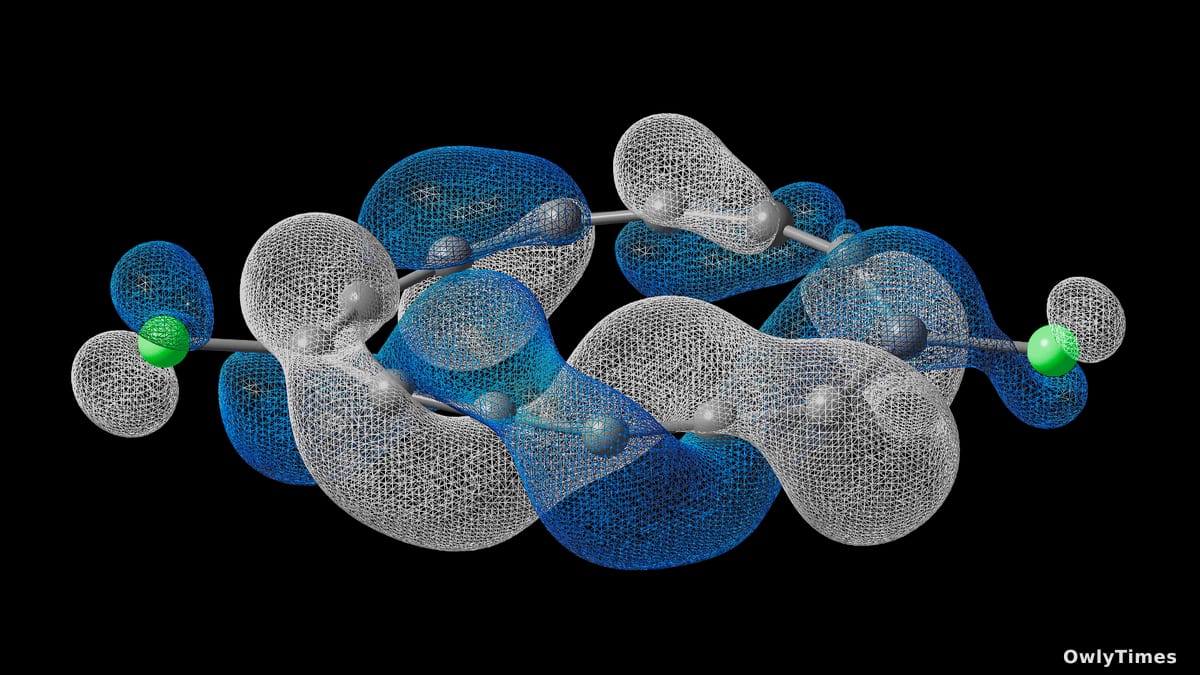

The pursuit of fundamentally new molecular structures isn’t simply an exercise in chemical artistry; it’s a quest to understand – and ultimately harness – the bizarre rules governing the quantum world. For decades, chemists have envisioned molecules with “non-trivial topology,” shapes that defy simple descriptions and unlock unusual quantum behaviors. Now, a team at IBM Research has moved beyond theoretical possibility, successfully synthesizing a molecule exhibiting a “half-Möbius” topology, a structure even more complex than the famed Möbius strip. This isn’t just about creating a novel shape; it’s about opening a new avenue for exploring how molecular geometry dictates quantum properties, and demonstrating the power of quantum computing to validate these complex findings.
The breakthrough, published today in Science, builds on the IBM team’s history of atomic manipulation – they famously created a stop-motion film, “A Boy and His Atom,” in 2013 by precisely positioning individual atoms. This time, the challenge wasn’t just arrangement, but inducing a specific twist in the electron cloud surrounding a ring of atoms. To grasp the significance, consider a standard ring-shaped molecule. Electrons orbit these atoms, existing as probability “clouds” with defined orientations. In a “full Möbius” molecule, these orientations twist around the ring, so the final atom’s electron cloud is nearly inverted compared to the first. This twisting, while not changing the electron’s location, creates interference patterns – akin to conflicting radio signals – that alter the molecule’s behavior. The half-Möbius takes this a step further, with cross-shaped electron clouds twisting halfway around, creating an even more complex interference pattern.
Source material: scientificamerican.com.
What’s crucial to understand is what the study actually found versus how it’s being presented. Headlines proclaiming the creation of a “quantum playground” or a “revolution in molecular science” are, at this stage, premature. The molecule itself is incredibly unstable, existing only under highly controlled laboratory conditions. Leo Gross, a member of the IBM team, acknowledges this, stating, “We made this freakish molecule in these very special conditions. In nature, they would never be stable.” The real achievement lies in the successful synthesis and the confirmation of its unique topology using both advanced microscopy and, critically, IBM’s quantum computers. The team simulated the electron behavior within the half-Möbius structure, generating a predicted image for comparison with the microscopic observations. This comparison provided strong evidence that the synthesized molecule possessed the intended twisted electron cloud.
The validation through quantum computing is a particularly noteworthy aspect of this work. Traditional computers struggle to accurately model the behavior of electrons in complex molecules, as the computational demands scale exponentially with the number of electrons. Ivano Tavernelli, another scientist on the team, highlights the progress in quantum computing, noting the leap from two to four, and now to 100 qubits in roughly a decade. Qubits, leveraging the principles of quantum mechanics, can represent multiple states simultaneously, allowing for more efficient calculations. In this case, the quantum computer allowed the team to scale up the simulation and confirm the consistency of the electron cloud predictions, bolstering confidence in the microscopic observations. This isn’t simply a case of quantum computing being used in chemistry; it’s a demonstration of quantum computing enabling a discovery in chemistry.
However, several limitations to consider temper the immediate excitement. The molecule’s instability means practical applications are distant. Furthermore, the current study focuses on a single molecule, and the effects of this topology on chemical reactivity or material properties remain unknown. The electron cloud imaging, even with advanced microscopy, remains somewhat hazy, relying heavily on the quantum simulations for confirmation. While the simulations provide strong support, they are still based on approximations and assumptions about the underlying physics. Yasutomo Segawa, a researcher at the Institute for Molecular Science in Japan who was not involved in the study, rightly points out the significance of the synthesis itself, stating, “The fact that such a molecule has not only been theoretically proposed but has actually been synthesized will have a major impact on the field of molecular science,” but this impact is currently potential, not realized.
The next crucial steps involve exploring the chemical behavior of molecules with similar topologies. Can these twisted electron clouds be harnessed to create materials with novel electronic or optical properties? Can the principles of topological chemistry be applied to design more stable, practical molecules? Perhaps most importantly, researchers will be watching to see if this success spurs further development in quantum computing, allowing for even more complex molecular simulations and accelerating the discovery of new materials with tailored quantum properties. The IBM team’s half-Möbius molecule isn’t a finished product, but a powerful proof-of-concept – a signal that the intersection of topology, quantum mechanics, and advanced computation is poised to reshape our understanding of the molecular world.





