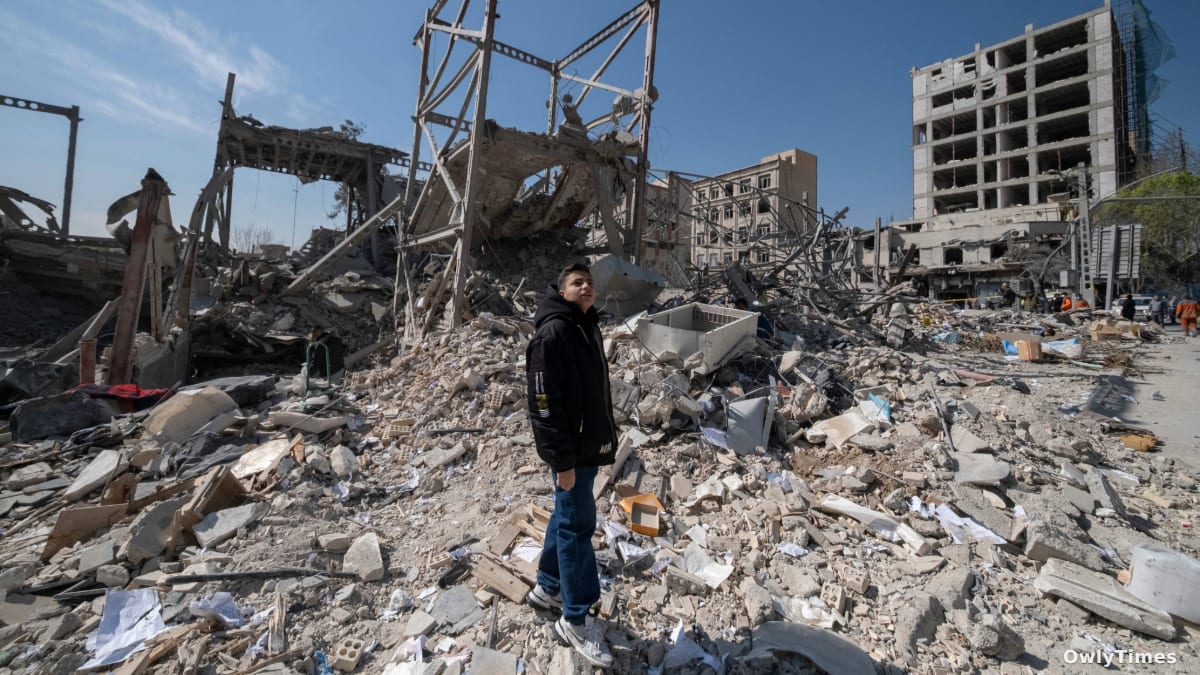

Is the future of warfare less about bombs and more about bugs? The image of a young boy sifting through the rubble of Tehran, a stark testament to the recent US-Israeli strikes on Iran, isn’t just a tragedy – it’s a preview of how profoundly different this conflict, and all future conflicts, will be. Everyone’s focused on the geopolitical fallout, the escalating tensions, the potential for regional collapse. The real story here isn’t the who or the where of this war – it’s the unsettling realization that we’re entering an era where the lines between code and kinetic force are dissolving, and Silicon Valley is rapidly becoming the new arms dealer.
The conflict in the Middle East has laid bare three critical fault lines, each more disturbing than the last. First, the reckless integration of AI targeting systems, and the gaping accountability void that comes with them. Second, the collapse of any meaningful information guardrails at precisely the moment we need them most. And third, the accelerating privatization of warfare, with tech companies now providing the essential infrastructure for military operations. A fourth, quieter thread runs beneath it all: the chilling potential for surveillance systems, initially built to control populations, to be turned against the very states that created them.
Based on the original techpolicy.press report.
The debate surrounding Anthropic and its negotiations with the US Department of War is a masterclass in distraction. We’re obsessing over “red lines” and “human oversight,” while ignoring the fundamental flaw: generative AI is demonstrably unreliable. As Heidy Khlaaf, Chief AI Scientist at the AI Now Institute, points out, these algorithms “hallucinate” – fabricating information with a staggering 50% inaccuracy rate. To suggest these systems are suitable for targeting, even with a human “in the loop,” is not just naive, it’s dangerous. If Anthropic itself admits its models are too flawed for Lethal Autonomous Weapons Systems (LAWS), then they’re equally unfit for AI-Decision Support Systems (DSS), or the autonomous drone swarms they’re proposing. The distinction, as Khlaaf argues, is largely superficial, and the promise of safety theater shouldn’t lull us into a false sense of security.
The speed and scale of the recent strikes underscore this point. Within the first 24 hours, US forces reportedly struck 1,000 targets. This wasn’t achieved through traditional intelligence gathering and painstaking planning; it was enabled by platforms like Maven, overseen by Palantir and powered by Anthropic’s Claude. As Steven Feldstein, Senior Fellow at the Carnegie Endowment for International Peace, notes, this represents a crucial shift: AI is no longer a supporting player in warfighting, it’s central to it. Maven reportedly generated target lists, provided precise coordinates, and prioritized objectives, “speeding the pace of the campaign” and turning weeks of planning into real-time operations. But this efficiency comes at a cost. The lessons from Ukraine and Gaza – mounting reports of civilian harm resulting from AI targeting errors – should be a blaring warning. The question now isn’t if mistakes will be made, but how many, and who will be held accountable when they inevitably occur. Feldstein rightly asks: how accurate are these target lists as high-value targets are eliminated? How is the model compensating for decreasing accuracy as data becomes “noisy”? And crucially, what level of oversight is the US military actually exercising?
The situation is further complicated by the erosion of information integrity. Platforms like X (formerly Twitter) are awash in Iranian state-sponsored propaganda, including AI-generated images falsely depicting destruction of US facilities. What’s particularly alarming, as highlighted by Melanie Smith and Bret Schafer of the Institute for Strategic Dialogue, is that these platforms have drastically reduced their trust and safety teams, effectively removing the guardrails that might have mitigated the spread of disinformation. The result is an information environment demonstrably worse than during the Russian invasion of Ukraine, where at least a pretense of fact-checking existed. This isn’t simply about “fake news”; it’s about deliberately manipulating perceptions during a period of intense conflict, potentially escalating tensions and justifying further violence.
And then there’s the privatization of warfare itself. Companies like Anthropic, Palantir, Anduril, and even Elon Musk’s Starlink are no longer simply providing tools to the military; they’re becoming integral components of the battlefield. Brett Solomon and Betsy Popken of the University of California, Berkeley’s Human Rights Center, point out that these venture-backed defense tech firms are “embedded deeply and continuously” in military operations, operating from the software layer upward. Anthropic’s technology, for example, wasn’t just used to potentially develop autonomous weapons; it was reportedly instrumental in an operation that illegally overthrew a foreign leader. And Starlink, while providing crucial communication infrastructure, demonstrated its own power by shutting down services in Sudan at the behest of the government, highlighting the control a private company can wield over access to information during a conflict. This isn’t about arms sales; it’s about outsourcing core functions of warfare to the private sector, with minimal accountability and a primary focus on profit.
Finally, the case of Tehran’s compromised traffic cameras, allegedly exploited by Israeli intelligence to locate and target Ali Khamenei, reveals a disturbing inversion. Surveillance systems built for internal repression have been repurposed for external attack, demonstrating that infrastructure designed to control citizens can create systemic vulnerabilities. As Azadeh Akbari of Goethe University Frankfurt notes, closed digital systems don’t guarantee security, and the networks built to discipline society can ultimately expose the state itself.
The war in Iran isn’t just a regional crisis; it’s a stress test for the 21st-century battlefield. And the results are deeply unsettling. We’re witnessing the normalization of unreliable AI, the collapse of information integrity, and the increasing privatization of warfare. The question isn’t whether these trends will continue – they already are. The crucial question is: will we see a surge in demand for low-cost, autonomous systems like LUCAS, the US military’s new “precise mass” system, reverse-engineered from Iranian technology? If LUCAS proves effective, expect a significant shift towards scalable, cost-effective options, potentially straining inventories of high-end munitions and signaling a new era of automated, precision warfare. That’s the scenario we should be watching for – and preparing for – in the months to come.