
56%: That’s the estimated percentage of Iran’s commercial aircraft currently grounded, a figure that doesn’t represent a struggling airline industry, but a fundamentally altered one. Iran’s airlines aren’t optimizing for efficiency anymore; they’re operating on pure survival, a reality dictated not by market forces, but by decades of international sanctions. Follow the money – or, in this case, the parts – and you’ll find a parallel aviation ecosystem built on aging airframes, scavenged components, and aircraft long considered obsolete elsewhere in the world. This isn’t simply a story of economic hardship; it’s a case study in how sanctions reshape entire industries, creating both vulnerabilities and unexpected resilience.
The inability to purchase new aircraft, engines, or receive Original Equipment Manufacturer (OEM) support has forced Iran into a unique position. While global airlines retire fleets for newer, more fuel-efficient models, Iran has become a haven for “retro jets” – aircraft types rarely seen in commercial service elsewhere. According to data from planespotters.net, as of January 2026, Iranian airlines operate a diverse fleet including the Boeing 737 Classic, McDonnell Douglas MD-82/83/87/88, and even the BAe Avro RJ, all aircraft largely phased out by Western carriers. This isn’t a matter of preference; it’s a consequence of necessity. The average age of an aircraft in the US fleet is 14.4 years as of 2023, according to Statista. Iran’s fleet is demonstrably older, and growing older, with no clear path to renewal.
Reporting from aerospaceglobalnews.com informs this analysis.
Sanctions don’t just inflate the price of new aircraft; they sever access to the entire support ecosystem that makes modern aviation practical. Parts pipelines, approved repairs, software updates, training – these are all critical components that become inaccessible under sanctions. This creates a perverse incentive to keep older aircraft flying for as long as possible, cannibalizing parts from grounded planes to maintain operational fleets. The experience of other sanctioned nations highlights this fragility: newer aircraft variants, while potentially more efficient, quickly become unsustainable without full access to engines, spares, and manufacturer support. The cost of maintaining a modern aircraft without OEM support can quickly exceed the benefits of its fuel efficiency.
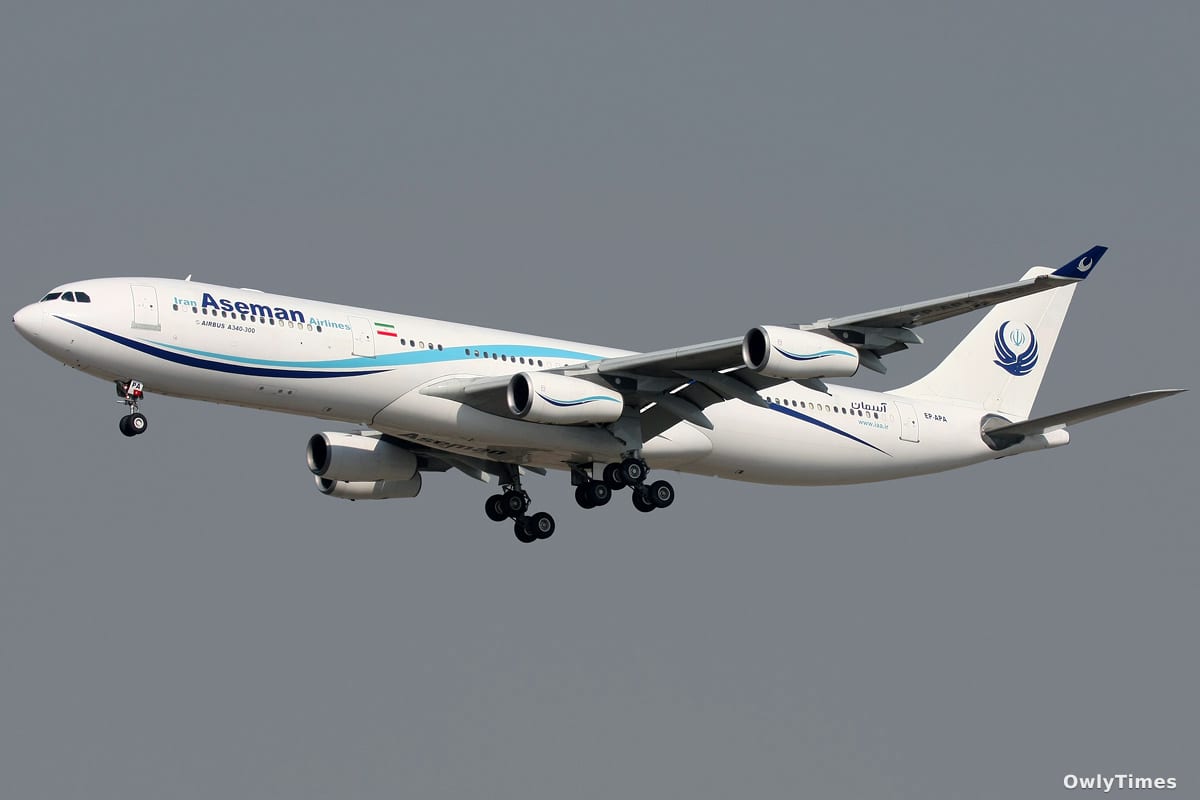
Iran’s response has been remarkably resourceful, bordering on clandestine. A network of shell companies has been established to purchase secondhand parts from aircraft scrapyards globally, a practice almost impossible to fully curtail through legal means. In 2022, an ex-A340 mechanic quoted by Israel Hayom revealed that parts from Turkish Airlines A340s were “knowingly sold” to Iran, disassembled in Istanbul, and smuggled in via Russia and Turkey. This isn’t a one-off incident. The pattern demonstrates a sophisticated system for circumventing sanctions, relying on intermediaries and circuitous routes. The 2025 acquisition of five ex-Singapore Airlines and ex-NokScoot Boeing 777-200ER aircraft, re-registered in Madagascar, exemplifies this tactic.
The reliance on opaque deals extends to bartering as well. In 2025, Iran acquired two Airbus A330-200s from China’s Haokun Energy in exchange for Iranian oil, leveraging China’s non-participation in Western-led sanctions. Perhaps the most audacious examples involve diverting aircraft mid-flight. In 2024, four ex-Turkish A340-300s, initially destined for Uzbekistan, were rerouted to Tehran. Simultaneously, Iran Watch reported the smuggling of two Airbus A340s owned by a Gambian leasing company, Macka Invest, which switched off their transponders upon entering Iranian airspace. Mahan Airlines, linked to Iran’s Islamic Revolutionary Guard Corps, now boasts the second-largest A340 fleet globally, with 15 aircraft in inventory.
This isn’t solely an Iranian phenomenon. Venezuela, facing similar sanctions, is also struggling to maintain its commercial aviation infrastructure. Iran has emerged as a key supplier to Venezuela, providing aircraft to bolster its severely limited fleet. Conviasa, Venezuela’s largest airline, received four A340s from Iran’s Mahan Air in 2022 and 2023. However, the risks are high: sanctioned aircraft are often seized at airports, restricting Venezuelan airlines to flying to “friendly” countries. The impoundment of a Mahan Air-leased Boeing 747-300 in Argentina in 2022 serves as a stark reminder of this vulnerability.
The long-term implications are clear: sanctions, while effective at blocking access to new technology, are surprisingly ineffective at eliminating older aircraft and spare parts. As major airlines phase out widebodies, a steady supply of cheap jets and components becomes available, creating a black market that sanctioned states can exploit. For Iran and Venezuela, fuel inefficiency and high maintenance costs are secondary concerns compared to simply keeping planes in the air. This has created a peculiar equilibrium – a 150-strong fleet of operational commercial aircraft in Iran, sustained by a constant influx of aging planes and smuggled parts.
What this means for your wallet: While seemingly distant, this situation impacts global aviation insurance rates. The increased risk associated with operating aging fleets in sanctioned environments drives up insurance costs for all airlines, ultimately reflected in ticket prices. More immediately, watch for increased scrutiny of aircraft ownership and registration, particularly in countries with lax oversight. The ease with which aircraft can be re-registered and diverted highlights a potential loophole in international aviation security, and regulators will be forced to address it. The question now is not if another aircraft will be diverted or smuggled, but when, and what measures will be taken to prevent it.