
The $16 million renovation of the Lincoln Memorial Reflecting Pool has become a focal point of financial and operational scrutiny as the Trump administration attempts to address persistent maintenance failures. While the White House recently touted the project’s success on social media, the initiative is currently characterized by ballooning costs and a cycle of recurring infrastructure repairs that experts warn may be insufficient.
Follow the money: The financial trail behind the pool’s transformation reveals significant disparities in projected versus actual spending. According to NBC News, the project’s initial estimate of $1.5 million to $2 million has swelled to $13.1 million for a no-bid contract awarded to Atlantic Industrial Coatings, with an additional $14.6 million cited as the final price following National Park Service change orders. Furthermore, the government issued a separate $1.7 million contract to Green Water Solutions—a firm linked to a wealthy donor—to combat the aggressive algae blooms that have plagued the site since the renovation. The Independent reports that Democratic members of Congress are currently investigating the project, specifically flagging the no-bid contracts for "excessive" profit margins and "inflated overhead."
The operational reality on the ground contradicts the administration’s public-facing narrative. Interior Secretary Doug Burgum confirmed in an interview on CNN’s "State of the Union" that the government intends to retain Atlantic Industrial Coatings for upcoming repairs, defending the company's performance despite reports that chunks of the pool's "American flag blue" paint have peeled away. The administration has attributed this damage to vandalism, claiming that individuals cut large gashes into the pool’s surface. This narrative has led to legal friction, including the indictment of former Olympian David Hearn, who was charged with destruction of property after allegedly touching a piece of detached coating. Hearn’s legal counsel, cited by The Independent, characterizes the arrest as a "misuse of government power against an ordinary citizen based on a concocted narrative."
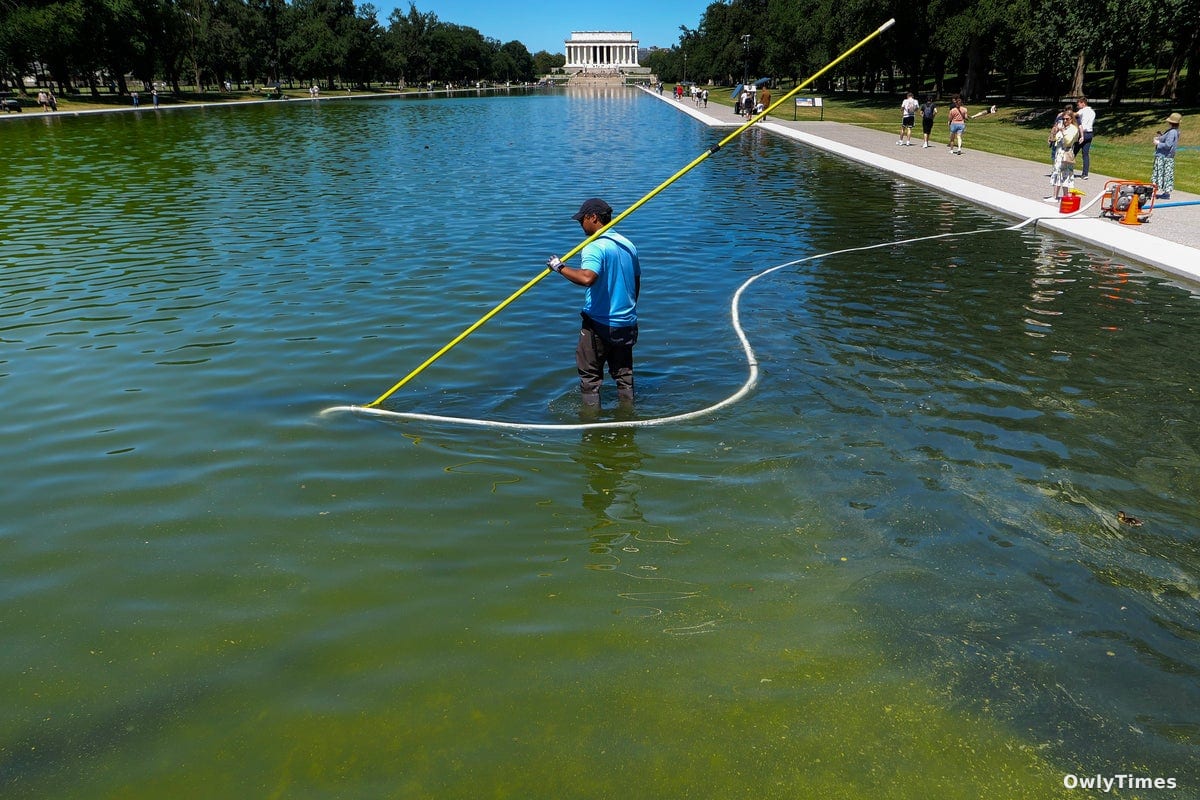
The biological challenges facing the monument are equally persistent. While the administration claims "advanced nanobubbler technology" has cleared the water, Science News notes that the pool is now dominated by Scenedesmus, a eukaryotic algae that is largely resistant to the chemical treatments being deployed. Aquatic scientist Lewis Molot of York University observed that the dark blue paint may inadvertently exacerbate the problem by increasing water temperatures, creating an environment where the strongest species of algae thrive. This aligns with warnings from former National Capital Area director Kym Hall, who previously likened the pool’s plumbing issues to "pouring water into a colander," suggesting that without fundamental repairs to the leaking system, the current maintenance strategy is akin to a temporary stopgap.
For taxpayers and observers, the immediate takeaway is one of continued uncertainty. With the pool scheduled to be drained for a second time this year to address structural cracks, the project remains in a state of flux. The primary financial trigger to watch is the ongoing congressional investigation into the contract awards, which may dictate future oversight of monument renovation spending. Until the underlying plumbing issues identified by former National Park Service officials are addressed, the recurring costs of cleaning and repainting will likely continue to weigh on the project’s total fiscal footprint.