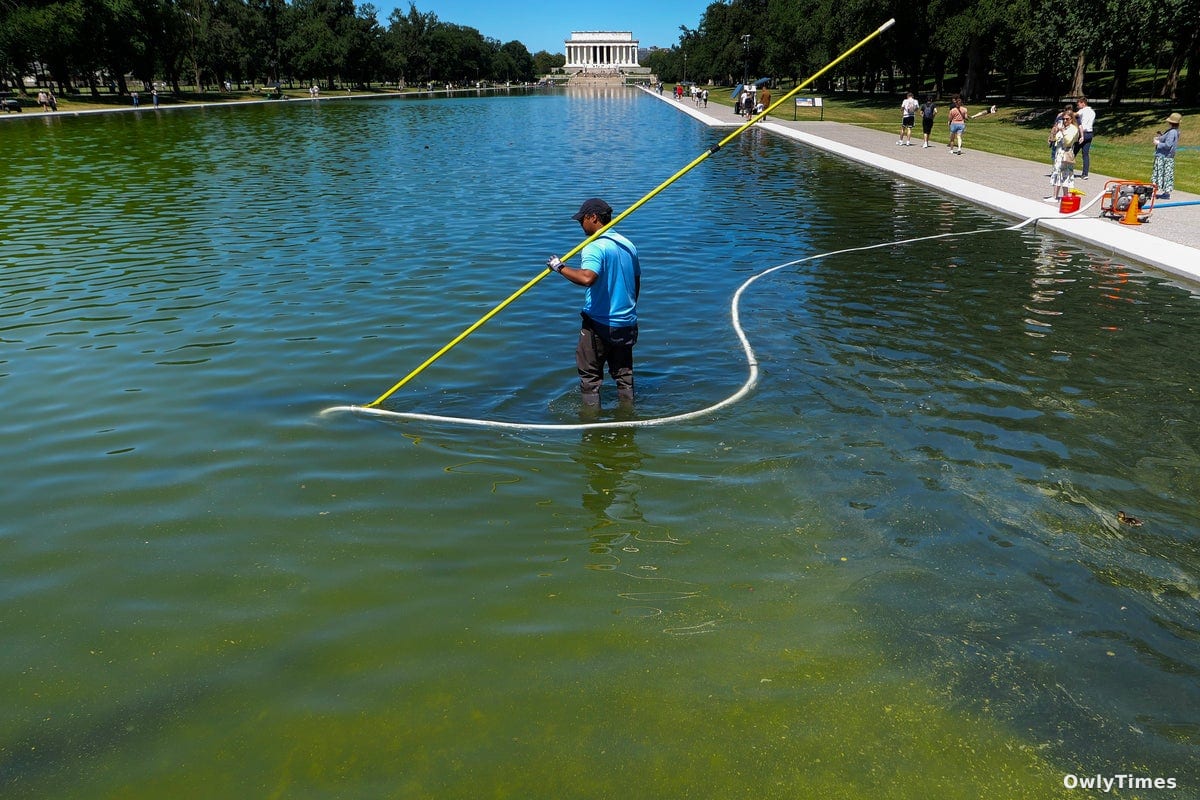

The Lincoln Memorial Reflecting Pool has become the site of a complex intersection between environmental biology and federal legal action. While administration officials have focused on manual labor and chemical interventions to address persistent algae blooms, independent researchers are raising questions about the efficacy of these methods, pointing to the pool’s unique design as a catalyst for the ongoing ecological struggle.
The Science of Algal Blooms vs. Administrative Interventions
The administration’s efforts to clear the green growth have been multifaceted. According to The Independent, crews have utilized manual vacuuming, nanobubbler filtration, and the application of hydrogen peroxide to the water. President Donald Trump has publicly attributed the state of the pool to vandalism, announcing on Truth Social that the pool would be drained following the Fourth of July to address damage.
However, scientific analysis suggests these measures may be insufficient. Science News reports that while hydrogen peroxide can trigger a cell-bursting process called ferroptosis in certain cyanobacteria, it may have minimal impact on the eukaryotic algae, such as Scenedesmus, currently dominating the pool. Furthermore, Eric Palkovacs, a professor of ecology at the University of California, Santa Cruz, argues in The Independent that chemical and mechanical fixes are temporary. He notes that the pool’s shallow depth and dark "American flag blue" paint increase water temperatures, creating an ideal environment for rapid regrowth.
Alternative Biological Approaches
Instead of chemical treatments, Palkovacs proposes the introduction of Daphnia, or water fleas. He suggests these zooplankton could naturally control the algae by consuming it. The Independent highlights that Daphnia are evolutionarily resilient, capable of adapting to high-heat and low-oxygen urban environments. This biological approach, he argues, would be more sustainable and carry less risk to surrounding wildlife than the current cycle of draining and refilling the basin.
Legal Fallout and Vandalism Claims
Parallel to the scientific debate, the federal government has pursued a strict legal response to the pool’s maintenance issues. CBS News reports that U.S. Attorney Jeanine Pirro announced a felony indictment against David Hearn, a 67-year-old Olympian, for the destruction of property. Hearn is accused of removing a piece of sealant from the pool’s liner on June 19.
Reports on the scope of these legal actions vary slightly. While CBS News states that at least five people have been arrested and five others issued federal citations, The Independent cites a figure of at least six arrests. Hearn faces up to 10 years in prison if convicted, though he maintains his innocence, claiming he was merely curious about the texture of the sealant. His defense team contends that the indictment is an attempt by the administration to shift blame for their own maintenance failures.
Limitations to Consider
There is a significant disconnect between the administration's stated goals and the findings of aquatic scientists. While officials characterize the algae as a byproduct of "criminal" behavior, experts like Lewis Molot of York University note that the pool essentially functions as a large, unmanaged experimental system where nutrient-rich water from the Potomac River feeds the bloom. The administration’s internal records, as noted by The Independent, reveal that officials were aware of equipment failures within their $1.7 million cleaning system even while touting the renovation as a success.
Future research into the dynamics of bloom collapse—specifically how iron and hydrogen peroxide interactions drive cell death—could provide better predictive models for urban water management. However, as Science News emphasizes, such insights are unlikely to resolve the immediate aesthetic concerns at the Lincoln Memorial. The next definitive step remains the planned drainage of the pool after July 4, a process that Palkovacs warns may further destabilize the ecosystem’s natural ability to recover.