
The impulse to understand why things happen is arguably the most human trait, and it’s one that’s being actively cultivated in a small, but remarkably productive, charter school in Nome, Alaska. While headlines from the Alaska Science and Engineering Fair in Anchorage on March 28 focused on the winning projects – and the impressive ten awards earned by students from the Anvil City Science Academy (ACSA) – the story isn’t simply about accolades. It’s about a deliberate approach to scientific inquiry, one that prioritizes hands-on research deeply rooted in the Alaskan environment, and a model for how to foster genuine curiosity even in young learners. The success at state isn’t a fluke; it’s the culmination of a process that begins with fifth graders formulating questions about their own surroundings, and then being given the tools – and the ice-bound fieldwork – to find answers.
The ACSA, serving 60 students in grades five through eight, held its annual science fair on March 12, a proving ground before sending 20 students to the statewide competition. The theme this year was “Alaska,” and the projects reflected that focus, moving beyond typical volcano models to address questions directly relevant to life in the region. Josiah Hanebuth, Ethan Piscoya, and Andrew Bernard, fifth graders, weren’t pondering abstract physics; they were trying to solve a practical problem for their basketball games: a slippery ball. Their “Grip Spray,” a concoction of water, hand sanitizer, honey, and glycerin, exemplifies the pragmatic approach taken by many ACSA students. It’s easy to dismiss this as a simple solution, but the project demonstrates an understanding of friction and surface tension, and a willingness to test a hypothesis – a core tenet of the scientific method. What’s often lost in reporting on science fairs is the iterative process; the students didn’t arrive at the final formula immediately, but through experimentation and observation.
This article draws on reporting from knom.org.
Beyond the basketball court, students tackled more complex ecological questions. Kinley Krift’s investigation into “The Beaver Effect” – how beaver dams impact ice depth – is a prime example. This wasn’t a literature review; it involved weeks of fieldwork, including the deployment of an underwater camera system built with the help of science teacher Keane Richards. This highlights a crucial element of the ACSA model: teacher involvement isn’t about giving students answers, but about facilitating their exploration. Richards emphasizes that the goal is to support student-driven inquiry, even if it means venturing out onto the ice to help deploy a homemade camera. This level of commitment is notable, particularly in a rural setting where resources can be limited. The project’s significance lies not just in the data collected, but in the engineering skills developed and the understanding of a critical Alaskan ecosystem.
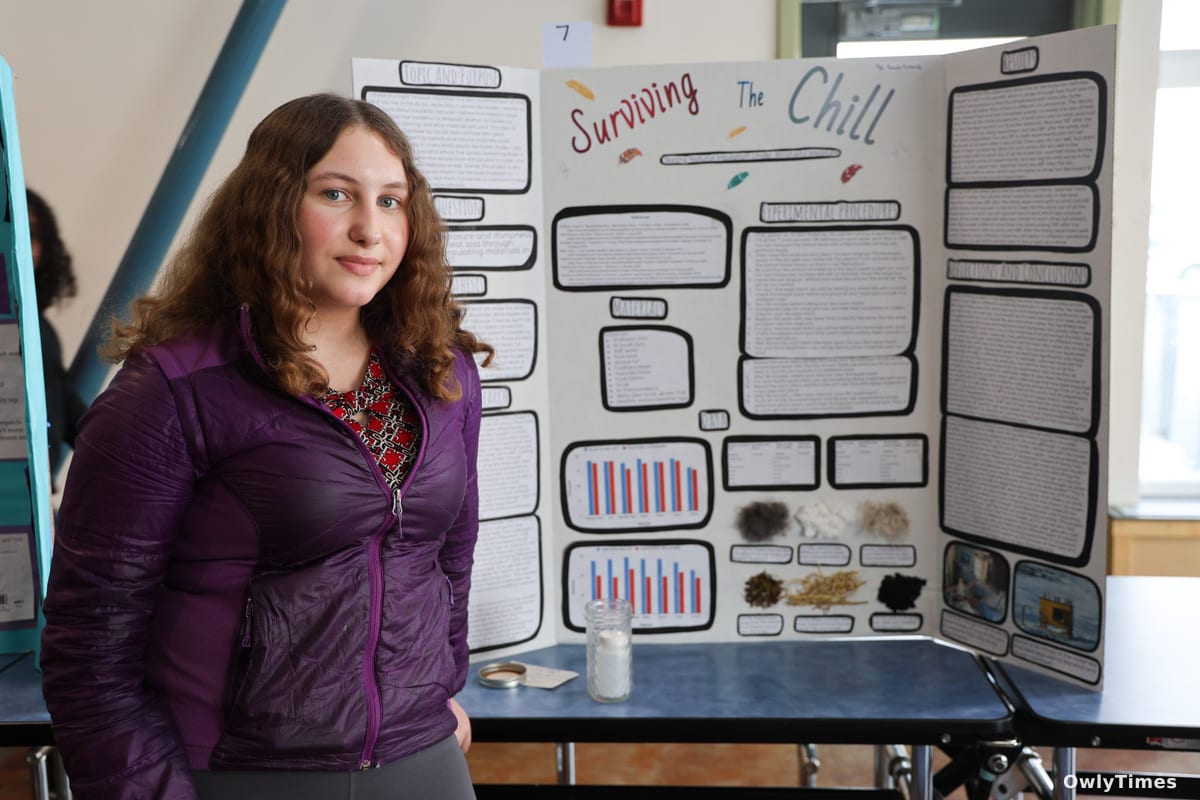
The range of projects extended to wildlife studies as well. Sixth graders Gabby Hughes and Kourtney Bogart, along with seventh grader Sophia Piscoya, analyzed muskox scat to determine their diet, meticulously examining samples under a microscope and comparing them to local plant life. Their findings – a dominance of willow, bell heather, and lichen – provide valuable insights into the muskox’s role in the Alaskan tundra. Eighth grader Rosalie Richards’s project, “Surviving the Chill,” investigated the effectiveness of natural insulation materials, testing moss, dog hair, and cotton under varying conditions of wind and dampness. While Richards acknowledged her results were “mixed,” the project’s value lies in the nuanced understanding of material science and the challenges of Arctic construction. The fact that she couldn’t arrive at a definitive “best” material is, in itself, a valuable scientific outcome – it demonstrates the complexity of real-world problems and the limitations of simple solutions.
It’s important to note the perspective of judges like Claudia Ihl, a biology professor at the University of Alaska Fairbanks Northwest Campus in Nome. While accuracy and execution of the scientific process are paramount – she specifically mentioned attention to units on graphs – Ihl also emphasized the importance of fostering a love of science. The goal isn’t just to identify the “best” project, but to instill a sense of curiosity and demonstrate that scientific inquiry is both challenging and rewarding. This is a crucial point, as public perception of science often focuses on breakthroughs and discoveries, overlooking the painstaking work and occasional ambiguity that characterize the process.
However, the ACSA model isn’t without limitations. The school’s small size – 60 students – allows for individualized attention, but also limits the scope of potential projects and the diversity of perspectives. The success relies heavily on dedicated teachers like Richards and Ventress, and the continued support of parent-led fundraising and community donations. Scaling this model to larger schools or different contexts would require significant resources and careful planning. Furthermore, while the projects are grounded in Alaskan realities, the data collected is often localized and may not be generalizable to other regions.
Looking ahead, the next step isn’t simply to replicate the ACSA model, but to build upon it. Researchers should investigate how this type of place-based, inquiry-driven learning impacts student engagement and long-term STEM (Science, Technology, Engineering, and Mathematics) career choices. Specifically, will these students, having experienced the thrill of authentic scientific investigation, be more likely to pursue careers in fields relevant to Alaska’s unique challenges – climate change, resource management, and sustainable development? The success of the ACSA students isn’t just a local story; it’s a potential blueprint for cultivating the next generation of Alaskan scientists and problem-solvers. The question now is whether we can create the conditions to allow that potential to flourish on a wider scale.