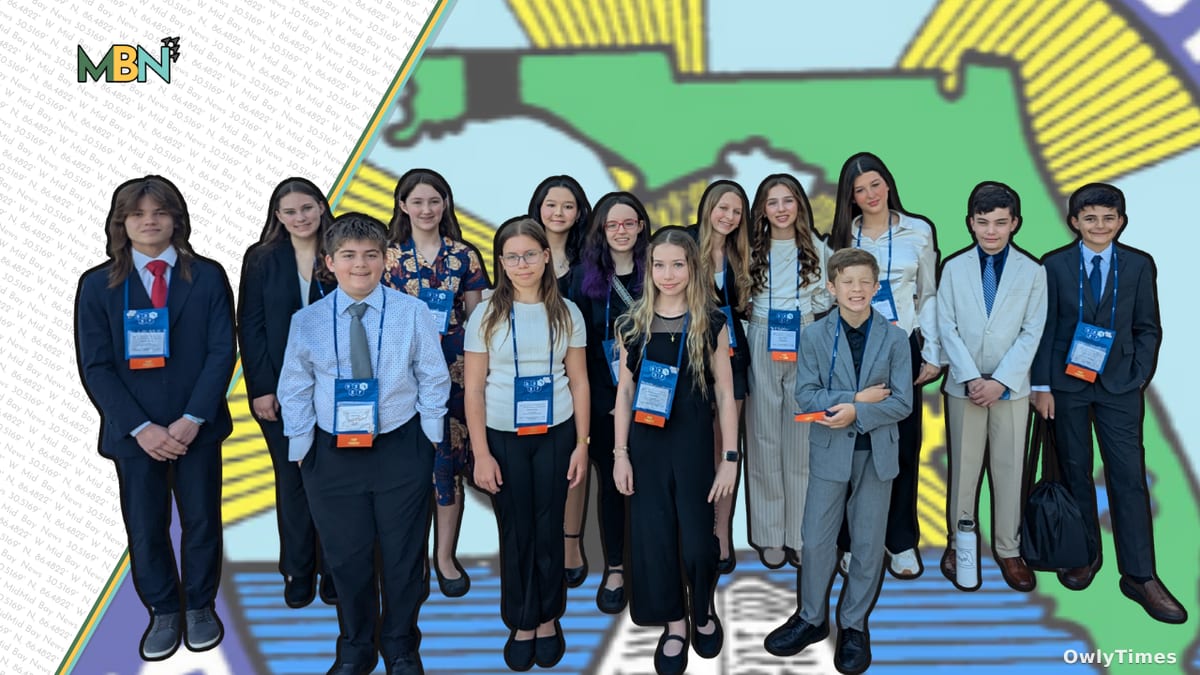

The question of how effectively regional secondary education prepares students for high-level scientific inquiry is rarely answered by a single exam. Instead, it is found in the rigorous, multi-stage vetting process of state-level competitions. When 15 students from the Okaloosa County School District advanced to the State Science and Engineering Fair in Lakeland this past April, they were entering a field of 716 total projects. To understand the significance of their performance, one must look past the headlines of "top honors" and examine the sheer density of the competition, which included roughly 430 entries in the Senior Division alone.
Beyond Participation: Quantifying Academic Rigor
For many, science fairs are viewed as extracurricular pageantry, yet the methodology behind the projects presented by Okaloosa students suggests a shift toward professional-grade application. Benjamin Nusimow, an 8th grader at Ruckel Middle School, secured a first-place finish in the Biomedical and Health Sciences Junior Division by applying a logistic regression model to skin cancer detection. By utilizing geometric analysis to refine diagnostic tools, Nusimow moved his work beyond simple observation and into the realm of computational health—a discipline often reserved for undergraduate research.
Similarly, the performance of Brantley Lane, also an 8th grader at Okaloosa STEMM Academy, provides a metric for excellence that is difficult to ignore. Lane earned first place in his category and was named one of only four Ying Scholar Award recipients statewide. This distinction, which functions as a "Best in Show" designation for middle schoolers, comes with a $500 prize and a commemorative plaque. When a district captures 16 awards across 12 students, as Okaloosa did this year, it suggests that the local curriculum is successfully fostering the kind of independent, hypothesis-driven thinking that the state fair judges prioritize.
Limitations in the Data
While the success rate is impressive—with 80% of the district's state-level representatives bringing home some form of recognition—it is important to frame these results cautiously. Science fair outcomes are inherently subjective, relying on the specific expertise and temperament of the judging panels present in Lakeland. Furthermore, the "best in show" designations represent a snapshot of a student’s work at a single point in time. While these awards validate the current efficacy of the district’s STEM initiatives, they do not necessarily predict long-term career trajectories in the sciences, nor do they account for the varying levels of institutional resources available to students in different Florida districts.
A Broad Spectrum of Disciplines
The depth of the district's performance is further evidenced by the diversity of the categories in which they were recognized. Beyond the health sciences, students displayed proficiency in environmental and physical disciplines. Aimi Frasca of Northwest Florida Ballet Académie placed third in Environmental Engineering, while Alexis Cole of Niceville High School was honored with the Monroe Marine Conservation Award. Other students, such as Ian Allen in Physics and Astronomy and Nolan Kirk in Plant Sciences, were recognized for their work, demonstrating that the district's academic strength is not siloed into a single niche.
The next reading of the district’s internal program evaluation metrics will show whether this high level of engagement in independent research continues to grow. Jennifer Cook, the district’s Science Fair Coordinator, and Superintendent Marcus Chambers have framed these awards as a reflection of sustained support from teachers and families. As the district prepares for the next academic cycle, the focus will remain on whether these students can transition their current research into more complex, longitudinal studies, which remains the true indicator of academic maturity.