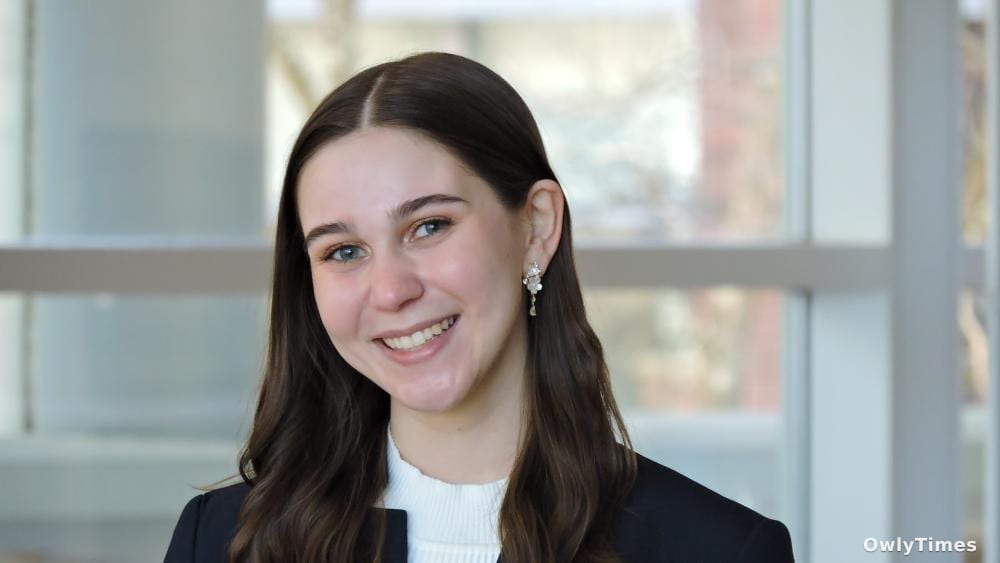

The increasing polarization of American politics isn’t simply a matter of differing opinions; it’s a communication problem. That’s the core insight driving the research of Emily Danczyk, a Penn State undergraduate whose work is gaining national recognition. While headlines often focus on the effects of political division, Danczyk’s work, recently honored with both an APSA Diversity Fellowship and the University’s 2026 John W. Oswald Award, investigates how we talk about politics – and how that very act of communication shapes our understanding of each other and the issues at stake. It’s a shift in focus that’s particularly crucial now, as traditional avenues for political discourse are increasingly bypassed in favor of fragmented online spaces.
Danczyk, a dual major in political science and media studies with a minor in legal studies, isn’t simply studying political rhetoric; she’s examining the role of satire, social media, and what she terms “intersectionality” – the interconnected nature of social categorizations such as race, class, and gender – in shaping political behavior. The APSA Diversity Fellowship, awarded to students entering doctoral programs, specifically supports research focused on historically underrepresented populations. Danczyk’s work recognizes that understanding the political perspectives of diverse groups requires acknowledging the unique ways they experience and communicate about the political landscape. She emphasizes that this isn’t about identifying “problems” within these communities, but rather uncovering “significant trends that help shape future political science understandings,” as she stated.
Original reporting: psu.edu.
This emphasis on understanding how people communicate, rather than simply what they believe, stems from a deeply personal foundation. Danczyk’s upbringing involved extensive travel across 49 of the 50 U.S. states with her family, a formative experience she credits with fostering a nuanced understanding of regional differences and the diverse perspectives within American society. A particularly memorable stop, the Corn Palace in Mitchell, South Dakota, became a recurring metaphor in her thinking. “The Corn Palace is my go-to example when thinking about political diversity; things that may seem strange to us are someone else’s normal, someone else’s home,” she explained. This seemingly simple observation underscores a critical point: political viewpoints are often rooted in local contexts and cultural norms that are easily overlooked by those outside those communities.
However, it’s important to clarify what Danczyk’s research doesn’t claim. The APSA Fellowship and her awards aren’t endorsements of any particular political viewpoint. Rather, they recognize the methodological rigor and intellectual importance of studying the communication processes that underpin political engagement. The focus isn’t on proving one side “right” or “wrong,” but on developing a more comprehensive understanding of how political opinions are formed and expressed. This is a subtle but vital distinction, particularly in an era where academic research is often weaponized for political purposes. Danczyk’s work, in contrast, aims to provide a more neutral and analytical framework for understanding the complexities of American political life.
Looking ahead, Danczyk plans to pursue a doctorate in political science, focusing on the impact of satire and online communication on American politics. She’s particularly interested in exploring how “citizen satire” – the memes, tweets, and other humorous expressions of political opinion – shapes public discourse and influences policy outcomes. This research direction is particularly timely, given the increasing role of social media in political campaigns and the proliferation of misinformation. However, several limitations to consider remain. Much of this research relies on analyzing online data, which may not be representative of the broader population. Access to data and the algorithms that govern social media platforms also present significant challenges.
The next crucial step in this line of inquiry will be to develop more robust methodologies for studying online political communication, including techniques for mitigating bias and ensuring data privacy. Furthermore, researchers need to move beyond simply identifying trends and begin to explore the causal mechanisms that link online communication to real-world political behavior. Will increased exposure to political satire lead to greater civic engagement, or will it simply reinforce existing biases? That’s the question Danczyk and others in her field are poised to answer – and the answer will likely shape the future of political discourse in the United States. We should all be watching for how researchers begin to account for the “echo chamber” effect and the role of algorithmic amplification in shaping individual political perceptions.