
The quest for more efficient solar energy isn’t simply about capturing more sunlight, but about how quickly that captured energy can be channeled and utilized. For decades, the prevailing understanding of electron behavior within solar materials has dictated limitations on speed – limitations that, if overcome, could dramatically increase the efficiency of converting sunlight into electricity. Recent work from the University of Cambridge, however, suggests those limitations may be far less rigid than previously thought, revealing a surprisingly swift and coordinated electron transfer facilitated by the very structure of the material itself. This isn’t just a tweak to existing models; it’s a potential paradigm shift in how we approach solar material design, and the implications extend beyond renewable energy into fields like molecular electronics.
The Speed of Electrons: Challenging Established Theory
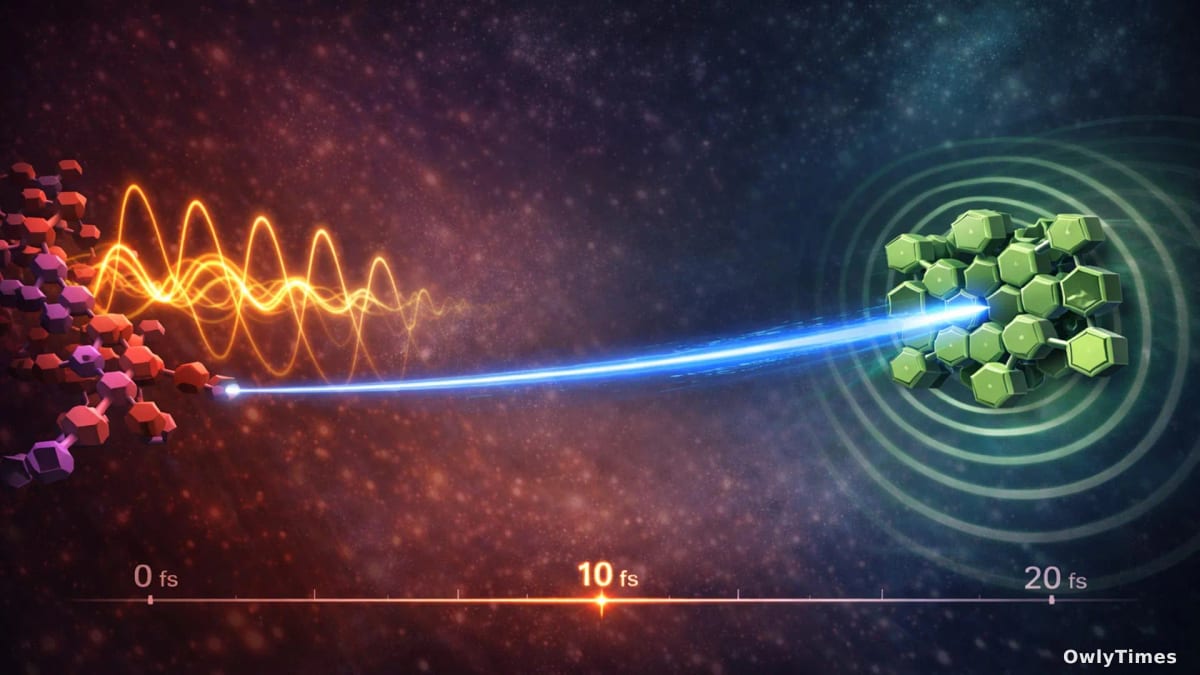
The core of this discovery, published in Nature, centers around the observation of electrons moving across a molecular boundary in a mere 18 femtoseconds. To grasp the scale, a femtosecond is one quadrillionth of a second – so brief that it’s difficult to conceptualize. For context, a blink of an eye takes roughly 300,000,000 femtoseconds. Previous theoretical models predicted electron transfer across such boundaries would be a comparatively sluggish process, relying on a more random “hopping” mechanism. Dr. David Coles, lead author of the study, and his team utilized a sophisticated experimental setup involving ultrashort laser pulses to observe this electron movement. They weren’t looking for this speed, initially; the observation emerged as a discrepancy from expected results, prompting a deeper investigation into the underlying mechanisms. What they found was that the electrons weren’t simply overcoming an energy barrier, but were being actively propelled by the natural vibrations within the molecule – a “molecular catapult,” as the researchers describe it. This isn’t simply faster electron transfer; it’s a fundamentally different mode of transfer.
Original reporting: sciencedaily.com.
How Molecular Vibrations Act as a Catalyst
The key lies in understanding that molecules aren’t static structures. They’re constantly vibrating, and these vibrations possess energy. The Cambridge team discovered that these vibrations aren’t just background noise, but a crucial component in facilitating electron transfer. When a molecule absorbs light, it excites these vibrations, creating a wave-like motion. The electrons, instead of randomly diffusing across the boundary, effectively “ride” this vibrational wave, allowing them to traverse the distance almost instantaneously. This is a coherent process, meaning the electrons move in a coordinated fashion, rather than independently. This contrasts sharply with the traditional “diffusion” model, which assumes electrons randomly bounce around until they find a pathway to their destination. The efficiency gains from this coherent transfer are potentially substantial. Current solar cell efficiencies typically range from 15-22% for commercially available silicon-based cells; a material leveraging this vibrational mechanism could, theoretically, approach efficiencies closer to the theoretical limit of around 33.7%.
What the Study Didn’t Find – and Why Headlines Can Be Misleading
It’s crucial to note that this research doesn’t represent an immediate breakthrough in solar panel technology. Many headlines have proclaimed a “revolution” in solar energy, but the study itself was conducted on a specific molecular system in a highly controlled laboratory environment. The observed effect was demonstrated on a model compound, not a fully functional solar cell. The researchers haven’t yet demonstrated that this vibrational mechanism can be reliably replicated and scaled up in commercially viable materials. Furthermore, the 18 femtosecond transfer time represents the initial burst of electron movement; the subsequent steps involved in converting that energy into usable electricity are still subject to the limitations of existing technology. The study demonstrates a potential pathway to faster electron transfer, but significant engineering challenges remain before it can be translated into practical applications.
Limitations to Consider: Scalability and Material Specificity
The current research is limited by the specific molecular system used. The observed effect was strongest in a carefully designed molecule with specific vibrational properties. It’s not yet clear whether this mechanism will be as effective in other materials, particularly those commonly used in solar cell manufacturing. Scalability is another major hurdle. Creating materials with the precise vibrational characteristics needed to facilitate this rapid electron transfer will likely be complex and expensive. The team also acknowledges that the experiment itself is incredibly sensitive, requiring highly specialized equipment and expertise. Replicating these results in other labs will be essential to validate the findings and build upon this work. Finally, the long-term stability of materials utilizing this mechanism needs to be assessed. Will the vibrational properties degrade over time, reducing efficiency? These are critical questions that require further investigation.
The Next Steps: From Lab Curiosity to Practical Application
The Cambridge team is now focused on exploring a wider range of materials to determine which ones exhibit similar vibrational properties and can effectively leverage this electron transfer mechanism. They are also investigating methods for incorporating these materials into prototype solar cell designs. A key area of future research will be understanding how the molecular environment – the surrounding atoms and molecules – influences the vibrational properties and electron transfer efficiency. Dr. Coles emphasized that “the next step is to move beyond these model systems and explore how we can harness these vibrations in real-world materials.” The broader scientific community will be watching closely to see if this “molecular catapult” can truly propel solar energy technology forward. Specifically, researchers will need to determine if manipulating molecular vibrations can improve the performance of perovskite solar cells, a promising but currently unstable alternative to silicon. If successful, this could lead to a new generation of solar panels that are not only more efficient but also more durable and cost-effective.





