
Beyond Cleanliness: The Hidden Implications of Space-Based Microbial Studies
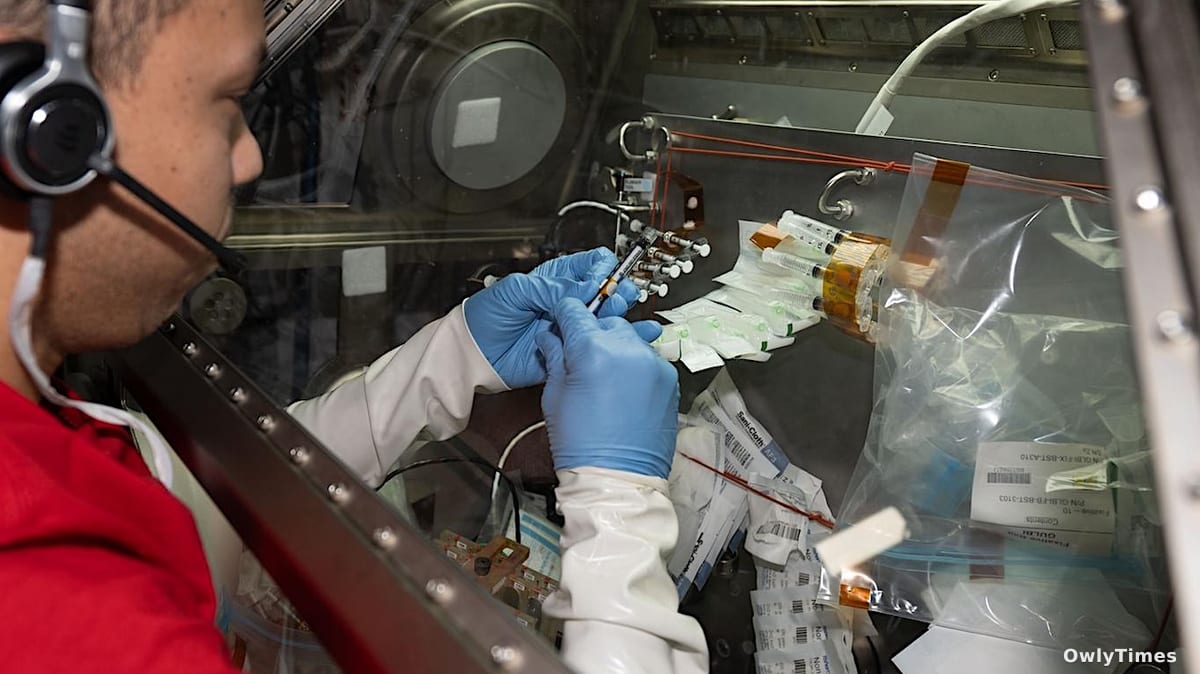
The quest for pristine environments is often framed as a matter of hygiene, but aboard the International Space Station (ISS) in March 2026, Chris Williams, a NASA Expedition 74 Flight Engineer, was tackling the problem of microbial life with a far more ambitious goal in mind: understanding how to survive – and keep equipment functioning – in the face of persistent biological contamination. While headlines focused on the use of ultraviolet (UV) light for disinfection, the work within the Destiny laboratory module’s Microgravity Science Glovebox represents a crucial, and often overlooked, step in preparing for long-duration spaceflight and, ultimately, the search for life beyond Earth. It’s not simply about killing microbes; it’s about understanding their resilience and adaptation in conditions radically different from our own.
The core of Williams’ investigation centered on evaluating UV light’s effectiveness against microbial growth on spacecraft surfaces. This isn’t a new concern – spacecraft have always been subject to microbial hitchhikers – but the stakes are significantly higher with extended missions to the Moon, Mars, and beyond. A 2021 NASA study estimated that microbial contamination could degrade materials on a Mars transit vehicle by as much as 10% over a three-year mission, impacting everything from life support systems to structural integrity. The current work isn’t about achieving absolute sterility, an impossible goal, but about managing microbial populations to acceptable levels. Williams’ experiments, conducted within the carefully contained environment of the Microgravity Science Glovebox, allowed for precise control and observation of microbial responses to UV exposure, something impossible to replicate effectively on Earth due to convection and sedimentation.
The Antarctic Parallel: Why Extreme Environments Matter
This research isn’t happening in isolation. Simultaneously, in February 2026, Dale Andersen was leading astrobiological investigations at Lake Untersee in Antarctica, a subglacial lake sealed off from the atmosphere for millennia. Andersen’s team, as reported in his field updates, is studying microbial life in this extreme environment to understand the limits of biological survival. The connection? Both the ISS and Lake Untersee represent closed, isolated systems where microbes are forced to adapt to unique stressors – in the case of space, microgravity and radiation; in Antarctica, extreme cold, darkness, and chemical limitations. Studying these environments in parallel provides a powerful comparative framework. The microbes found thriving in Lake Untersee, for example, offer clues about the types of organisms that might survive on icy moons like Europa or Enceladus, and how they might interact with – or contaminate – human-built habitats.
Source material: astrobiology.com.
It’s important to clarify what these studies aren’t claiming. Reports haven’t announced the discovery of novel life forms, nor have they solved the problem of spacecraft sterilization. Instead, the work is building a foundational understanding of microbial behavior. Williams’ experiments aren’t identifying which microbes are most resistant to UV light, but rather how microbes respond to it in microgravity. This distinction is critical. Knowing the mechanisms of resistance – whether it’s biofilm formation, DNA repair, or spore production – is far more valuable than simply cataloging resistant species. This mechanistic understanding will inform the development of more effective disinfection strategies and protective materials.
The Radiation Factor: A Complicating Variable
The focus on UV disinfection also obscures another critical factor: cosmic radiation. While the ADVACAM chips being deployed on the Artemis II Orion spacecraft (reported February 5, 2026) will meticulously monitor radiation exposure for the crew, the impact of radiation on microbial life itself is less well understood. Radiation can both kill microbes and induce mutations, potentially creating new, more resilient strains. This creates a complex dynamic where disinfection efforts might inadvertently select for radiation-resistant organisms. This is a tension that needs further investigation. Are we simply shifting the microbial landscape, rather than eliminating the threat? The interplay between radiation, microgravity, and disinfection techniques is a significant knowledge gap.
Limitations to Consider: Earth-Bound Assumptions in Space
Despite the promise of these investigations, several limitations must be acknowledged. The Microgravity Science Glovebox, while providing a controlled environment, is still a relatively small-scale system. Microbial communities in spacecraft are far more complex, involving interactions between different species and the formation of biofilms on various surfaces. Extrapolating results from the glovebox to a full-scale spacecraft requires careful modeling and validation. Furthermore, the microbes used in Williams’ experiments are primarily terrestrial organisms. While this is a necessary starting point, it’s possible that extraterrestrial microbes, if they exist, might exhibit fundamentally different responses to UV light and other stressors. Finally, the reliance on UV disinfection assumes that it won’t damage spacecraft materials. Long-term exposure to UV radiation can degrade polymers and other components, creating a trade-off between microbial control and hardware preservation.
Looking ahead, the next crucial step is to integrate these findings into the design of future spacecraft. This means developing materials that are inherently resistant to microbial colonization, incorporating more sophisticated air filtration systems, and exploring alternative disinfection technologies that minimize radiation damage. Perhaps most importantly, it requires a shift in perspective – from viewing microbes as simply “enemies” to be eradicated, to recognizing them as dynamic components of the space environment that must be understood and managed. The question now isn’t just whether we can keep spacecraft clean, but whether we can create sustainable, biologically-balanced ecosystems for long-term space exploration. Will future missions prioritize proactive microbial management, or continue to react to contamination events as they arise? The answer will likely determine the success – and safety – of our journey to the stars.





