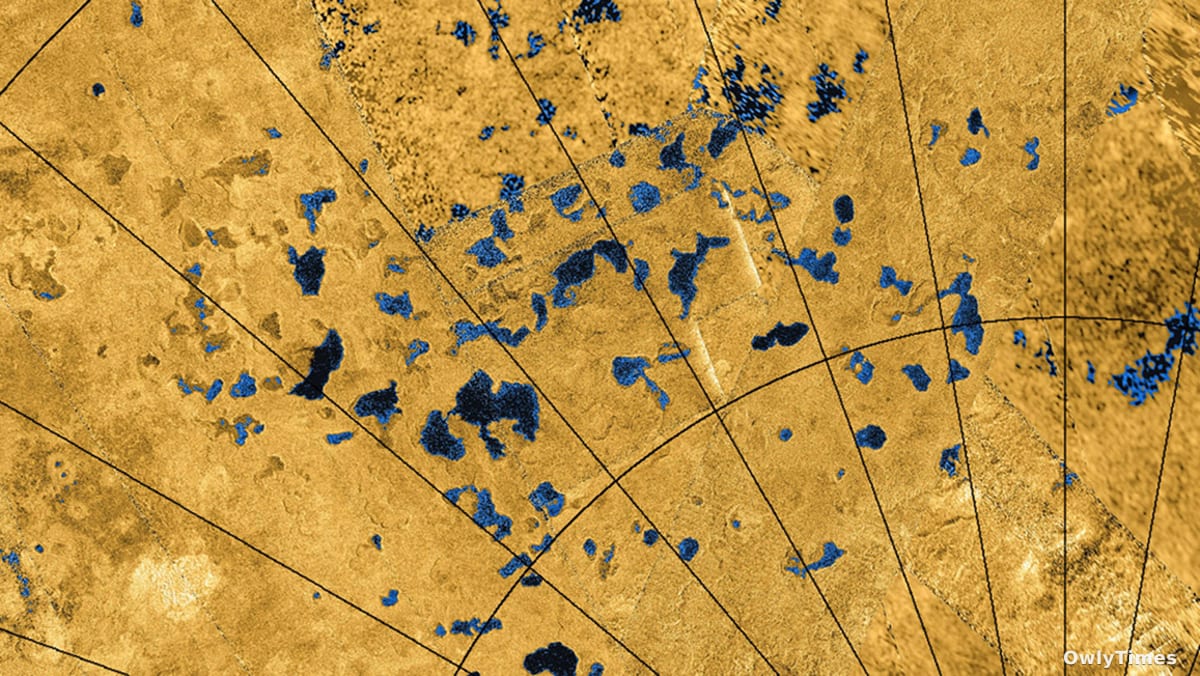

The search for life beyond Earth often begins with a fundamental question: what are the necessary conditions for life as we understand it? For decades, scientists have largely focused on the “habitable zone” – the distance from a star where liquid water can exist. But Saturn’s moon Titan challenges this assumption. With surface temperatures averaging -290 degrees Fahrenheit, water ice is as hard as rock, and the landscape is sculpted by rivers and lakes of liquid methane and ethane. This radically different environment prompted speculation about alternative biochemistries, specifically the possibility of cell-like structures forming in these hydrocarbon seas. Recent research, however, casts doubt on a key component of that hypothesis, revealing the complexities of predicting life’s potential in truly alien settings.
A Simulation’s Promise, An Experiment’s Reality
In 2015, computer simulations offered a tantalizing possibility: that vinyl cyanide (also known as acrylonitrile), a chemical present on Titan’s surface, could spontaneously assemble into structures called azotosomes. These hypothetical spheres, akin to cell membranes, would be stable in liquid methane and ethane, potentially providing a protective enclosure for prebiotic chemistry or even, conceivably, life itself. This idea gained traction because traditional cell membranes, composed of lipids, would simply freeze and shatter in Titan’s frigid temperatures. However, a subsequent simulation challenged these initial findings, suggesting azotosome formation was unlikely. This divergence in predicted outcomes underscored a critical need for experimental validation – a step that hadn’t been taken until now. Tuan Vu and Robert Hodyss at NASA’s Jet Propulsion Laboratory in Pasadena, California, recognized this gap and designed an experiment to test the azotosome hypothesis directly.
Original reporting: sciencenews.org.
Mimicking Titan’s Surface: Crystals, Not Bubbles
The experiment, detailed in the March 11 issue of Science Advances, sought to replicate a plausible scenario for chemical interaction on Titan. The researchers simulated atmospheric vinyl cyanide falling onto Titan’s lakes, sprinkling solid particles of the compound onto supercooled liquid ethane and liquid methane. This approach, as Vu explains, mirrors “one way that they can come into contact on Titan, when you have acrylonitrile forming in the atmosphere [and] coming down onto the surface where it condensed as a solid, and it comes into contact with a lake.” The results were definitive: rather than forming azotosomes, the vinyl cyanide and liquid ethane crystallized together. Crucially, no azotosomes emerged in liquid methane either. This outcome significantly weakens the argument that this specific chemical pathway could lead to cell-like structures on Titan. It’s important to note, however, that the study doesn’t disprove the possibility of life on Titan, but rather demonstrates that the formation of azotosomes from vinyl cyanide under these conditions is unlikely.
Beyond Azotosomes: The Limits of Earth-Centric Thinking
The implications of this research extend beyond Titan itself. The initial excitement surrounding azotosomes stemmed from a desire to broaden our understanding of life’s potential, to move beyond the constraints of Earth-based biochemistry. Yet, this study highlights the inherent challenge of applying our current knowledge to radically different environments. As Vu points out, “We tend to interpret life as we know it, because that’s the only form of life that we know,” but life on Titan, if it exists, “could be life as we don’t know.” This is a crucial caveat. The absence of azotosomes doesn’t preclude the possibility of alternative membrane structures or entirely different mechanisms for compartmentalization and replication. The experiment’s design, while clever in its attempt to mimic Titan’s conditions, is limited by its focus on a single chemical pathway and a specific set of environmental parameters.
What’s Next for the Search on Titan?
This research doesn’t signal the end of the search for life on Titan, but rather a recalibration of our approach. Future studies should explore alternative chemical compounds that might form stable structures in liquid hydrocarbons, and investigate different energy sources that could drive prebiotic chemistry in this unique environment. Perhaps more importantly, researchers need to develop more sophisticated simulations that account for the complex interplay of atmospheric processes, surface chemistry, and geological activity on Titan. The upcoming Dragonfly mission, scheduled to launch in 2027, will be instrumental in this endeavor. This rotorcraft lander will explore Titan’s surface, analyzing its chemical composition and searching for evidence of prebiotic molecules. The key question now isn’t simply can life exist on Titan, but what would life on Titan look like? And will Dragonfly be able to detect it, even if it doesn’t resemble anything we’ve ever seen before?