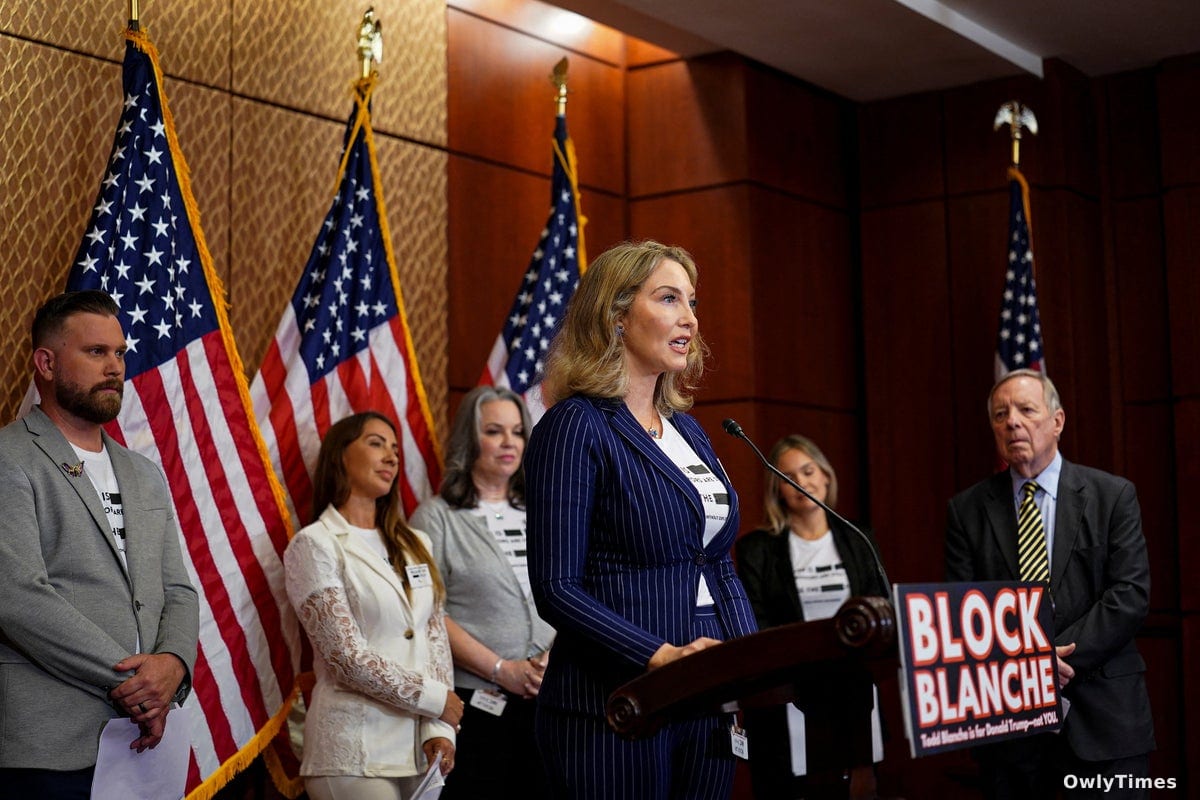

The strategic calculus behind Acting Attorney General Todd Blanche’s recent meeting with survivors of Jeffrey Epstein is clear: he is attempting to clear a final, high-stakes hurdle in a volatile confirmation process that hinges on the votes of two undecided Republican senators. By engaging with survivors, Blanche sought to satisfy a prerequisite set by Sen. Thom Tillis (R-N.C.), who has explicitly linked his support for the nominee to a demonstration of accountability regarding the Department of Justice’s mishandling of files related to the late sex offender.
The political utility of this move—and the resistance it faced—highlights a widening rift within the Senate Judiciary Committee. While both The Independent and CBS News report that the meeting occurred on Thursday, the accounts of its efficacy differ sharply. Tillis, who is retiring at the end of the year, publicly commended Blanche for the engagement, according to the Independent, stating that he appreciated the nominee’s "willingness to directly engage." Conversely, survivors who attended the meeting described the interaction as a "perfunctory audition" and "condescending," with attendee Lara Blume McGee noting that Blanche failed to offer a plan to investigate anyone beyond Epstein and his associate Ghislaine Maxwell.
Who benefits and who loses here is a matter of institutional credibility. Blanche benefits by potentially securing the support of Tillis and potentially Sen. John Cornyn (R-Texas), both of whom are essential for his confirmation following the recent death of Sen. Lindsey Graham, which left the committee tightly divided at 11 Republicans and 10 Democrats, as noted by NPR. The losers appear to be the survivors, who CBS News reports were caught in a bureaucratic tug-of-war after the Justice Department initially insisted on staff presence, only to later facilitate a meeting that left participants feeling that the department was once again "passing the buck."
The nomination process has been further complicated by allegations regarding the internal culture of the Justice Department under Blanche’s tenure. The Guardian reports that former pardon attorney Liz Oyer testified that she was fired by Blanche after refusing to "rubber-stamp a political favor" for Mel Gibson, an actor and ally of President Donald Trump. Blanche has countered these claims, asserting that Oyer’s decisions were "inconsistent with President Trump’s authority." This clash mirrors the broader historical precedent of executive-branch friction, where the boundary between the Department of Justice’s independence and the president's personal legal interests becomes the central point of contention.
Beyond the personnel disputes, Blanche faces intense scrutiny over a controversial $10 billion civil settlement with the IRS, which included a $1.8 billion "anti-weaponization" fund. While Blanche told the Judiciary Committee that the fund is now "dead," CBS News and NPR confirm that the immunity provision granted to the President and his sons remains a significant point of concern for Cornyn, who has publicly questioned the breadth of the legal release.
The political chess move to watch next is the upcoming committee vote, which Tillis indicated will occur in approximately two weeks. Whether Blanche can parlay his recent meeting with survivors into the necessary votes—or if the ongoing criticism from both the left and the right regarding his tenure as acting attorney general proves too heavy a burden—remains the defining question of his confirmation.