
The challenge of scientific communication is not merely a matter of simplifying jargon; it is a fundamental question of how to bridge the gap between rigorous, laboratory-based discovery and the lived experience of the communities that stand to benefit from it. While public speaking is a source of anxiety for an estimated three-quarters of the population, the stakes are uniquely high for researchers tasked with translating complex medical findings into actionable human narratives. The University of Arkansas for Medical Sciences (UAMS) Translational Research Institute’s TRIumph public speaking program, launched in 2024, is currently attempting to solve this by formalizing the art of the scientific narrative.
Beyond the Podium: Reimagining Researcher Engagement
Led by Julien Mirivel, Ph.D., a professor of applied communication at the University of Arkansas at Little Rock, the program was initiated at the behest of Laura James, M.D., director of the Translational Research Institute. The core objective is to move beyond the traditional academic lecture, which often relies on dense data, toward a model of community-building. The curriculum spans three distinct phases: macro-structural organization, the integration of storytelling to enhance memory, and intensive one-on-one coaching supported by draft-video reviews.
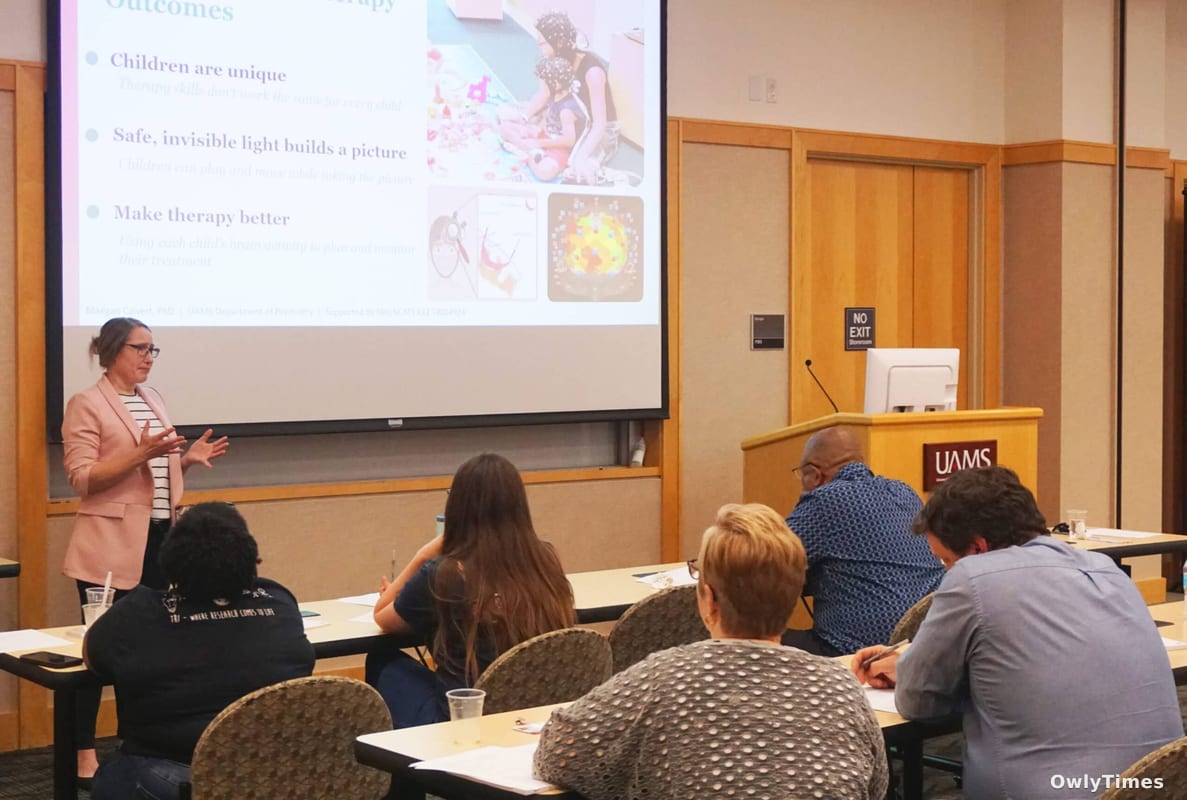
The methodology focuses on a high-pressure, high-reward exercise: a live, note-free presentation delivered with only a single slide. On April 2, 2026, five UAMS researchers demonstrated this training by delivering eight- to 10-minute talks to community members. Among them were Meghan Breckling, Pharm.D., who focuses on rural overdose education, and Maegan Calvert, Ph.D., who utilizes neuroimaging to model human behavior and treatment interventions.
Distinguishing Training from Transformation
It is essential to distinguish what the TRIumph program achieves versus common misconceptions about "science communication" workshops. Headlines often suggest that such programs simply teach scientists how to "dumb down" their work. However, the testimonies from participants like Alexa Escapita, Ph.D., and Carol Morris, Ph.D., clarify that the program is actually about relational communication. For Escapita, a postdoctoral fellow studying infant brain development, the training shifted her focus from merely listing developmental milestones to framing her work as an emotional and practical tool for mothers.
This distinction is vital because the program is not an exercise in marketing; it is an effort to improve scientific literacy by fostering trust. As Mirivel noted, the program operates on the premise that greater understanding of scientific inquiry is positively associated with higher public trust in scientists. By encouraging a "vital exchange" rather than a one-way information dump, the researchers aim to ensure that their findings are not just published, but understood and integrated by the public.
Limitations to Consider
While the success of the spring 2026 cohort is clear in their anecdotal reports, the broader impact of such programs remains difficult to quantify. The TRIumph model relies heavily on individual coaching and intense personal commitment, which may not be scalable across all academic departments without significant infrastructure. Furthermore, while the program successfully equips researchers with the tools for engagement, the long-term effect on community health outcomes—the ultimate metric of translational research—is not immediate. The program’s success currently hinges on the voluntary participation of researchers who are already predisposed to value public outreach.
The Path Toward Sustained Public Trust
The next step for this initiative will be observing the longitudinal reach of these researchers as they return to their specific fields. The effectiveness of the program will ultimately be measured by the degree to which these researchers continue to engage with community members outside of the structured training environment. With the Translational Research Institute supported by the National Institutes of Health (NIH) National Center for Advancing Translational Sciences (NCATS) under Clinical and Translational Science Awards (CTSA) Program grants UM1 TR004909, K12 TR004924, and T32 TR004918, the institutional commitment to this communication model is substantial. Future cycles of the TRIumph program will provide a clearer indicator of whether this communicative approach can become a standard competency for medical researchers or if it remains a specialized skill for a select few.





